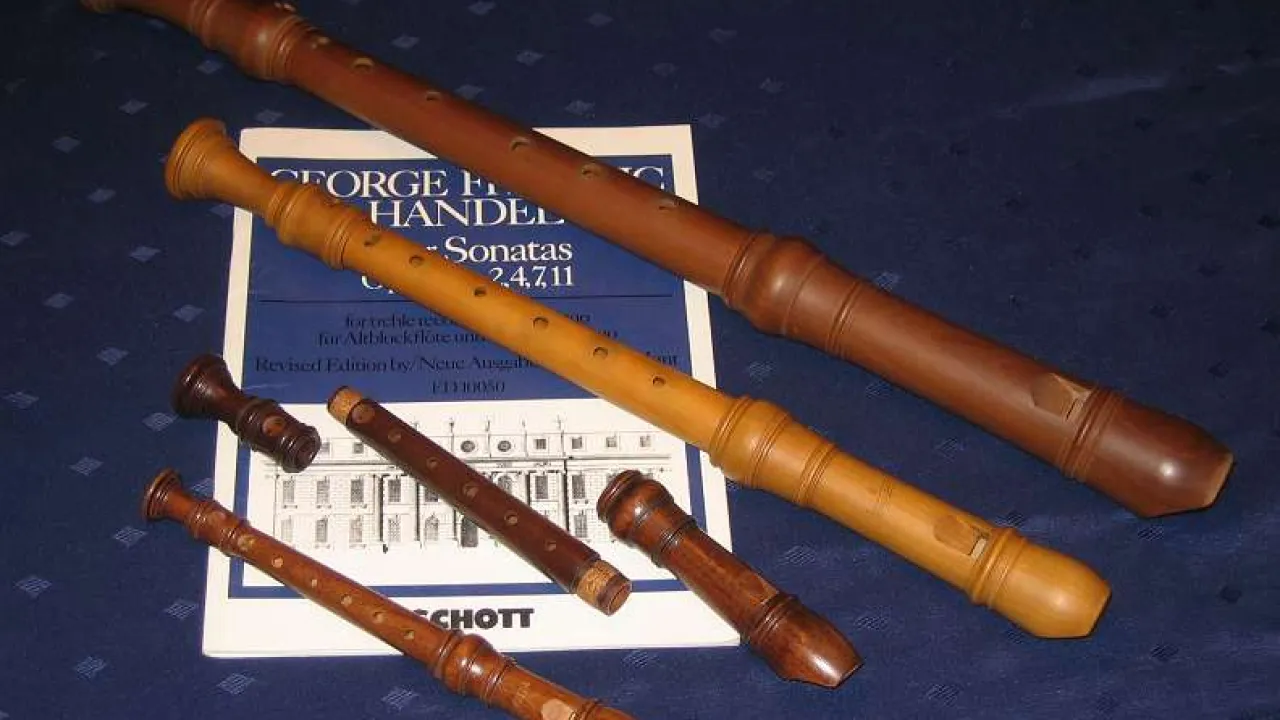
1. How many finger holes sit on the front and back of a standard recorder?
2. What happens if you blow way too hard into a recorder?
🤯 Mind-Blowing Fact • Grade 2
Look closely at the bottom two holes on a recorder—each one is split into tiny twin holes so players can half-cover them for sharps and flats!
✨ Word Sparks (Grade 2 Glossary)
Tap 🔊 to hear
labium
Sharp slanted edge splitting breath into sound
windway
Narrow slot guiding breath toward the labium
soprano
High-voiced classroom size of the recorder family
🪝
Before tape recorders existed, how did a wooden flute get the name recorder?
1
Named After Warbling Birds
Long before electronic gadgets existed, the old English verb to record meant to learn by heart or warble softly like a young songbird! Because this wooden flute sounded so pure and birdlike, musicians named it the recorder.
2
Inside the Whistle Window
Peek at the top beak and you will spot a square opening with a sharp slanted ramp called a . A narrow tunnel aims your breath straight at that ramp, slicing the air into musical vibrations!
3
Tiny Squeakers to Six-Foot Giants
Classroom recorders are just twelve inches long, yet wooden recorder families range from pocket-sized sopraninos to six-foot bass giants!
1. Where did the musical instrument name 'recorder' originally come from?
2. Why are the bottom two finger holes on many recorders split into tiny double holes?
🤯 Mind-Blowing Fact • Grade 3
When Baroque composer J.S. Bach wrote Brandenburg Concerto No. 4, the dazzling solo wind parts were written for two wooden alto recorders—not modern silver flutes!
Matched family group of different-sized instruments
Baroque
Ornate European musical era from 1600 to 1750
🪝
Why was one of today's most famous school instruments once the superstar solo flute of Baroque kings and queens?
1
Royal Superstar in Disguise
You may know the soprano recorder from school music class, crafted from sturdy colorful plastic. Yet three hundred years ago, when Johann Sebastian Bach or Antonio Vivaldi wrote 'flauto' on a concert score, they usually meant a handcrafted wooden recorder!
2
Fipple Duct Acoustics
Unlike transverse flutes where lips aim air across an open hole, the recorder is an internal-duct or flute. A wooden plug called a block channels your breath through a narrow windway straight onto the razor-sharp labium edge, swirling air rapidly above and below the blade.
3
Pinching the Thumb Hole
To climb into the higher octave, players bend their left thumbnail slightly into the back hole—venting a tiny sliver of air so the standing wave splits neatly in half!
4
Whole Consorts of Wood
Renaissance and musicians played matched sets called carved from boxwood, maple, or rosewood—from tiny six-inch garklein flutes down to rumbling two-meter contrabasses!
1. How does a recorder player help high notes jump cleanly into the second octave?
2. In Baroque scores by Bach and Vivaldi, what instrument did the word 'flauto' usually refer to?
🤯 Mind-Blowing Fact • Grade 4
Inside a wooden recorder's mouthpiece, makers often insert a porous block of aromatic red cedarwood because cedar absorbs breath droplets instead of letting puddles clog the narrow windway!
✨ Word Sparks (Grade 4 Glossary)
Tap 🔊 to hear
reverse-conical
Bore widest near top and narrowing downward
edge tone
Musical pitch made when air splits edges
chromatic
Including every sharp, flat, and natural note
🪝
Why did Baroque French woodworkers taper the recorder's inside backward—making it narrower at the bottom than at the top?
1
Pure Air Split on a Wooden Blade
Send a ribbon of warm breath down a cedar-lined windway barely a millimeter tall, watch it strike a beveled hardwood lip, and listen as invisible whirlpools of air sing with crystalline purity. For over six centuries, the recorder has enchanted royal courts, Baroque theaters, and modern classrooms alike.
2
Hotteterre's Reverse-Conical Revolution
Medieval and Renaissance recorders featured wide, nearly cylindrical bores that blended richly in four- and five-part consorts across about an octave and a sixth. Around the 1670s at the French court, the Hotteterre family redesigned the recorder into three precision-turned joints—head, body, and foot—with a pronounced bore that tapers narrower toward the bottom! That backward cone focuses upper harmonics and stretches the agile solo range past two octaves.
3
Why Pitch Rises With Breath Pressure
Because a fixed fipple windway locks the air-jet geometry in place, players cannot roll their lips to adjust pitch the way transverse flutists do. Blowing harder speeds up the edge-tone jet and pushes notes sharper! Consequently, expressive recorder masters pair delicate breath shading with intricate finger forkings to shape dynamics in tune.
4
Forgotten Century and Modern Revival
As nineteenth-century symphony orchestras swelled louder, keyed transverse flutes eclipsed the gentle recorder for over a century—until instrument maker Arnold Dolmetsch sparked a historic revival in 1919, restoring Vivaldi's concertos and inspiring millions of students worldwide.
1. How did the Hotteterre family change the recorder's internal bore in late-seventeenth-century France?
2. Why do woodworkers carve the inner fipple block of fine wooden recorders from red cedar?
🤯 Mind-Blowing Fact • Grade 5
Surviving from medieval Holland around the year 1360, the famous Dordrecht recorder was discovered preserved in castle moat mud after more than five hundred years!
✨ Word Sparks (Grade 5 Glossary)
Tap 🔊 to hear
laminar
Smooth, layered airflow moving without messy turbulence
vortices
Tiny swirling whirlpools formed in moving air
articulation
Tongue syllables shaping how notes start cleanly
🪝
How does a fixed one-millimeter cedar windway and a reverse-tapering boxwood cone turn simple breath into Vivaldi's lightning-fast concertos?
1
Deceptively Simple, Acoustically Exacting
Because injection-molded ABS resin soprano recorders introduce millions of children to music-making, listeners sometimes underestimate the instrument's virtuosic pedigree. Yet place a hand-voiced European boxwood alto or sopranino recorder in a Baroque specialist's hands, and thirty-second-note arpeggios cascade across more than two octaves with bell-like no reed can outpace.
2
Jet-Drive Fluid Dynamics and Reverse-Conical Impedance
Organologically an internal-duct flute with finger holes (Hornbostel-Sachs 421.221.12), the recorder channels breath past an absorbent red-cedar fipple block through an arched windway ~0.8 to 1.2 millimeters high. Emerging as a ribbon, the air jet impinges on the sharp bevel of the labium window, shedding alternating Kármán inside and outside the tube in feedback lock with the standing wave of the open-open air column. Redesigned around 1670 by Jean Hotteterre and colleagues into three turned joints of dense boxwood (Buxus sempervirens), rosewood, or grenadilla, the Baroque bore tapers inversely—narrowing from headjoint to foot—which compresses stretched upper modes into accurate octave alignment across C5 (~523.3 Hz) to D7+ (~2,349 Hz) on soprano (in C) and F4 (~349.2 Hz) to G6+ (~1,568 Hz) on treble/alto (in F).
3
Fork Fingerings and Dynamic Pitch Coupling
With fixed duct geometry, jet velocity controls both loudness and pitch simultaneously: blowing harder raises frequency by 20 to 50 cents! Virtuosos master expressive swells by pairing micro-shaded fork fingerings and alternate harmonics with precise breath pressure, while crisp consonant ('tu-ku', 'du-gu', and Baroque 'di-del-l' double tonguing) sculpt rhythmic light and shade.
4
Consort Architecture Across Four Centuries
Surviving instruments like the c. 1360 Dordrecht recorder attest to medieval origins before sixteenth-century Venetian workshops built homogeneous Renaissance consorts spanning eight pitch tiers—down to cavernous sub-great-basses exceeding 2.4 meters.
5
Dolmetsch, Brüggen, and Contemporary Reinvention
Following nineteenth-century eclipse, Arnold Dolmetsch's 1919 Bavington reconstruction and Carl Orff's Schulwerk pedagogy ignited a global renaissance, while twentieth-century titans Frans Brüggen and Michala Petri commissioned avant-garde multiphonic works alongside timeless masterpieces by Bach, Handel, Telemann, and Vivaldi.