1. What two things do you need in the sky to spot a natural rainbow?
2. Which color always shines along the very top outside edge of a main rainbow?
🤯 Mind-Blowing Fact • Grade 2
Airplane pilots flying high above rain showers sometimes see a complete, unbroken circle rainbow with no ends at all!
✨ Word Sparks (Grade 2 Glossary)
Tap 🔊 to hear
spectrum
the full band of rainbow colors in order
reflect
bounce back like light off a mirror
indigo
deep midnight blue between blue and violet
🪝
Why can you never walk up to the end of a rainbow and touch it?
1
Put the Sun Behind You
Want to hunt for a rainbow after an afternoon shower or in the spray of a garden hose? Always stand with the bright Sun right behind your back and look toward the falling water drops in front of you!
2
How Raindrops Bend Light
When fast sunlight enters a clear water drop, it slows down slightly and bends. Scientists call this bending refraction. Because each hidden color bends by a slightly different amount, white sunlight fans out into seven vivid bands: red, orange, yellow, green, blue, , and violet.
3
A Moving Picture Made of Light
A rainbow is not a solid object hanging in one place. When you walk forward, your eyes catch light from brand-new raindrops, so the rainbow moves right along with you!
1. Where must the Sun be in the sky when you look at a rainbow in front of you?
2. Why can't anyone ever reach the 'end' of a rainbow?
🤯 Mind-Blowing Fact • Grade 3
Isaac Newton proved in 1666 that glass prisms don't 'stain' white light with color—he used a second prism to recombine the rainbow right back into pure white light!
✨ Word Sparks (Grade 3 Glossary)
Tap 🔊 to hear
wavelength
distance from one light wave peak to the next
dispersion
splitting white light into separate colors
secondary rainbow
fainter outer rainbow with reversed color order
🪝
Why are the colors of the outer ring in a double rainbow flipped completely upside down?
1
Millions of Tiny Water Prisms
Mist rises from a roaring waterfall as late-afternoon sunbeams pierce the spray, and suddenly a luminous bridge of color arcs across the gorge! Every single spherical water droplet in that mist is working like a miniature glass prism and mirror combined.
2
Three Steps Inside One Raindrop
First, white sunlight refracts—slows down and bends—as it enters the front of a raindrop, spreading into separate color waves. Second, those colored rays reflect off the smooth inside back wall of the drop. Third, the rays refract one more time as they exit toward your eyes!
3
Why Red Tops Violet
Longer red light waves bend the least, exiting at a 42-degree angle, while shorter violet waves bend the most at 40 degrees. High drops send red to your eyes while slightly lower drops send violet!
4
Secret of the Double Rainbow
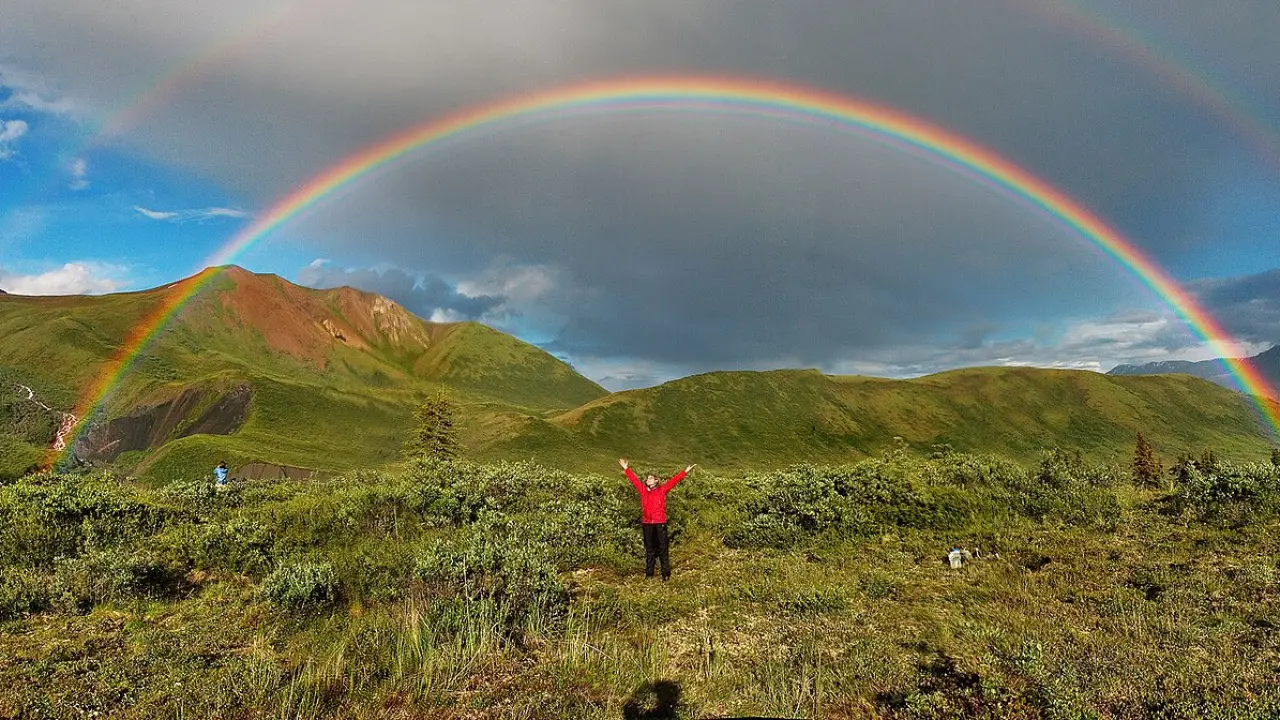
Sometimes light bounces twice inside raindrops before escaping, painting a fainter outer with flipped colors—violet on top and red on the bottom!
1. Which color of visible light bends the most when refracting through a raindrop?
2. What creates a fainter outer 'double rainbow' with reversed colors?
🤯 Mind-Blowing Fact • Grade 4
Microscopic droplets in fog are so tiny that light waves smear together, creating a ghostly pure-white 'fogbow' instead of colored stripes!
✨ Word Sparks (Grade 4 Glossary)
Tap 🔊 to hear
antisolar point
spot directly opposite the Sun through your shadow
fogbow
pale white arch formed in tiny fog droplets
moonbow
rare nighttime rainbow lit by a bright Moon
🪝
Why does the sky between the two arcs of a double rainbow look noticeably darker than the sky inside the main arch?
1
Geometry of the Antisolar Point
Stand in a Virginia field right after a passing summer thunderstorm when the sun hangs low in the west and dark rain curtains drift east. Look straight at the shadow of your own head on the grass: that spot marks your ! Every primary rainbow forms a precise circular cone centered on that antisolar point with an angular radius between 40 and 42 degrees—which also explains why you cannot see a natural sky rainbow at high noon in summer, when the antisolar point plunges too far below the ground!
2
Wave Speed and Refractive Index
Light zips through air at nearly 300,000 kilometers per second, but entering denser liquid water slows it to about 225,000 kilometers per second. Crucially, water slows short-wavelength violet light slightly more than long-wavelength red light! That tiny speed difference causes dispersion, fanning white sunlight into a continuous spectrum remembered by the acronym ROYGBIV.
3
Alexander's Dark Band
Look closely during a vivid double rainbow: the sky inside the primary 42-degree arch glows bright because raindrops scatter extra white light inward, while the secondary arch sits outside near 51 degrees. Between 42 and 51 degrees, raindrops cannot reflect single-bounce or double-bounce rays toward your eyes, leaving a dramatic dusky strip named Alexander's dark band!
4
Moonbows and Fogbows
Bright full moons can cast ghostly nighttime lunar rainbows ('') near waterfalls, while tiny fog droplets diffract light so broadly that colors overlap into an eerie, pure-white !
1. Why can't you spot a natural rain-shower rainbow in a flat field when the Sun sits straight overhead at noon?
2. Why does 'Alexander's dark band' look darker between the primary and secondary rainbows?
🤯 Mind-Blowing Fact • Grade 5
Faint extra pastel stripes sometimes tucked right inside a rainbow's violet edge—called supernumerary arcs—could not be explained by simple ray geometry and helped prove in 1803 that light travels as waves!
✨ Word Sparks (Grade 5 Glossary)
Tap 🔊 to hear
refractive index
number measuring how much a material slows light
caustic
bright concentration of bent or reflected light rays
interference
overlapping light waves reinforcing or canceling each other
🪝
How did René Descartes and Isaac Newton unlock the exact mathematical angles hidden inside a single spherical raindrop?
1
Snell's Law and Chromatic Dispersion
In 1637, mathematician René Descartes traced individual sunbeams through a water-filled glass sphere and discovered why rainbows cluster along a sharp skyward ring rather than smearing evenly across an entire storm. Thirty years later, Isaac Newton supplied the missing piece: chromatic dispersion. Governed by Snell's law of refraction, water exhibits a slightly higher for 400-nanometer violet light (n ≈ 1.344) than for 700-nanometer red light (n ≈ 1.331), bending violet rays more sharply at both entry and exit.
2
The Descartes Caustic at 40° to 42°
Sunlight strikes every part of a spherical raindrop's sunlit hemisphere, yet rays entering at one special impact zone bunch tightly together upon exiting—forming a brilliant optical concentration called a ! For one internal reflection, red rays concentrate sharply at a 42.0-degree deviation from the antisolar axis, while violet rays concentrate at 40.2 degrees.
3
Teamwork of Millions of Falling Drops
One drop cannot send the whole spectrum to your pupil at once: if a high drop sits at 42 degrees to beam red light into your eye, its 40-degree violet ray shoots harmlessly over your head! Millions of lower drops positioned along the 40-degree cone supply the violet band, and as drops fall, new ones seamlessly take their places.
4
Double Reflections and Supernumerary Fringes
Rays undergoing two internal reflections exit between 50.4 degrees (red) and 53.5 degrees (violet), producing the inverted secondary bow outside Alexander's dark band. Inside the violet edge of vivid primary bows, wave between nearly parallel light paths occasionally paints delicate pastel ripples called supernumerary arcs!
5
Raindrop Flattening and Twinned Bows
Even drop size leaves fingerprints: tiny drizzle drops broaden and pale the spectrum via diffraction, whereas huge 4-millimeter raindrops flattened on the bottom by air resistance brighten the rainbow's base while fading its top!