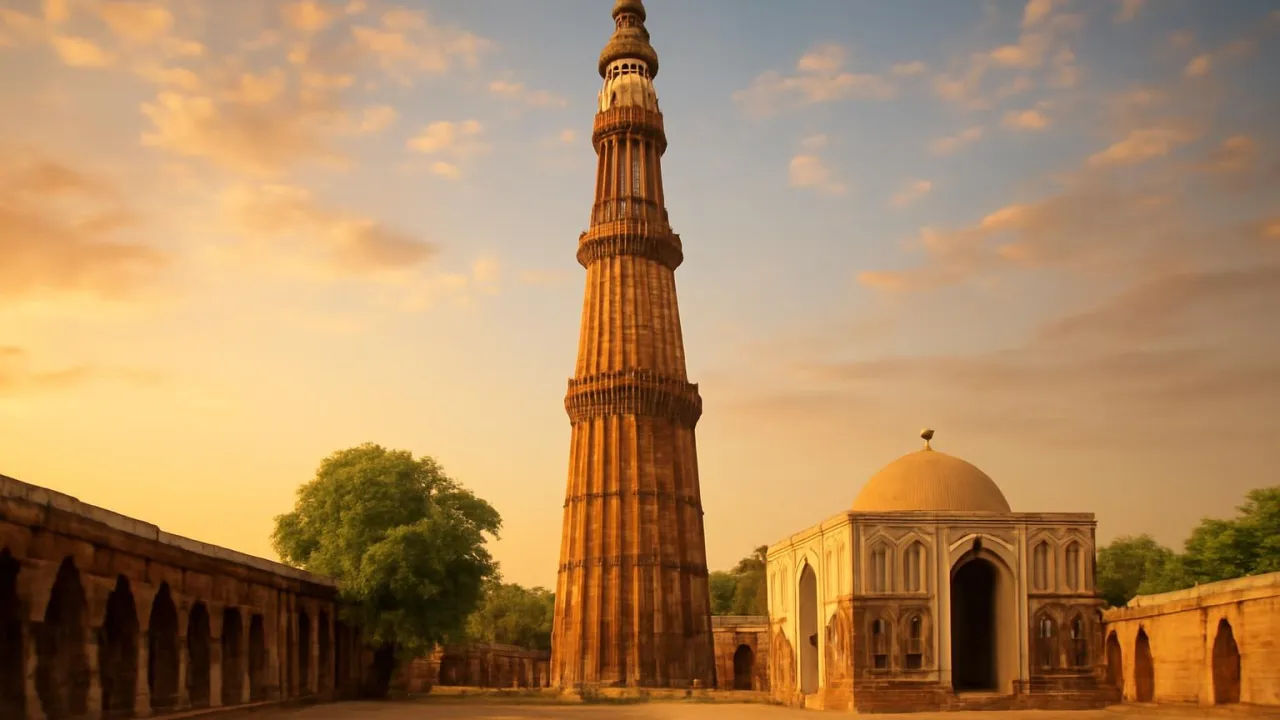
Have you ever wondered how it feels to stand inside a giant spiral tower?
1
A Tower in the Sky
Qutub Minar rises high above the trees, shining in the sunlight. Its bricks are red and brown, stacked in tall circles. People come from all over to see its beauty. The tower looks magical against the blue sky.
2
Steps That Twist
Inside, a leads up and up, winding like a giant spring. Each step is made of stone and feels cool to touch. The stairs go in circles all the way to the top. Looking down, you feel like you are floating above the ground.
3
A Place for All
Families take pictures and listen to birds singing nearby. The gardens around the tower are green and peaceful, perfect for a picnic. Sometimes, you can hear the wind whistle through the . Qutub Minar is a place full of stories and fun.
1. What shape does the staircase inside Qutub Minar make?
2. What do people enjoy in the gardens?
🤯 Mind-Blowing Fact • Grade 3
Qutub Minar survived several earthquakes and still stands strong today!
✨ Word Sparks (Grade 3 Glossary)
Tap 🔊 to hear
monument
A building made to remember history
corbeling
A way to hold up stone arches
calligraphy
Fancy handwriting or lettering
🪝
Imagine your footsteps echoing as you climb a tower older than your school!
1
A Tower Through Time
Qutub Minar was started over 800 years ago by a ruler named Qutb-ud-din Aibak. The tower is made from red sandstone and marble, stacked in five tall stories. Each story has a balcony with beautiful arches and carvings. The tower stands as a to ancient builders’ skill.
2
Spiraling Steps and Echoes
Inside, a spiral staircase of 379 steps winds to the top. As you climb, your footsteps create echoes that bounce off the stone walls. The spiral shape makes the tower strong and helps it stand tall. Looking out from the balconies, you can see all of Delhi below.
3
Amazing Arches and Carvings
The Qutub Minar is covered with carved patterns and from the Quran. Its arches are built using special engineering called , which holds up the heavy stone. The carvings show flowers, vines, and writing in Arabic. These decorations make the tower famous all over the world.
4
A Place of Wonder
Today, Qutub Minar is a UNESCO World Heritage Site visited by millions each year. People come to learn about its history and admire its architecture. The tower’s height and beauty inspire artists, writers, and travelers. It stands as a symbol of India’s rich past and bright future.
The Qutub Minar leans slightly, but its clever engineering keeps it safe and upright!
✨ Word Sparks (Grade 4 Glossary)
Tap 🔊 to hear
bracket
A support that holds up something heavy
erosion
Slow wearing away by wind or rain
heritage
Important history passed down to us
🪝
What secrets do the ancient stones of Qutub Minar whisper when the wind rushes by?
1
A Tower of Triumph
The Qutub Minar was begun in 1192 CE by Qutb-ud-din Aibak, marking the start of Muslim rule in India. Rising to 239 feet, it was constructed with red sandstone and marble, using intricate carving techniques. Its five stories are separated by projecting balconies supported by elaborate stone . The tower’s design blends Indo-Islamic and local Indian architectural styles, making it a unique historical monument.
2
Engineering Marvels
The spiral staircase inside the Qutub Minar has 379 steps, winding tightly around a central core. This spiral shape helps distribute weight and vibration, allowing the tower to withstand earthquakes and strong winds. The arches and corbelled use physics to transfer the massive weight safely down to the ground. Over centuries, careful repairs have preserved its structure despite natural and damage.
3
Artistry in Stone
The tower’s surface is covered with bands of calligraphy and geometric patterns carved in stone. Verses from the Quran and floral designs show the skill of ancient craftsmen. The use of both red sandstone and white marble creates striking color contrasts, especially at sunrise and sunset. These decorations not only add beauty but also tell stories from history and religion.
4
A Global Landmark
Recognized as a UNESCO World Site, Qutub Minar attracts millions of visitors from around the world each year. It stands as a symbol of India’s rich cultural heritage and architectural innovation. Festivals, art shows, and educational tours are held in its gardens, keeping its legacy alive. The tower’s influence can be seen in many later buildings across South Asia and beyond.
1. How does the spiral staircase help the tower survive earthquakes?
2. What makes Qutub Minar’s carvings special?
🤯 Mind-Blowing Fact • Grade 5
Qutub Minar’s base is wider than a school bus is long, but its top is only as wide as a dinner table!
✨ Word Sparks (Grade 5 Glossary)
Tap 🔊 to hear
minaret
A tall tower built next to a mosque
seismic
Related to shaking from earthquakes
preservation
Caring for something to keep it safe
🪝
If you could travel back to the 1200s, what engineering secrets would you discover inside Qutub Minar’s towering walls?
1
A Monumental Beginning
Construction of the Qutub Minar began in 1192 CE under the rule of Qutb-ud-din Aibak, the founder of the Delhi Sultanate, and was completed by his successors. This was built to celebrate victory and the arrival of a new era in northern India. Standing at 239 feet (72.5 meters), it is the tallest brick minaret in the world and remains an enduring symbol of Indo-Islamic architecture. Its five distinct stories are marked by projecting balconies, each supported by intricate stone brackets and decorated with bands of calligraphy.
2
Engineering and Structural Wonders
The Qutub Minar’s robust structure relies on a circular plan and a tapering design, with the base measuring 47 feet (14.3 meters) in diameter and narrowing to 9 feet (2.7 meters) at the top. The 379-step spiral staircase winds inside a thick core, distributing the tower’s weight and providing stability against vibrations and wind forces. The use of corbelled arches and brackets demonstrates advanced knowledge of physics, allowing the heavy stone to be safely supported. Despite several earthquakes over the centuries, the tower’s original engineering has kept it standing with only minor repairs.
3
Materials and Artistic Detail
The tower is constructed mainly from red sandstone, with bands of white marble accentuating each level, creating a striking visual contrast. The exterior is adorned with intricate carvings, including Quranic inscriptions, geometric motifs, and floral patterns, showcasing the artistry of medieval Indian and Persian craftsmen. The calligraphy and patterns are not only decorative but also serve to reinforce the stone, reducing erosion by breaking up rainwater flow. The use of both local and imported materials demonstrates the region’s trade connections and cultural exchanges.
4
Legacy and Global Influence
As a UNESCO World Heritage Site, Qutub Minar draws millions of visitors annually, contributing to Delhi’s status as a cultural and historical hub. The tower’s innovative design influenced later and monuments throughout South Asia, including the nearby Alai Minar and structures in Afghanistan and Central Asia. Festivals, educational programs, and archaeological research at the site keep its legacy alive, connecting past achievements with present-day learning. Its gardens and ruins provide a living classroom for students, historians, and engineers alike.
5
Preservation and Modern Challenges
Preserving Qutub Minar involves constant monitoring for structural stress, pollution damage, and erosion caused by weather and human activity. Conservationists use modern technology, such as 3D scanning and sensors, to detect shifts and prevent damage. Restoration efforts focus on using traditional materials and techniques to maintain authenticity while ensuring safety for visitors. The tower’s slight lean, caused by centuries of ground movement, is carefully measured and stabilized to prevent collapse. Qutub Minar stands not only as a triumph of medieval engineering but also as a testament to the ongoing importance of heritage .