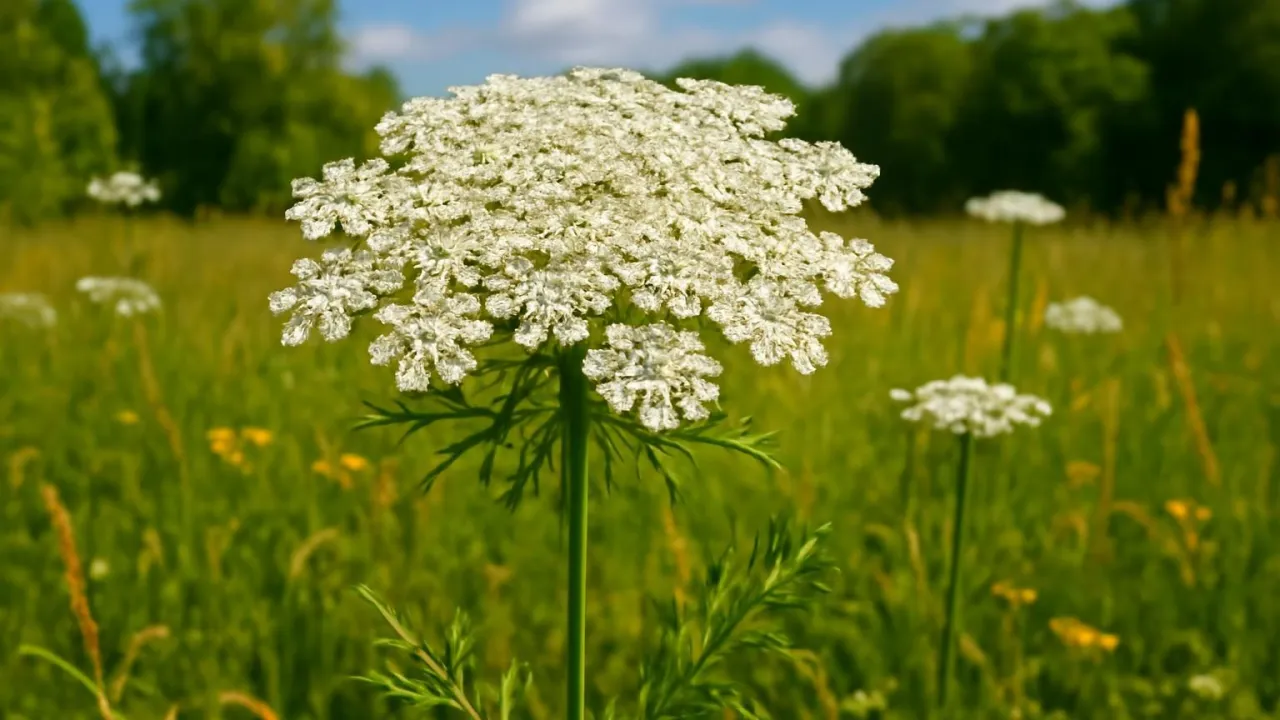
Queen Anne's Lace is actually a wild carrot, related to the carrots we eat!
✨ Word Sparks (Grade 2 Glossary)
Tap 🔊 to hear
cluster
A group of things close together
pollinator
An animal that helps flowers make seeds
native
Originally from a certain place
🪝
Have you ever seen a flower that looks like a white umbrella?
1
Lace-Like Flower Clusters
Queen Anne's Lace flowers grow in flat that look like lace. These tiny white flowers bloom in summer and attract many . The flower heads can be up to six inches wide.
2
Sunny Fields and Roadsides
This plant grows well in sunny fields and along roadsides. It prefers well-drained soil and can reach heights of up to four feet. It is to Europe but now grows in North America too.
3
Special Flower Feature
One tiny dark purple flower often appears in the center of the . This unique spot helps attract insects for pollination. The plant’s leaves look feathery and are green.
1. What special flower color is in the center of Queen Anne's Lace?
2. Where did Queen Anne's Lace originally come from?
🤯 Mind-Blowing Fact • Grade 3
Queen Anne's Lace is a wild ancestor of the carrot we eat today!
✨ Word Sparks (Grade 3 Glossary)
Tap 🔊 to hear
taproot
A big root that grows deep underground
pollination
When pollen moves to help flowers make seeds
adaptation
A special trait that helps plants survive
🪝
Did you know Queen Anne’s Lace hides a secret carrot root underground?
1
Lace-Like Flowers and Camouflage
Queen Anne’s Lace produces flat clusters of tiny white flowers that resemble delicate lace. This flower cluster helps the plant attract many pollinators like bees and butterflies. The lace pattern also provides some camouflage from predators. The plant blooms mainly in summer and early fall.
2
Life Cycle and Growth
This biennial plant grows a that looks like a small carrot underground. In its first year, it grows leaves and a root. In the second year, it sends up tall flower stalks. After , it produces seeds to grow new plants.
3
Adaptations for Survival
The feathery green leaves help the plant capture sunlight efficiently for photosynthesis. The tiny dark purple flower in the center of the cluster attracts specific pollinators. Its strong stores nutrients to survive winter cold. These help it thrive in open fields.
4
Pollination and Protection
Queen Anne’s Lace relies on insects for , which helps produce seeds. The flower’s lace shape makes it easy for insects to land and collect nectar. The plant also deters some herbivores with its hairy stems and leaves. This helps protect it from being eaten.
1. What part of Queen Anne’s Lace looks like a small carrot?
2. Why does the purple flower in the center help the plant?
🤯 Mind-Blowing Fact • Grade 4
Queen Anne’s Lace helps many insects and is linked to the carrot we eat today!
✨ Word Sparks (Grade 4 Glossary)
Tap 🔊 to hear
ecosystem
All living things and their homes together
herbivore
An animal that eats plants
biodiversity
Many different kinds of plants and animals
🪝
How does Queen Anne’s Lace help its ecosystem and survive in many places?
1
Flower Structure and Ecosystem Role
Queen Anne’s Lace produces flat, lace-like flower clusters that attract many pollinators such as bees, butterflies, and beetles. This plant plays an important role in food webs by providing nectar and pollen. Its flowers also support beneficial insects that help nearby crops. The lace pattern increases the flower’s visibility and landing space.
2
Growth, Habitat, and Distribution
Native to temperate Europe, Queen Anne’s Lace has spread widely across North America and other regions. It thrives in sunny fields, roadsides, and disturbed soils with well-drained conditions. This biennial plant grows a strong taproot that stores nutrients, allowing it to survive cold winters and droughts. Its ability to grow in many habitats helps it spread quickly.
3
Cause and Effect of Adaptations
The plant’s hairy stems and leaves deter , reducing damage from animals like deer and rabbits. The central dark purple flower attracts specific pollinators, increasing seed production. Because it produces many seeds, Queen Anne’s Lace can colonize new areas rapidly. These adaptations help maintain its population and balance.
4
Human Impact and Uses
Though often considered a wildflower or weed, Queen Anne’s Lace has been used historically for food and medicine. Its root is an ancestor of the cultivated carrot, and some parts have been used as herbal remedies. However, in some areas, it can outcompete native plants, affecting . Understanding its role helps manage habitats responsibly.
Queen Anne’s Lace’s flower cluster design helps many pollinators land easily and find nectar quickly!
✨ Word Sparks (Grade 5 Glossary)
Tap 🔊 to hear
inflorescence
A group of flowers growing together on one stem
umbel
A flat flower cluster shaped like an umbrella
taproot
A large root growing straight down underground
🪝
Did you know Queen Anne’s Lace is the wild ancestor of the carrot and has unique flower mechanics?
1
Scientific Classification and Origins
Queen Anne’s Lace, scientifically named Daucus carota, belongs to the Apiaceae family, which includes carrots and parsley. It is native to temperate regions of Europe and Western Asia but has naturalized widely across North America. This biennial herbaceous plant completes its life cycle over two years, producing a characteristic in the first year and flowering in the second.
2
Physiological Mechanics and Adaptations
The plant’s is an , a flat-topped cluster of numerous tiny white flowers, often with a single dark purple flower at the center. This arrangement enhances pollinator attraction by providing a large landing platform and visual contrast. Its deeply dissected, pinnate leaves maximize photosynthetic efficiency, while the stores carbohydrates to survive winter and drought.
3
Ecological Role and Conservation Status
Queen Anne’s Lace plays a vital role in supporting pollinator populations, including bees, butterflies, and beetles, thus contributing to local biodiversity. While not endangered, it can become invasive outside its native range, competing with native flora. Conservation efforts focus on habitat management to balance its ecological benefits with potential impacts on native plant communities.
4
Botanical History and Human Uses
Historically, Queen Anne’s Lace has been valued for its edible , which is the progenitor of the cultivated carrot. Herbalists have used it for medicinal purposes, such as diuretics and digestive aids. Its delicate flowers have inspired lace patterns in textiles, linking botanical beauty with cultural arts.
5
Quantitative Comparisons and Environmental Preferences
Queen Anne’s Lace typically grows between one and four feet tall (30 to 120 centimeters) and produces up to six inches (15 centimeters) wide. It thrives in full sun with well-drained soils and tolerates temperatures from freezing to about 95 degrees Fahrenheit (35 degrees Celsius). Its can extend over a foot deep, allowing access to deep soil moisture.