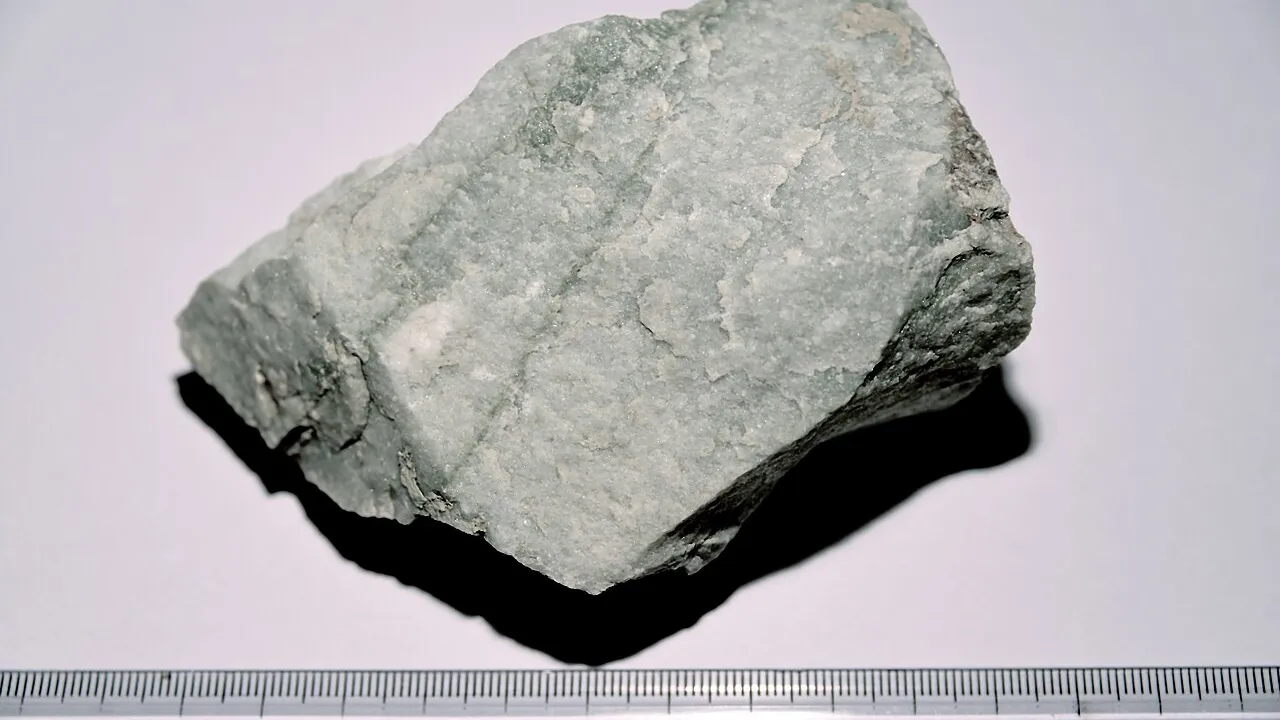
1. Which gritty rock turns into super-hard quartzite under heat and pressure?
2. What happens if you try to scratch quartzite with a steel nail?
🤯 Mind-Blowing Fact • Grade 2
Virginia's famous Devil's Marbleyard in the Blue Ridge Mountains is a giant eight-acre hillside covered in car-sized boulders of sparkling white Antietam Quartzite!
✨ Word Sparks (Grade 2 Glossary)
Tap 🔊 to hear
fracture
How a rock cracks when broken open
boulder
A very large rock bigger than a basketball
ballast
Crushed hard stone supporting heavy railroad tracks
🪝
How can you tell gritty sandstone apart from its super-strong cousin quartzite?
1
Around the Grains or Right Through Them!
Break a piece of ordinary sandstone, and the crack zigzags AROUND the tiny sand grains, leaving a bumpy surface like sandpaper. Break metamorphic quartzite, and the sand grains are fused so tightly that the crack slices RIGHT THROUGH the grains—leaving a smooth, sugary, glassy shine!
2
Pastel Colors From Tiny Extras
Pure quartzite gleams snowy white or misty gray. Tiny specks of iron turn it rosy pink or maroon, while rare green mica turns a famous variety called aventurine bright shimmery green!
3
Tracks Under Heavy Trains
Because crushed quartzite refuses to crumble under millions of pounds, railroad crews pack angular quartzite underneath heavy train tracks.
1. How does metamorphic quartzite break compared to ordinary sandstone?
2. Why do railroad engineers spread crushed quartzite under train tracks?
🤯 Mind-Blowing Fact • Grade 3
Pencil-thin vertical tubes called Skolithos inside Virginia's Blue Ridge quartzite are fossilized homes of beach worms that lived over half a billion years ago!
✨ Word Sparks (Grade 3 Glossary)
Tap 🔊 to hear
silicon dioxide
Hard chemical compound making quartz and quartzite
Skolithos
Ancient vertical worm-burrow trace fossils in beach rock
interlocking
Grown tightly together with zero gaps between grains
🪝
Why did prehistoric toolmakers hike miles up Blue Ridge peaks to collect chunks of quartzite?
1
Recrystallizing Pure Silica
Imagine burying a clean quartz beach sand miles beneath a rising mountain range! As temperatures climb past 300 to 600 degrees Celsius under intense pressure, original sand grains and quartz cement dissolve along pressed edges and regrow into an jigsaw puzzle of pure (SiO2). All open pore spaces vanish!
2
Non-Foliated Strength
Unlike shale—which grows flat mica sheets to become foliated slate—pure quartz sandstone contains almost no clay or mica. Because blocky quartz crystals grow equally in all directions, quartzite is a classic non-foliated metamorphic rock with uniform toughness from every angle.
3
Ancient Worm Burrows in Blue Ridge Stone
Hike along Virginia's Blue Ridge Parkway or Shenandoah National Park, and look for pencil-straight vertical tubes inside white Antietam Quartzite! Called , those tubes are 520-million-year-old worm burrows from a Cambrian beach that survived turning into quartzite!
4
Stone Age Blades and Modern Kitchens
Native Americans flaked tough Virginia quartzite into spear points for over 10,000 years, and today homeowners prize natural quartzite slabs as scratch-proof kitchen countertops.
1. Why is quartzite non-foliated instead of splitting into flat sheets like slate?
2. What are the straight, pencil-shaped tubes often seen in Virginia's Antietam Quartzite?
🤯 Mind-Blowing Fact • Grade 4
The silicon microchips inside computers and smartphones often trace their raw silica all the way back to quarried beds of ultra-pure metamorphic quartzite!
✨ Word Sparks (Grade 4 Glossary)
Tap 🔊 to hear
metaquartzite
True quartzite recrystallized by metamorphic heat and pressure
frost wedging
Splitting of cracked rock by freezing, expanding water
talus
Slope of broken angular boulders below a cliff
🪝
Why does quartzite stand near the very top of Earth's survival list against wind, rain, and acid?
1
Metamorphic Quartzite Versus Orthoquartzite
Geologists carefully distinguish two ultra-hard quartz rocks. Sedimentary orthoquartzite is quartz sandstone so thoroughly cemented by low-temperature silica groundwater that cracks already break across grains. True (metamorphic quartzite), however, endured tectonic heat and pressure, erasing rounded sand-grain outlines by suturing crystal boundaries together into a tight mosaic scoring a full 7 on the Mohs hardness scale.
2
Chemical Invincibility at Earth's Surface
Why do marble monuments dissolve slowly in humid rain and gabbro hills rust into clay, while quartzite cliffs stand virtually untouched? Quartz sits at the very bottom of Bowen's Reaction Series, meaning it crystallized last at the coolest magma temperatures and is completely at home in cool, wet surface air! Weak carbonic acid in rain cannot dissolve quartz, and almost zero porosity blocks frost from prying individual grains loose.
3
Frost-Wedged Talus Fields
Water can only attack quartzite along wide tectonic fractures. During Ice Age winters in Virginia's Blue Ridge, freezing water expanded inside cliff joints, wedging off angular blocks that tumbled into vast boulder seas like Devil's Marbleyard and Big Schloss.
4
Ultra-Pure Silicon for the Digital Age
High-purity quartzite is smelted in electric-arc furnaces to refine metallurgical silicon—the starting material for solar cells and computer microchips!
1. Why does quartzite resist chemical weathering in humid climates better than almost any other common rock?
2. How did Ice Age weather create giant boulder fields like Virginia's Devil's Marbleyard if quartzite barely dissolves?
🤯 Mind-Blowing Fact • Grade 5
In Wisconsin's Baraboo Hills, hikers can touch 1.7-billion-year-old ocean wave ripples preserved in solid purple quartzite from an era when only single-celled microbes lived on Earth!
✨ Word Sparks (Grade 5 Glossary)
Tap 🔊 to hear
monadnock
Isolated mountain of ultra-resistant rock surviving erosion
Glittering optical sparkle from tiny mineral plates inside quartz
🪝
How can 1.7-billion-year-old wave ripples survive intact inside solid metamorphic quartzite?
1
Grain-Boundary Migration and Sutured Quartz
View a thin section of metamorphic quartzite between crossed polarizers, and you witness dynamic recrystallization frozen in stone! Under greenschist- to amphibolite-facies conditions (350 to 700 degrees Celsius), intracrystalline dislocation creep and grain-boundary migration erase original detrital sand rims, replacing them with serrated, interlocking crystal sutures or clean 120-degree polygonal junctions showing where the crystal lattice strained under mountain-building stress.
2
Preserving Primary Structures Across Billion-Year Spans
Astonishingly, even after complete recrystallization, subtle iron-oxide dustings or heavy-mineral laminations (zircon and rutile) preserve ancient sedimentary structures! In Wisconsin's 1.7-billion-year-old Proterozoic Baraboo Quartzite and Virginia's Cambrian Chilhowee Group (Weverton and Antietam quartzites), geologists walk across pristine symmetrical wave ripples and trough cross-beds older than land plants!
3
Monadnocks: Topographic Champions of Erosion
Because quartzite combines compressive strengths often exceeding 250 megapascals with extreme chemical inertness, folded quartzite synclines and anticlines outlast kilometers of surrounding rock, standing isolated above eroded plains as classic —such as New Hampshire's Mount Monadnock itself and Ontario's gleaming white La Cloche Mountains.
4
Fuchsite, Dumortierite, and Gem Varieties
Trace mineral inclusions trapped during metamorphism transform snow-white metaquartzite into vibrant ornamental stones: chromium-bearing muscovite flakes (fuchsite) create shimmering emerald-green in Indian and Brazilian aventurine quartzite, iron-titanium hematite plates blush slabs rose-pink, and microscopic aluminum-boron dumortierite needles dye rare Bahia slabs deep denim and royal blue.
5
High-Purity Silica Metallurgy
Carbothermically reduced with purified carbon inside submerged-arc furnaces at 2,000 degrees Celsius—following the reaction SiO2 + 2C -> Si + 2CO—ultra-pure (>99.5% SiO2) metaquartzite yields metallurgical-grade elemental silicon indispensable for refining nine-nines-pure photovoltaic solar wafers, lightweight aluminum-silicon alloys, ferrosilicon steel deoxidizers, and transoceanic fiber-optic cables.