1. Why did scientists nickname Qianzhousaurus 'Pinocchio rex'?
2. What grew in a neat row along the top of Qianzhousaurus's nose?
🤯 Mind-Blowing Fact • Grade 2
Before Qianzhousaurus was found, scientists had only young skeletons of long-snouted tyrannosaurs and argued for years over whether adults kept long noses!
✨ Word Sparks (Grade 2 Glossary)
Tap 🔊 to hear
mudstone
Smooth rock formed from ancient hardened mud
sleek
Slender, graceful, and streamlined for speed
nimble
Quick and light in every movement
🪝
What happened when construction workers in China unearthed a long-nosed tyrannosaur?
1
Surprise at a Building Site
Imagine operating a backhoe at an industrial park in Ganzhou, China, and spotting giant dinosaur bones gleaming in red ! In 2010, thoughtful workers paused right away and called museum scientists. Inside the rock lay a nearly complete twenty-nine-foot tyrannosaur named Qianzhousaurus after Ganzhou's ancient name, Qianzhou.
2
Meet Pinocchio Rex
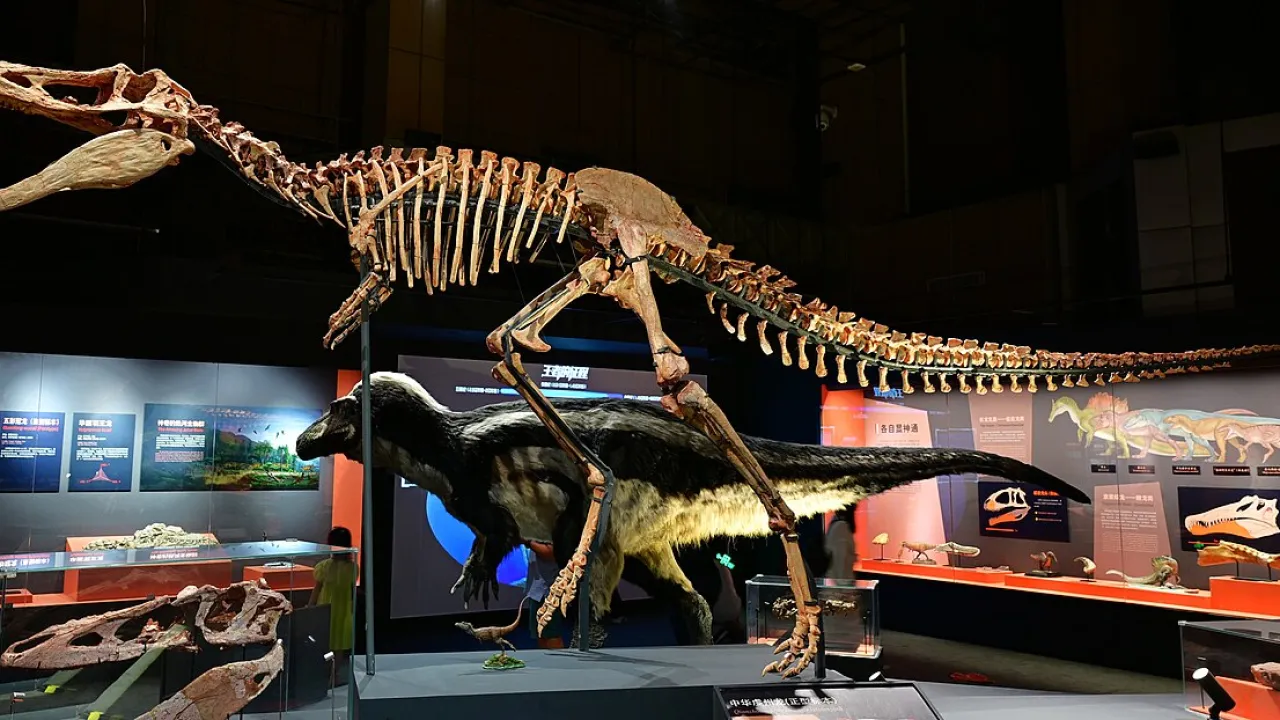
While Tyrannosaurus rex had a deep, wide, heavy snout, Qianzhousaurus had a snout thirty-five percent longer than normal tyrannosaurs of its size! Along the bridge of its nose ran a row of short bony hornlets.
3
Fast Hunter of Quick Prey
Weighing less than a ton, this predator used narrow teeth and quick neck snaps to catch oviraptorosaurs, lizards, and small mammals.
1. How much longer was Qianzhousaurus's snout compared to typical tyrannosaurs of the same body size?
2. What kind of animals did agile Qianzhousaurus hunt?
🤯 Mind-Blowing Fact • Grade 3
Even though Qianzhousaurus measured nearly 30 feet long, its light, air-filled bones meant it weighed about one-tenth as much as a huge adult T. rex!
✨ Word Sparks (Grade 3 Glossary)
Tap 🔊 to hear
skeptic
A scientist who asks for stronger proof before agreeing
oviraptorid
A beaked, bird-like feathered dinosaur from Asia
pursuit
Chasing actively after fast-moving prey
🪝
How did Qianzhousaurus solve a mystery that puzzled dinosaur scientists for thirty-five years?
1
A Whole Branch of Long-Nosed Rexes
Dust swirls across a sunlit Late Cretaceous basin in southern China 68 million years ago. Sprinting past nesting grounds of feathered dinosaurs comes Qianzhousaurus sinensis, a nine-meter predator weighing only 750 kilograms—lightweight for a tyrannosaur nearly thirty feet long! When paleontologists Junchang Lü and Stephen Brusatte unveiled it in 2014, dinosaur fans instantly dubbed it 'Pinocchio rex.'
2
Solving the Juvenile Puzzle
Previously, scientists had found two smaller long-snouted tyrannosaurs in Mongolia called Alioramus. Because both were juveniles, wondered if they were merely young Tarbosaurus whose snouts hadn't thickened yet. Because the Qianzhousaurus skeleton belonged to a nearly mature nine-meter individual, it proved once and for all that long-snouted tyrannosaurs formed their own true branch, Alioramini!
3
Knife Teeth Instead of Bone-Crushers
Rather than thick, banana-shaped teeth for shattering bone, Qianzhousaurus carried narrow, blade-like teeth along its ninety-centimeter skull, crowned by six bumpy nasal hornlets.
4
Sharing the Ancient Landscape
By specializing as a fast hunter of feathered and small herbivores, Qianzhousaurus lived right alongside giant deep-jawed tyrannosaurs like Zhuchengtyrannus-type cousins without competing.
1. What major scientific debate did the nearly adult Qianzhousaurus skeleton settle in 2014?
2. How did Qianzhousaurus share ecosystems with heavier, deep-skulled tyrannosaurs?
🤯 Mind-Blowing Fact • Grade 4
Qianzhousaurus lived in one of Earth's richest oviraptorosaur hotspots—sharing Ganzhou's ancient floodplains with at least seven different species of feathered, parrot-beaked dinosaurs!
✨ Word Sparks (Grade 4 Glossary)
Tap 🔊 to hear
Alioramini
The specialized Asian tribe of long-snouted, slender tyrannosaurs
inertia
Resistance an object has to quick changes in motion
bending stress
Internal strain when force pushes across a long structure
🪝
What happened when engineers tested the 3D digital skull of 'Pinocchio rex' under biting forces?
1
Unearthing the Alioramin Tribe
Picture the warm floodplains of southern China's Nanxiong Formation 68 million years ago, teeming with crested Corythoraptor, brooding Citipati relatives, and long-necked titanosaurs. Darting across the red mudflats is Qianzhousaurus sinensis, discovered near Ganzhou in 2010 and formally named in 2014 by Junchang Lü, Stephen Brusatte, and colleagues. This remarkably preserved subadult skeleton anchored a newly recognized tribe of slender-snouted tyrannosaurids: the .
2
Trade-Off Between Speed and Bite Force
In 2022, paleontologist Fion Waisum Ma and colleagues built 3D biomechanical models of Qianzhousaurus's ninety-centimeter skull to test how it handled feeding stresses. Compared to deep-skulled tyrannosaurs, Qianzhousaurus experienced higher if it bit hard bone, and its eighteen narrow maxillary teeth lacked heavy bone-crushing roots. Instead, its lightweight, elongated snout reduced rotational —allowing lightning-fast sideways and forward snaps to snatch agile feathered oviraptorosaurs and lizards.
3
Ornamented Snout and Pneumatic Skull
Large antorbital openings lightened its long face, while a row of five to six rugose hornlets atop the fused nasals and forward-pointing lacrimal horns created a bold visual profile during courtship.
4
End-Cretaceous Asian Diversity
Far from declining before the asteroid impact 66 million years ago, Asian tyrannosaurs diversified into both heavy bone-crushers and swift, long-snouted specialists like Qianzhousaurus.
1. What advantage did a lighter, elongated snout give Qianzhousaurus according to 2022 3D skull models?
2. Which group of feathered dinosaurs was extraordinarily abundant alongside Qianzhousaurus in Ganzhou?
🤯 Mind-Blowing Fact • Grade 5
In 2024, paleontologists discovered a compact, deep-snouted tyrannosaurine named Asiatyrannus in the exact same Ganzhou rock formation, proving short-snouted and long-snouted tyrannosaurs shared southern China side by side!
✨ Word Sparks (Grade 5 Glossary)
Tap 🔊 to hear
finite-element analysis
Computer engineering method calculating how 3D shapes handle physical stress
endemic
Native and restricted naturally to one geographic region
guild
A group of species exploiting similar resources in related ways
🪝
How did Qianzhousaurus sinensis reshape our view of tyrannosaurid guild structure at the close of the Cretaceous?
1
Serendipity in the Nanxiong Red Beds
During the summer of 2010, excavation crews leveling red sandstones for an industrial park near Ganzhou in Jiangxi Province, China, uncovered an articulated theropod skeleton dating to the Maastrichtian stage (72–66 MYA). Recognizing its scientific value, researchers Junchang Lü, Stephen Brusatte, and colleagues described Qianzhousaurus sinensis in 2014—honoring Qianzhou, the historic name for Ganzhou, while affectionately dubbing it 'Pinocchio rex.'
2
Validating the Clade Alioramini
For decades after Sergei Kurzanov named Alioramus remotus (1976) and Stephen Brusatte named Alioramus altai (2009) from juvenile Mongolian skulls, paleontologists debated whether long-snouted tyrannosaurs were merely immature ontogenetic stages of deep-skulled Tarbosaurus. Measuring approximately nine meters long, weighing roughly 757 kilograms, and exhibiting fused cranial and vertebral sutures indicative of near-adult maturity, Qianzhousaurus confirmed Alioramini as a distinct, long-lived lineage to Late Cretaceous Asia.
3
Craniodental Finite-Element Biomechanics
In Qianzhousaurus, the preorbital region comprises roughly seventy percent of its ninety-centimeter skull length—thirty-five percent longer proportionally than equivalent-sized tyrannosaurines. Finite-element stress analyses published by Fion Waisum Ma and colleagues (2022) demonstrated that this elongated rostrum sacrificed resistance to torsional and dorso-ventral bone-crushing loads in favor of rapid angular velocity and ziphodont slicing using narrow maxillary crowns.
4
Cranial Ornamentation and Cursorial Build
Five to six rugose midline nasal rugosities and prominent cornual processes on the lacrimals served as socio-sexual signaling structures, while an elongated tibia-to-femur ratio powered swift pursuit across semi-arid alluvial plains.
5
Niche Partitioning Among Maastrichtian Giants
Coexisting with deep-jawed tyrannosaurines (such as Asiatyrannus and Tarbosaurus-grade giants) and diverse oviraptorosaurs, Qianzhousaurus occupied an agile mesopredator-to-large-pursuit right up to the end-Cretaceous boundary.