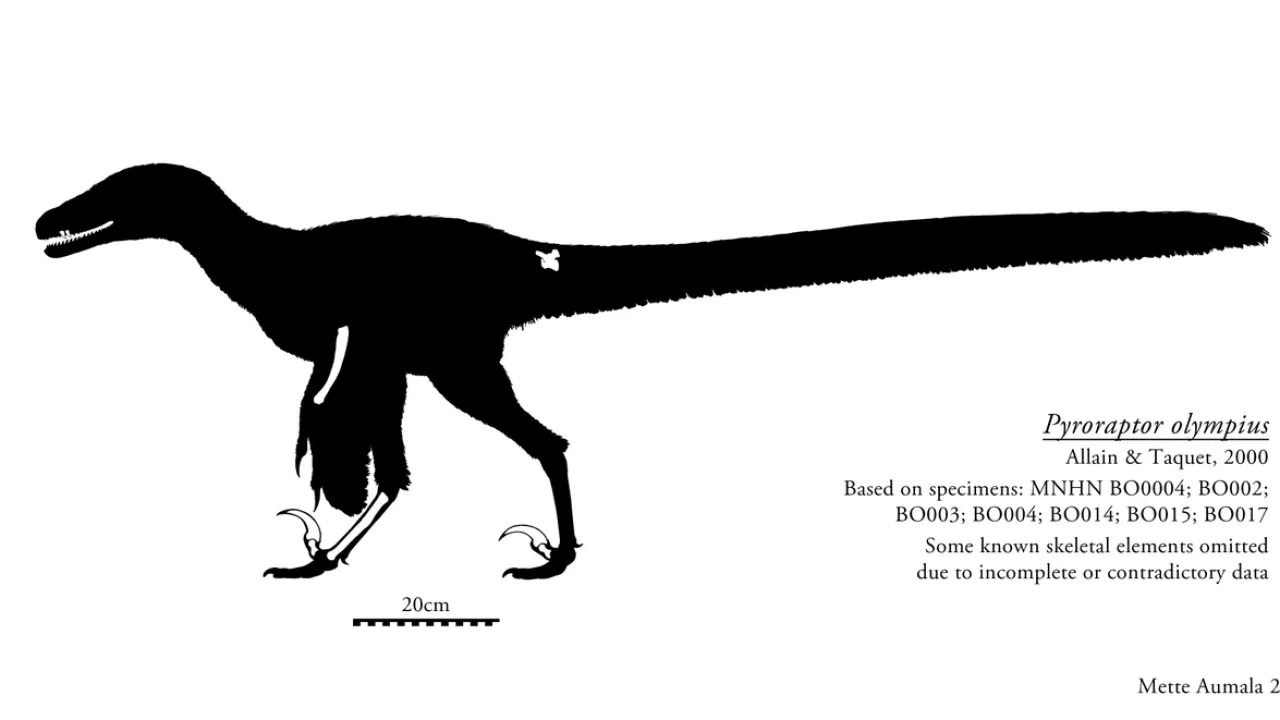
During Pyroraptor's lifetime, rising seas turned Europe into a tropical archipelago of islands rather than one solid continent!
✨ Word Sparks (Grade 2 Glossary)
Tap 🔊 to hear
Agile
Able to move quickly and turn easily
Sickle
Shaped like a sharp curved crescent hook
Archipelago
A large group or chain of islands
🪝
How did a wildfire in France help scientists meet a brand-new feathered dinosaur?
1
An Island Hunter
Picture a chain of warm green islands where modern Europe sits today. About seventy million years ago, Pyroraptor darted through these coastal woods. Roughly as long as a sofa, it balanced with a stiff feathered tail while chasing lizards and small mammals.
2
Built Like a Bird
Although Pyroraptor could not fly, it looked remarkably bird-like. Long feathers fanned out from its arms and tail. On the second toe of each foot, it carried a curved claw more than two inches long to pin down slippery prey.
3
The Fire Discovery
In 1992, a brush fire burned away thick bushes on a rocky slope in Provence, France. Soon after, heavy rain washed clean dinosaur bones into view, giving Pyroraptor its unforgettable name: the fire thief!
1. Where on its body did Pyroraptor carry its special curved sickle claw?
2. What did Europe look like when Pyroraptor lived there?
🤯 Mind-Blowing Fact • Grade 3
Tiny ridges on Pyroraptor's ulna arm bone—called quill knobs—give scientists direct fossil clues that its forearms carried sturdy, bird-style feathers!
✨ Word Sparks (Grade 3 Glossary)
Tap 🔊 to hear
Dromaeosaurid
Family of swift feathered dinosaurs with toe claws
Serrated
Having tiny saw-like notches along an edge
Paleontologist
Scientist who studies ancient life using fossils
🪝
What secrets can just a handful of claws, teeth, and arm bones reveal about an island predator?
1
Dashing Across Ancient Provence
Flash back seventy million years to the Late Cretaceous Period! Warm shallow seas covered much of Europe, leaving sunny forested islands behind. Across the island that would become southern France, a sleek predator named Pyroraptor bounded over roots and ferns with bird-like grace.
2
Feathers and Sickle Claws
Pyroraptor belonged to the , the famous family of feathered raptors. Measuring about eight feet from snout to tail tip, it weighed roughly as much as a golden retriever. Its forearm bones show tiny bumps where long wing feathers anchored, helping it balance during sudden turns.
3
Tools of a Clever Hunter
When hunting lizards, baby dinosaurs, or small mammals, Pyroraptor relied on speed and grip. Backward-curved teeth with edges lined its jaws, while each foot held a raised 2.5-inch sickle claw ready to hold active prey steady.
4
Uncovered at Mount Olympe
named the species Pyroraptor olympius in 2000 after studying fossils exposed after a 1992 wildfire near Mount Olympe in France. Even from partial bones, its distinctive claw proved raptors thrived in prehistoric Europe!
1. How did wing feathers help Pyroraptor even though it could not fly?
2. Why was the species given the second name olympius?
🤯 Mind-Blowing Fact • Grade 4
Before Pyroraptor's skeleton fragments were described in 2000 by Ronan Allain and Philippe Taquet, scientists mostly knew European raptors only from scattered fossil teeth!
✨ Word Sparks (Grade 4 Glossary)
Tap 🔊 to hear
Counterbalance
Weight that keeps a moving body steady
Pennaceous
Feathers with stiff shafts and flat vanes
Subtropical
Warm climate zone just outside the tropics
🪝
How did feathered raptors adapt to life on isolated European islands during the Late Cretaceous?
1
Life on the Ibero-Armorican Island
Step onto a sun-dappled floodplain in Southern Europe 70.6 million years ago. Instead of one connected landmass, high Cretaceous sea levels divided Europe into lush islands. Pyroraptor olympius prowled the Ibero-Armorican island—modern France and Spain—sharing rivers and woodlands with dwarf titanosaurs, armored nodosaurids, and early birds.
2
Anatomy of a Feathered Sprinter
Measuring roughly 2.5 meters (8 feet) in length and weighing around 30 to 38 kilograms, Pyroraptor combined lightness with muscular power. Hollow bones reduced body weight without sacrificing strength, while bundled bony rods stiffened its tail into a dynamic . Bumps along its forearm bone indicate anchor points for wing feathers used for warmth, display, and stability while leaping.
3
Precision Hunting Mechanics
Rather than slashing wildly, dromaeosaurids like Pyroraptor likely used their enlarged, 6.5-centimeter (2.5-inch) sickle claws like a hawk's talons to pin nimble prey against the ground. Flapping its feathered forelimbs helped the dinosaur stay balanced atop struggling lizards or small vertebrates while its serrated, blade-shaped teeth finished the catch.
4
Clues from Ashes and Rain
For decades, European raptor fossils remained frustratingly rare, limited mostly to isolated teeth. That changed in 1992 when a forest fire cleared dense Mediterranean scrub near Mount Olympe in Provence, and autumn rains eroded sandstone layers to reveal claws, teeth, vertebrae, and limb bones—confirming dromaeosaurids hunted across Late Cretaceous Europe.
1. How do scientists think Pyroraptor mainly used its curved second-toe claw?
2. What natural events teamed up in 1992 to expose Pyroraptor's fossils?
🤯 Mind-Blowing Fact • Grade 5
Despite popular movie myths showing Pyroraptor diving underwater like a penguin, nothing in its sandstone fossils or light hollow-boned raptor anatomy suggests an aquatic lifestyle!
✨ Word Sparks (Grade 5 Glossary)
Tap 🔊 to hear
Osteological
Relating to the structure of bones
Biogeographic
How species spread across places over time
Theropod
Two-legged dinosaur group that includes modern birds
🪝
How can a single fragmented specimen transform our map of dinosaur evolution across prehistoric islands?
1
Predator of the European Archipelago
Seventy million years ago during the Campanian-Maastrichtian boundary of the Late Cretaceous, tectonic forces and elevated global sea levels flooded low-lying basins, transforming Europe into an expansive tropical archipelago. On the Ibero-Armorican landmass—spanning parts of modern France and Spain—island ecosystems fostered unique evolutionary communities. Darting through braided river channels and conifer-palm forests was Pyroraptor olympius, an agile dromaeosaurid finely tuned for mid-sized predation.
2
Skeletal Clues to Avian Kinship
Although paleontologists recovered only a partial skeleton—including diagnostic foot claws, two serrated teeth, arm and foot bones, and tail and back vertebrae—comparative anatomy unlocks a vivid portrait. Reaching roughly 2.5 meters (8 feet) long and weighing 30 to 38 kilograms, Pyroraptor possessed hollow, air-filled bones and an ulna bearing distinct ridges associated with quill knobs. These markers demonstrate that Pyroraptor carried structured wing and tail plumage closely resembling early paravian birds.
3
Biomechanics of Raptors in Action
Modern biomechanical research into dromaeosaurid locomotion—often termed 'raptor prey restraint'—clarifies how Pyroraptor hunted. Rather than disemboweling large herbivores, its strongly curved 6.5-centimeter pedal ungual on digit II functioned as a grappling hook. By pinning small archosaurs, mammals, or reptiles beneath its body weight and flapping its feathered forelimbs for balance, Pyroraptor maintained stability on uneven forest terrain.
4
Island Ecology and Resource Sharing
Island habitats limit living space and food supplies, causing many European herbivores like the titanosaur Ampelosaurus and the ornithopod Rhabdodon to evolve smaller body sizes than mainland relatives. Within this compact food web, Pyroraptor occupied the swift pursuit niche alongside larger abelisaurid predators such as Tarascosaurus, avoiding direct competition by targeting smaller, faster quarry.
5
From Wildfire Ash to Scientific Discovery
Discovered in 1992 after a wildfire stripped vegetation from sandstone outcrops at La Boucharde near Mount Olympe in Provence, the specimen was formally described in 2000 by French paleontologists Ronan Allain and Philippe Taquet. As the first definitively named dromaeosaurid skeleton from France, Pyroraptor bridged critical gaps across Late Cretaceous Eurasia.