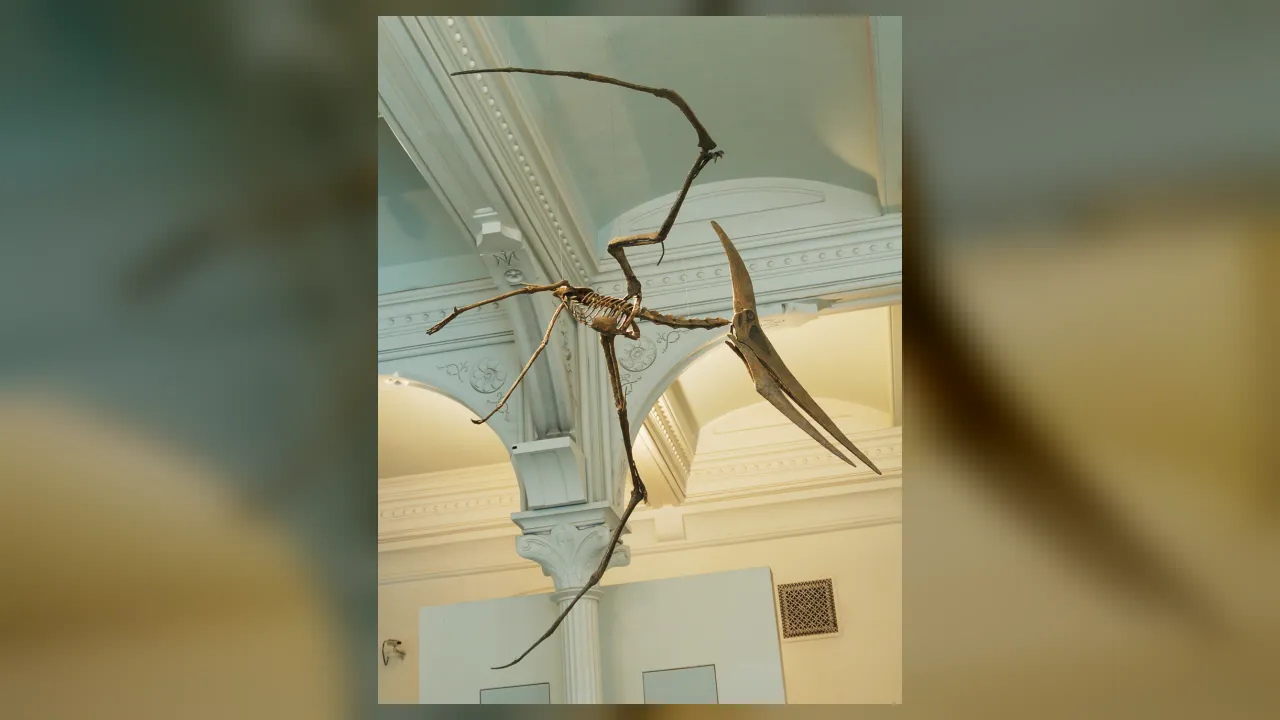
One famous Kansas fossil preserved a tidy ball of fish bones and scales right where Pteranodon's throat pouch or stomach once sat!
✨ Word Sparks (Grade 2 Glossary)
Tap 🔊 to hear
Chalk
Soft white limestone made from tiny sea shells
Pouch
Stretchy throat pocket for holding caught food
Colony
Large group of animals nesting close together
🪝
Did you know Kansas was once covered by a warm ocean where giant winged reptiles fished?
1
An Ocean Across America
Close your eyes and picture waves rolling across modern Kansas eighty-five million years ago! A warm shallow ocean called the Western Interior Seaway split North America right in two. High above the water glided hundreds of graceful Pteranodon.
2
Boys vs. Girls
Scientists studied more than one thousand Pteranodon fossils from Kansas beds and noticed two distinct sizes! Males grew twenty-foot wingspans and giant backward head crests, while females had twelve-foot wingspans, wider hips for laying eggs, and much smaller crests.
3
Floating Fishers
Like modern pelicans and gannets, Pteranodon likely settled onto the waves, dipped its long toothless beak underwater to snatch fish, and vaulted right off the water!
1. How could you tell a male Pteranodon apart from a female?
2. What covered Kansas when Pteranodon lived 85 million years ago?
🤯 Mind-Blowing Fact • Grade 3
Many Pteranodon fossils were buried in soft white sea chalk more than a hundred miles from the closest Cretaceous shoreline!
✨ Word Sparks (Grade 3 Glossary)
Tap 🔊 to hear
Pelagic
Living or feeding far out over open seas
Rudder
Flat blade used to steer a boat or plane
Albatross
Large seabird famous for ocean wind gliding
🪝
Why have paleontologists found over a thousand Pteranodon fossils hundreds of miles away from the nearest ancient beach?
1
Master of the Open Sea
Sweep across the sparkling Western Interior Seaway eighty-five million years ago! More than a hundred miles from shore, sleek shadows ride the ocean swells. Pteranodon longiceps was a true flyer—built like today's wandering to travel vast distances over open water without tiring.
2
Why That Giant Head Crest?
Early scientists wondered whether Pteranodon used its long backward crest as a steering in the air. Wind-tunnel tests later revealed a surprise: females flew wonderfully with tiny crests! That proved the huge male crest evolved mainly as a visual display badge to impress mates.
3
Paper-Thin Bones
Even with a twenty-foot wingspan, a large male weighed only fifty-five to ninety pounds. Air sacs filled its hollow wing bones, whose walls were barely as thick as a postcard!
4
First Found in 1870
Paleontologist Othniel Charles Marsh uncovered the first North American pterosaur bones in western Kansas chalk in 1870, naming toothless Pteranodon six years later.
1. How did scientists figure out Pteranodon's giant crest wasn't needed as a flight rudder?
2. Which modern seabird flies most like Pteranodon did?
🤯 Mind-Blowing Fact • Grade 4
Movie monsters often show Pteranodon carrying people in hawk-like talons, yet real Pteranodon had flat, human-like walking feet completely unable to grip prey!
✨ Word Sparks (Grade 4 Glossary)
Tap 🔊 to hear
Dimorphism
Clear size or shape differences between sexes
Aspect Ratio
Wing length compared against wing width
Plankton
Tiny drifting organisms floating in ocean water
🪝
How can over 1,200 Kansas chalk fossils reveal the family life, flight physics, and ocean hazards of a prehistoric reptile?
1
Best-Known Giant Pterosaur on Earth
Dive into the paleontological treasure chest of western Kansas's Smoky Hill Chalk! Eighty-five million years ago, microscopic shells snowed gently onto the floor of the Western Interior Seaway, entombing more than 1,200 specimens of Pteranodon. Thanks to paleontologist S. Christopher Bennett's landmark studies in the 1990s, scientists know more about Pteranodon's growth and anatomy than almost any other pterosaur.
2
Dramatic Sexual Dimorphism
Sorting hundreds of skeletons revealed two distinct adult body plans buried side by side, with females outnumbering males roughly two to one! Adult males reached 5.5 to 7 meters (18 to 23 feet) in wingspan and sported sweeping cranial crests nearly 80 centimeters long. Adult females spanned around 3.8 meters (12.5 feet), carried compact crests, and possessed a wide pelvic canal for passing leathery-shelled eggs.
3
Dynamic Soaring and Surface Dipping
With high-aspect-ratio wings nine times longer than wide, Pteranodon excelled at dynamic and slope soaring along wave fronts at gentle speeds. Rather than snatching Triceratops with bird-like talons as movies once showed—its flat, weakly curved feet could not grasp heavy objects at all!—it alighted on calm swells like a pelican, dipping its upward-curved beak after schooling fish.
4
Predators Beneath the Waves
Floating offshore carried real danger: fossil shark teeth from Cretoxyrhina have been found wedged directly into Pteranodon neck vertebrae, capturing dramatic marine encounters frozen in stone!
1. Why couldn't a real Pteranodon pick up prey in its feet like an eagle?
2. What fossil clue proves giant prehistoric sharks sometimes ambushed Pteranodon floating on the sea surface?
🤯 Mind-Blowing Fact • Grade 5
Older rock layers in Kansas preserve an earlier species, Pteranodon sternbergi, whose head crest pointed almost straight UP like a giant sail instead of sweeping backward!
✨ Word Sparks (Grade 5 Glossary)
Tap 🔊 to hear
Morphometric
Measuring bone shapes mathematically to compare species
Rookery
Crowded breeding colony of seabirds or reptiles
Wing Loading
Body weight divided by total wing area
🪝
How did statistical analysis of 1,200 Niobrara Chalk skeletons overturn a century of confusion over Pteranodon species, gender, and flight?
1
Pelagic Icon of the Niobrara Chalk
Between 86 and 84.5 million years ago during the late Coniacian to early Campanian stages of the Late Cretaceous, calcareous coccolithophore ooze accumulated across the floor of North America's Western Interior Seaway, forming the Smoky Hill Chalk of Kansas. First collected by Othniel Charles Marsh in 1870 and named Pteranodon ('toothless wing') in 1876, this marine reptile became the first toothless pterosaur known to science and remains represented by over 1,200 cataloged specimens.
2
Resolving Taxonomy and Sexual Dimorphism
For over a century, paleontologists named nearly a dozen separate Pteranodon species based on differing crest shapes and wingspans. In the 1990s, S. Christopher Bennett conducted exhaustive analyses demonstrating that differences within each rock layer reflected age and dramatic sexual dimorphism rather than extra species! Mature males spanned 5.6 to 7 meters with elongated frontoparietal crests, whereas smaller 3.8-meter females possessed spacious pelvic canals and modest crests—a skewed 1:2 sex ratio pointing to polygynous coastal rookeries.
3
Chronospecies Through Time
Across roughly two million years of chalk deposition, older strata preserve Pteranodon sternbergi, whose males bore tall, upright bulbous crests, while younger layers preserve Pteranodon longiceps with its classic sleek, backward-swept blade crest—documenting evolutionary change directly up the cliff face.
4
Aerodynamics and Water-Launch Mechanics
Ultra-pneumatic bones with cortical walls barely one millimeter thick kept even a 6.5-meter male near 35 kilograms. High-aspect-ratio wings paired with low enabled low-speed thermal and wave-slope gliding far from land. Biomechanical models by Michael Habib show Pteranodon could alight on ocean swells to plunge-dip for fish, then execute a powerful quadrupedal water-launch by slapping its webbed hands and forelimbs downward against surface tension.
5
Role in the Cretaceous Marine Web
Regurgitated fish-bone pellets, spiral coprolites, and fossils bearing bite marks from Cretoxyrhina sharks and Xiphactinus fish anchor Pteranodon squarely inside a vibrant pelagic food web.