2. What stood straight up along the top of a Psittacosaurus tail?
🤯 Mind-Blowing Fact • Grade 2
One famous rock slab from Liaoning preserved 34 tiny Psittacosaurus babies huddled right beside one protective older dinosaur!
✨ Word Sparks (Grade 2 Glossary)
Tap 🔊 to hear
Pigment
Natural tiny grains that give skin color
Gizzard
Muscular stomach part that grinds up food
Juvenile
A young animal that is still growing
🪝
How do scientists know the exact brown camouflage pattern on Psittacosaurus's face and belly?
1
Asia's Most Common Dinosaur
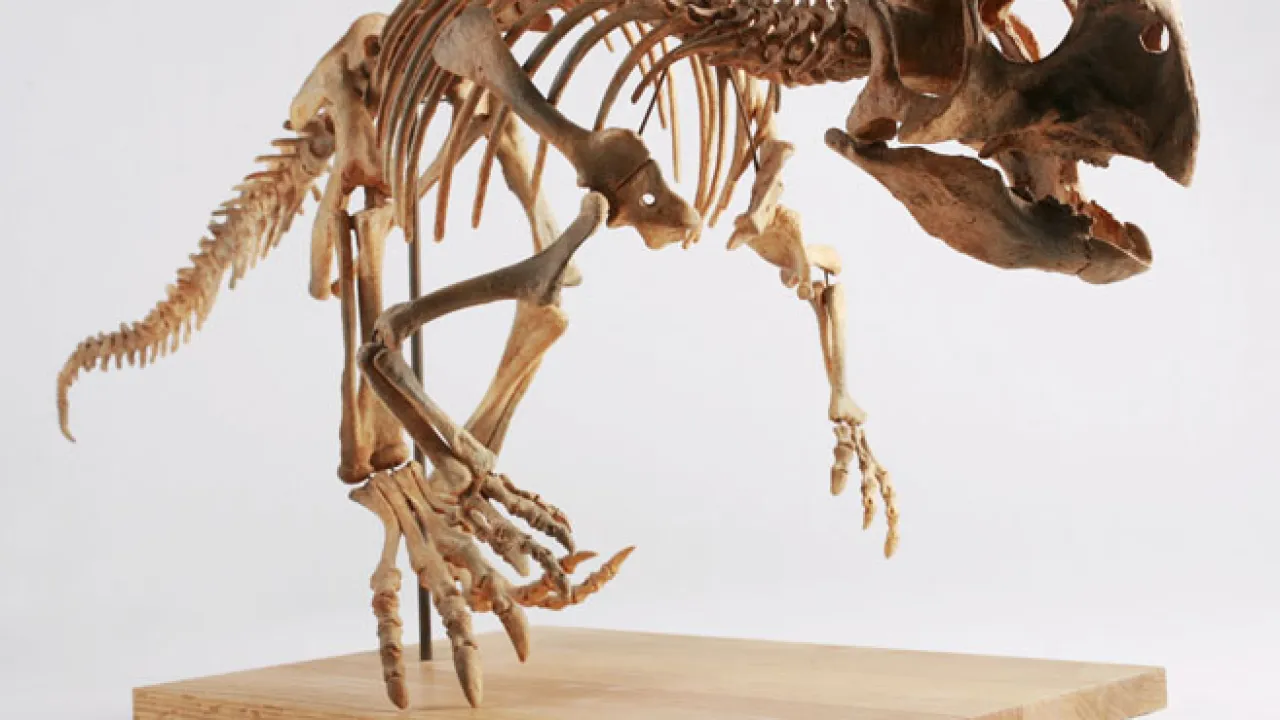
Dash through a dim Early Cretaceous forest in China 120 million years ago, and you would spot Psittacosaurus everywhere! Hundreds of fossils make this six-foot 'parrot lizard' one of the best-known dinosaurs on Earth.
2
Gizzard Stones and Nut Crackers
Its tall, hooked beak cracked hard seeds and fibrous leaves, while four grasping fingers held branches steady. Because its teeth could not grind food into paste, adults swallowed over fifty smooth stones to mash tough nuts inside their stomachs!
3
Painted in Forest Shadows
One incredible fossil kept dark color across its scales! Scientists saw it had a dark brown back, a pale tummy, dark face masks, and a cluster of tall tail bristles.
1. How did Psittacosaurus mash up hard seeds after cracking them with its beak?
2. How did Psittacosaurus's walking style change as it grew up?
🤯 Mind-Blowing Fact • Grade 3
Over 400 individual Psittacosaurus fossils have been discovered across China, Mongolia, Russia, and Thailand—more than almost any other dinosaur genus!
✨ Word Sparks (Grade 3 Glossary)
Tap 🔊 to hear
Melanosome
Microscopic cell packet holding dark color pigment
Canopy
Leafy roof formed by tall forest trees
Biped
An animal that walks on two legs
🪝
What happened when scientists shone laser light onto a 120-million-year-old Psittacosaurus fossil?
1
Grandparent of Horned Giants
Picture an animal the weight of a golden retriever sprinting on two legs, sporting flared cheek horns, a nut-cracking parrot beak, and a Mohawk of bristles on its tail! Living across Asia for 25 million years, Psittacosaurus sits near the base of the ceratopsian family tree that later produced Triceratops.
2
Laser-Revealed Forest Cloak
In 2016, scientist Jakob Vinther beamed safe laser light onto a Psittacosaurus fossil with preserved skin scales. Tiny color packages called glowed clearly, showing dark brown back scales that faded gradually low on its sides—a textbook match for dappled light beneath a closed forest !
3
Daycare in the Burrow
Young Psittacosaurus stuck together for safety: one volcanic mudflow trapped 34 juveniles alongside a subadult guardian, suggesting older siblings or helpers babysat groups of youngsters!
4
Crawlers Become Runners
Measuring arm and leg bones across dozens of ages proved hatchlings scurried on all fours until age four, when longer hind legs turned them into swift .
1. What habitat did Psittacosaurus's gradual camouflage pattern prove it lived in?
2. Why had giant mammal-like predators even learned to hunt baby Psittacosaurus?
🤯 Mind-Blowing Fact • Grade 4
In 2024, microscope X-rays of Psittacosaurus skin revealed two layers—bird-like outer feathers around its tail bristles AND tough reptile-style scales over the rest of its body!
✨ Word Sparks (Grade 4 Glossary)
Tap 🔊 to hear
Fluorescence
Glowing brightly when hit by special light
Quadruped
An animal that walks on four limbs
Jugal
Cheekbone framing the lower eye socket
🪝
How did lighting physics on a life-sized dinosaur model reveal the exact forest canopy above Early Cretaceous China?
1
Twenty-Five Million Years of Success
First named in 1923 by Henry Fairfield Osborn from Mongolian skeletons, Psittacosaurus became one of the longest-lasting and most species-rich dinosaur genera in history, spanning roughly 126 to 101 million years ago across Asia. With up to a dozen recognized species differing subtly in skull proportions and flared cheek horns, these two-meter basal ceratopsians thrived alongside feathered theropods and early mammals.
2
Reverse-Engineering Dinosaur Camouflage
Specimen SMF R 4970 from Liaoning preserves near-complete polygonal skin scales, umbilical-like belly scar tissue, and 16-centimeter hollow cylindrical bristles along the dorsal tail. Using laser-stimulated , paleobiologist Jakob Vinther and paleoartist Bob Nicholls mapped every pigment zone onto a 3D life-sized sculpture, then photographed gray reference models outdoors! Under open sunny skies, sharp shadows require high-waisted color transitions, whereas Psittacosaurus's low, gradual countershading neutralized shadows only under closed conifer and ginkgo forest canopies.
3
Postural Shift From Quadruped to Biped
In 2019, biomechanical modeling and bone histology by Qi Zhao and colleagues tracked how Psittacosaurus lujiatunensis changed locomotion as it grew. Hatchlings emerged with muscular, fast-growing forelimbs and walked on all fours until age three; between ages four and six, forelimb growth slowed dramatically while hindlimbs lengthened, shifting adults to agile bipedal running!
4
Caring Creches Against Predators
Buried volcanic tuffs in the Lujiatun beds preserved 34 coherent juveniles clustered around an older six-year-old helper—a survival strategy against predators ranging from feathered tyrannosauroids to carnivorous mammals like Repenomamus.
1. How did scientists test whether Psittacosaurus lived in open plains or shady forests?
2. What does the postural shift of Psittacosaurus reveal about ceratopsian evolution?
🤯 Mind-Blowing Fact • Grade 5
Microscopic synchrotron scans in 2024 discovered fossilized skin cells preserved in glassy silica on Psittacosaurus, showing how early dinosaurs kept protective scales while experimenting with feather-like tail bristles!
✨ Word Sparks (Grade 5 Glossary)
Tap 🔊 to hear
Propalinal
Sliding the lower jaw backward while chewing
Crypsis
Ability of an animal to avoid detection
Heterochronic
Shifting the timing or rate of growth
🪝
Why is Psittacosaurus hailed by paleobiologists as the single most completely understood non-avian dinosaur on Earth?
1
Unrivaled Fossil Sample Across Asia
Spanning the Barremian through Albian stages of the Early Cretaceous (126 to 101 million years ago), Psittacosaurus radiated into nearly a dozen valid species across China, Mongolia, Siberia, and Thailand. Represented by more than 400 articulated skeletons—from embryonic stages to ten-year-old adults—this two-meter, 20-kilogram basal neoceratopsian offers statistical sample sizes rarely seen in vertebrate paleontology.
2
Cranial Biomechanics and Gastrolith Milling
Diagnostic of Ceratopsia, a tall, triangular rostral bone capped the upper jaw opposite a scoop-like predentary, creating self-sharpening nut-cracking shears flanked by laterally flaring jugal bosses. Unlike later ceratopsids with multi-row dental batteries, Psittacosaurus performed an imprecise (fore-and-aft) jaw stroke with simple ridged teeth, delegating final mechanical trituration of tough seeds and gymnosperm fibers to gastric mills packed with over 50 quartz gastroliths.
3
Laser Fluorescence, Countershading, and Dual Skin
Extraordinary Jehol specimen SMF R 4970 preserves soft-tissue outlines, a row of ~100 hollow, 16-centimeter keratinous tail bristles, the first meticulously mapped dinosaur cloaca, and melanosome-rich scales. In 2016, Jakob Vinther's team combined laser-stimulated fluorescence with outdoor 3D-radiance experiments, proving its low-gradient countershading, pigmented ankles, and facial masks optimized inside closed-canopy temperate forests. Further UV and X-ray histology in 2024 by Zixiao Yang and colleagues revealed zoned silica-preserved skin cells containing corneous beta-proteins around feathered regions alongside scaly reptilian epidermis elsewhere!
4
Ontogenetic Locomotor Transition
Osteohistological growth series combined with center-of-mass modeling by Qi Zhao and Andrew Cuff (2013–2019) demonstrated limb growth: hatchlings hatched with robust, positively growing forelimbs for quadrupedal scrambling, then decelerated forelimb elongation after age three to become obligate bipeds with four-fingered grasping hands as adults.
5
Social Creches in Volcanic Tuffs
Lahar-like volcanic mudflows in Liaoning's Lujiatun Member entombed intact social clusters—such as 34 juveniles alongside an older subadult—confirming communal alloparental creches that buffered young Psittacosaurus against predators like Yutyrannus and the carnivorous mammal Repenomamus robustus.