2. Where did Protoceratops live during the Late Cretaceous?
🤯 Mind-Blowing Fact • Grade 2
One famous fossil caught a brave Protoceratops and a Velociraptor locked together when a sudden sand dune collapsed over both of them!
✨ Word Sparks (Grade 2 Glossary)
Tap 🔊 to hear
Oasis
A green spot with water in deserts
Legend
An old story passed down for centuries
Jaw
Bones framing the mouth for biting food
🪝
Did ancient desert travelers mistake Protoceratops fossils for mythical griffins?
1
First Horned Face
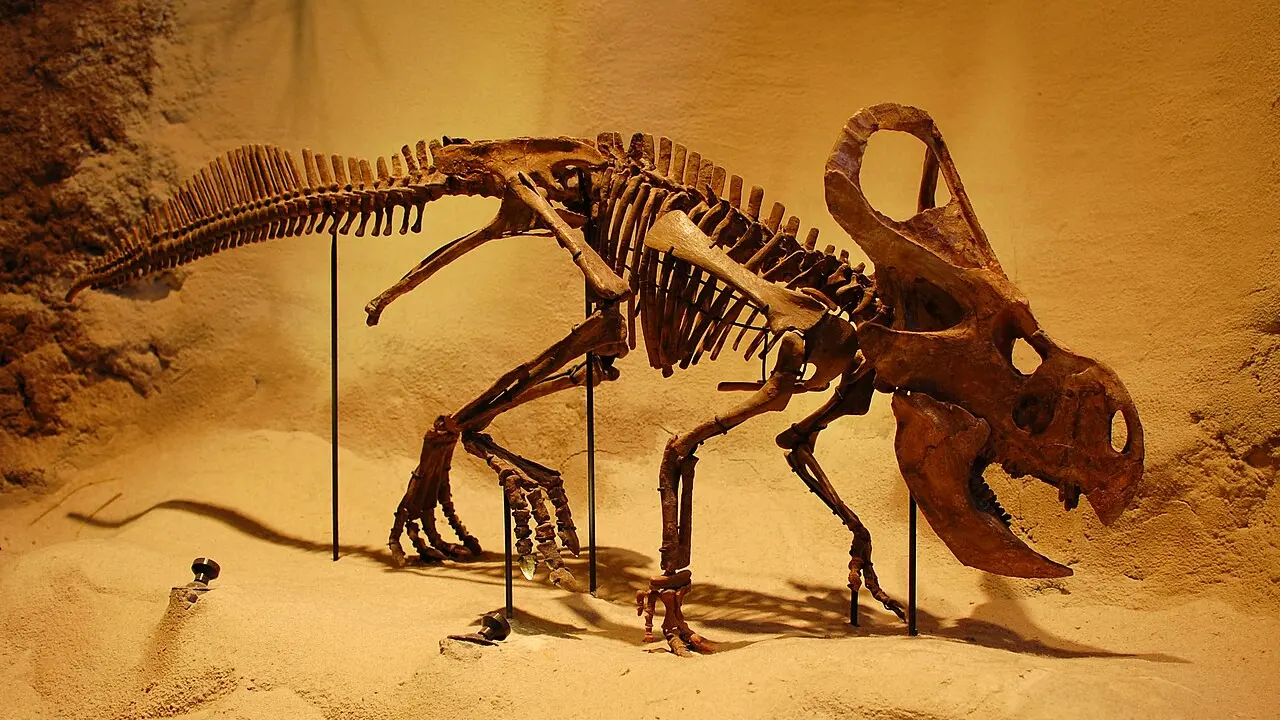
Swirling orange sand dunes stretched across Mongolia 73 million years ago. Trotting toward a shady comes Protoceratops, whose name means 'first horned face'! Even without long horns, this cousin of Triceratops sported a broad bony neck frill.
2
Super Snipping Beak
Tough desert bushes were no match for its deep, hooked beak! Strong muscles attached right onto its neck frill, giving Protoceratops a mighty bite for slicing woody stems.
3
Legends in White Bone
Bright white Protoceratops skeletons pop right out of red Gobi cliffs. Historians think ancient gold miners saw its beak and frill and imagined the legendary lion-eagle Griffin!
1. How did the bony frill help Protoceratops eat tough desert plants?
2. Which mythical creature may have been inspired by white Protoceratops skulls in red rocks?
🤯 Mind-Blowing Fact • Grade 3
Fifteen tiny baby Protoceratops skeletons were found huddled together facing the exact same direction inside a single Gobi nest bowl!
✨ Word Sparks (Grade 3 Glossary)
Tap 🔊 to hear
Forage
To search around for wild plants to eat
Crepuscular
Active mostly at dawn, dusk, or twilight
Sandstone
Rock formed from layers of pressed sand
🪝
What happened when a collapsing sand dune froze Protoceratops and Velociraptor in time?
1
Survivor of the Flaming Cliffs
Squint against the blazing sun at Mongolia's Flaming Cliffs, where crimson hold secrets from 73 million years ago. Back then, Protoceratops roamed dry dunes and scrubby oases in lively herds, growing from tiny six-inch hatchlings into sturdy 180-pound adults.
2
Built for Day and Dusk
Huge bony rings inside its eye sockets supported extra-large eyes! Those keen eyes let Protoceratops during cool desert evenings and spot sneaky predators hiding behind dunes. Its tall, flat-sided tail also looked wide like an alligator's.
3
The Fighting Dinosaurs Fossil
In 1971, Polish and Mongolian scientists uncovered one of the greatest fossils ever found: a Protoceratops clamping its powerful beak onto a Velociraptor's arm right as a rain-soaked sand dune buried them both!
4
Growing Up Frilled
With over a hundred skeletons from babies to elders, paleontologists watched how Protoceratops's frill grew wider and taller as it reached adulthood to signal herdmates.
1. What do the huge eye sockets of Protoceratops suggest about its daily schedule?
2. What famous 1971 discovery proved Protoceratops could defend itself fiercely?
🤯 Mind-Blowing Fact • Grade 4
For 70 years museums blamed Oviraptor for stealing Protoceratops eggs, until an embryo inside an identical egg in 1993 proved Oviraptor was actually sitting on its own nest!
✨ Word Sparks (Grade 4 Glossary)
Tap 🔊 to hear
Scleral
Bony ring supporting the shape of eyeballs
Cathemeral
Active at intervals during day and night
Rostral
Unique front beak bone of horned dinosaurs
🪝
Why did an expedition hunting for early humans stumble upon whole nurseries of Protoceratops instead?
1
Roy Chapman Andrews and the Gobi
In 1922, explorer Roy Chapman Andrews led motorcars into Mongolia's remote Gobi Desert. At the red sandstone bluffs he named the Flaming Cliffs, photographer J.B. Shackelford spotted a small horned skull jutting from the rock—Protoceratops andrewsi! Nearby lay spiral rings of fossilized dinosaur eggs, though scientists later realized the famous nests just feet away actually belonged to brooding Oviraptor mothers rather than egg-thieves.
2
Anatomy of a Desert Specialist
Thriving in an arid Late Cretaceous landscape demanded clever adaptations. Protoceratops possessed a deep beak backed by vertically slicing tooth batteries, powered by jaw muscles threaded through two large openings (fenestrae) in its parietal frill. Measurements of its eye rings indicate activity—grazing across both day and cool night hours to avoid scorching desert heat.
3
Display Frills and Tall Tails
High neural spines rose atop its tail vertebrae, forming a tall, laterally flattened fan behind its hips. Paired with a neck frill that expanded dramatically only as juveniles reached maturity, these billboards helped herd members recognize one another and compete for mates without dangerous horn jousting.
4
Frozen in Dune Collapses
Sudden sandstorms and rain-saturated dune avalanches buried entire family groups alive—including a 2011 discovery of fifteen sibling babies nestled in a sandy bowl, and the legendary 1971 Fighting Dinosaurs specimen.
1. How did paleontologists know Protoceratops's frill was used for social display as well as jaw muscles?
2. What cleared Oviraptor of the old accusation that it stole Protoceratops eggs at the Flaming Cliffs?
🤯 Mind-Blowing Fact • Grade 5
In 2016, paleontologists discovered the first true soft-shelled Protoceratops egg clutch containing tiny curled embryos—explaining why hard Protoceratops eggshells had seemed mysteriously rare for ninety years!
✨ Word Sparks (Grade 5 Glossary)
Tap 🔊 to hear
Eolian
Shaped, carried, or piled up by wind
Allometry
Body parts growing faster than overall size
Gregariousness
Instinct to live together in social groups
🪝
How did over a hundred Gobi skeletons make Protoceratops one of science's richest windows into dinosaur ontogeny, behavior, and ecology?
1
Abundance in the Djadochta Dunes
Between 75 and 71 million years ago during the Campanian stage of the Late Cretaceous, dune fields and ephemeral interdune oases stretched across southern Mongolia and Inner Mongolia. Within the orange-red sandstones of the Djadochta Formation, Protoceratops andrewsi accounts for roughly 70 to 80 percent of all recovered macrovertebrate fossils! Measuring 1.8 meters (6 feet) long and weighing around 82 kilograms, this sheep-sized neoceratopsian dominated its arid ecosystem.
2
Masticatory Mechanics and Nocturnal Vision
Lacking the elongated brow and nasal horns of giant North American ceratopsids, Protoceratops carried paired rugose nasal bosses and flared jugal cheekbones. Its hooked rostral bone and lower predentary formed precision shears backed by vertical cheek teeth, driven by adductor jaw musculature anchoring across its fenestrated parietal-squamosal frill. In 2011, Lars Schmitz and Ryosuke Motani analyzed its wide scleral rings and bony orbits, demonstrating scotopic light sensitivity suited for cathemeral foraging during cool desert nights as well as daytime.
3
Ontogenetic Allometry and Socio-Sexual Signaling
Because episodic sand-dune collapses entombed intact cohorts from 15-centimeter neonates to senescent adults, biometric studies by David Hone and colleagues charted complete ontogenetic trajectories. Positive caused the neck frill and nasal prominence to widen disproportionately at sexual maturity—strong evidence of visual display alongside tall, neural-spined tails—while subtle skull differences hinted at two distinct morphs.
4
Parental Care and Direct Combat Evidence
In 2011, researchers described a circular nest bowl containing fifteen articulated juvenile Protoceratops aligned parallel against blowing sand, signaling prolonged post-hatching . Equally iconic is the 1971 'Fighting Dinosaurs' specimen from Tugrikin Shireh, where an adult Protoceratops crushed the right forearm of a slashing Velociraptor mongoliensis inside its beak seconds before a fluidized dune slump entombed both combatants.
5
Cultural Echoes and Evolutionary Legacy
Discovered during the American Museum of Natural History's 1922 Central Asiatic Expeditions and described by Walter Granger and William K. Gregory in 1923, Protoceratops bridged small bipedal basal ceratopsians like Psittacosaurus with multi-ton horned giants—and, according to folklorist Adrienne Mayor, likely inspired ancient Scythian nomads' legends of gold-guarding Griffins.