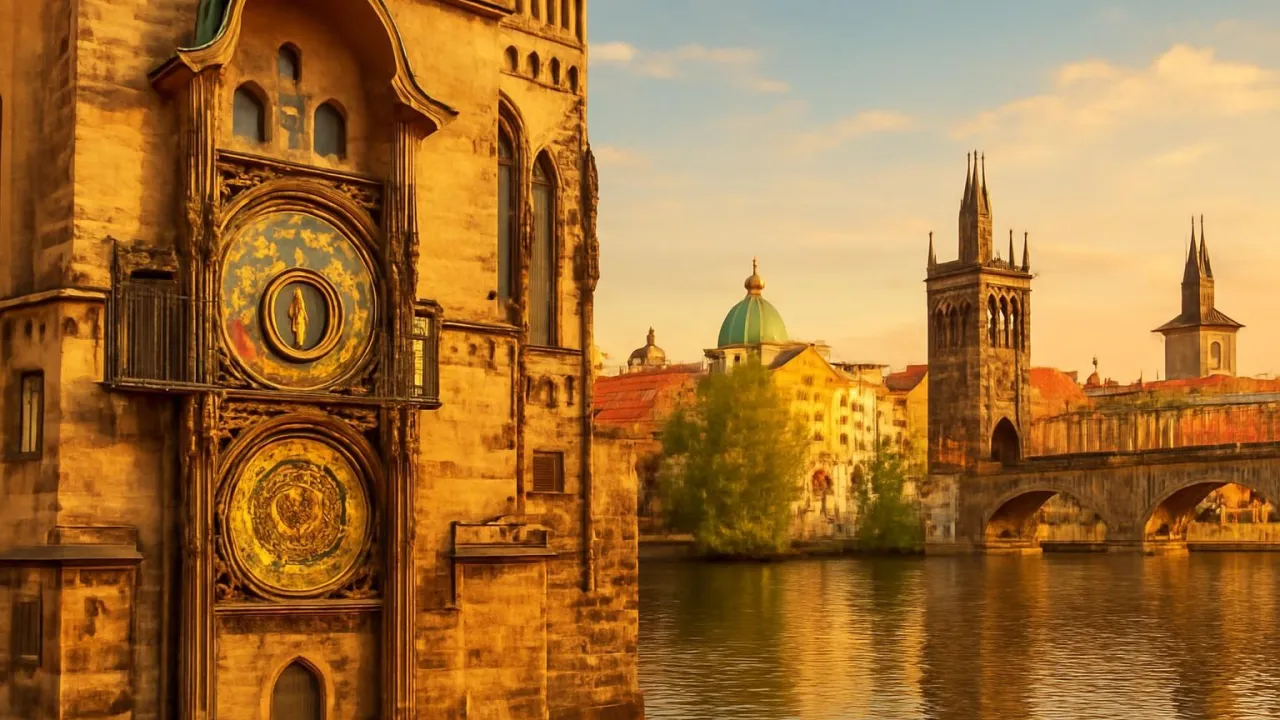
Can you imagine a clock that tells time with moving statues?
1
A Clock Full of Surprises
Every hour, the clock’s doors open and little move. People gather to watch the show, and the clock’s ring out. The golden hands point to the time and the sun and moon.
2
A Bridge Across the River
The Charles Bridge is made of stone and has many arches. People walk across it to see the city and watch boats sail below. and musicians often play on the bridge, making it lively and fun.
3
A Place for Visitors
At night, the clock glows and the bridge shines with lights. Many people take pictures and enjoy the view of the old city. Prague’s clock and bridge are famous all over the world.
The Astronomical Clock is the oldest one still working in the world.
✨ Word Sparks (Grade 3 Glossary)
Tap 🔊 to hear
gear
A wheel with teeth that turns
zodiac
Star signs like Leo or Taurus
erosion
Wearing away by water or wind
🪝
What secrets do the clock’s gears and the bridge’s arches keep?
1
A Clock That Shows the Sky
The Prague Astronomical Clock does more than tell time—it shows the sun, moon, and stars. Every hour, turn and statues parade, making the clock come alive for visitors. The golden face is covered in symbols for days, months, and signs. This clock has ticked for over six centuries, powered by clever medieval engineering.
2
The Mighty Charles Bridge
Charles Bridge stretches across the Vltava River with sixteen strong stone arches. Each arch helps spread the bridge’s weight, letting it stand for hundreds of years. Statues of saints line the bridge, watching over travelers and artists. The bridge connects the city’s Old Town to the grand Prague Castle.
3
How Do They Work?
The clock’s and weights use gravity and vibration to move its hands and statues. The bridge’s stone blocks are locked together in arches, which resist the river’s force and . Both landmarks were built with tools and teamwork, using knowledge passed down through generations. They show how science and art can work together to create wonders.
4
A Place for Everyone
Today, people from around the world visit Prague to see the clock and bridge. Musicians play tunes that echo under the arches, and the clock’s chimes ring through the square. The city celebrates these landmarks with festivals and light shows. Both the clock and bridge remind us of the power of imagination and invention.
The Charles Bridge was built using egg yolks mixed into the mortar for extra strength.
✨ Word Sparks (Grade 4 Glossary)
Tap 🔊 to hear
counterweight
A heavy object that balances a machine
scaffolding
Temporary structure for workers to stand on
heritage
Things from the past we protect and remember
🪝
Imagine hearing ancient bells ring and feeling stone arches beneath your feet—how did these wonders last so long?
1
The Astronomical Clock’s Marvelous Mechanics
Prague’s Astronomical Clock is a masterpiece of medieval engineering, blending art and science in one tower. Its gears, weights, and use gravity and vibration to drive the hands, statues, and astronomical dials. Every hour, a parade of carved figures, including the Twelve Apostles, circles the clock face as bells chime. The clock also tracks the sun, moon, and zodiac, making it both a timepiece and a cosmic calendar.
2
Charles Bridge: Strength in Stone
The Charles Bridge was built with sandstone blocks and supported by sixteen pointed arches, each designed to resist the river’s powerful currents. Medieval builders used wooden and stone-cutting tools, carefully shaping each block to fit the arch’s curve. Statues of saints and kings were added over centuries, turning the bridge into an open-air gallery. The bridge has withstood floods, wars, and centuries of foot traffic thanks to its clever design.
3
Enduring Through Time
Both landmarks have survived for over 600 years because of their strong construction and regular repairs. The clock’s gears are oiled and cleaned, while the bridge’s stones are checked for cracks and erosion. Engineers and historians work together to preserve these treasures, using both old and new technology. Their survival teaches us about resilience, teamwork, and the importance of protecting our .
4
A Global Legacy
Millions of visitors come to Prague each year to witness the clock’s show and stroll across Charles Bridge. Musicians, artists, and festival-goers fill the area with life, making it a center for culture and celebration. The clock and bridge are symbols of Prague’s history and creativity, inspiring people everywhere to dream, build, and explore. Their story is a reminder that great ideas can last for centuries.
The Prague Astronomical Clock’s main dial can track Old Czech Time, Central European Time, and Babylonian hours all at once.
✨ Word Sparks (Grade 5 Glossary)
Tap 🔊 to hear
camshaft
A rod that controls moving parts in a machine
compression
A force that pushes or squeezes things together
constellation
A group of stars forming a pattern
🪝
If you could step back in time, what would you discover about the world’s oldest working astronomical clock and the stone bridge that shaped a city?
1
Engineering Wonders of Medieval Prague
The Prague Astronomical Clock and Charles Bridge stand as extraordinary examples of medieval engineering ingenuity and artistic achievement. Installed in 1410, the clock’s intricate system of gears, levers, and counterweights enables it to display not just the hour, but also the positions of the sun, moon, and zodiac . The Charles Bridge, constructed between 1357 and 1402, features sixteen Gothic arches, each precisely calculated to distribute weight and withstand the powerful currents of the Vltava River.
2
Mechanics and Materials: How They Work
The Astronomical Clock’s mechanism relies on a series of interlocking bronze gears and iron axles, which transmit force from descending weights. The clock’s astronomical dial rotates to indicate solar and lunar phases, while animated figures emerge on the hour, thanks to a carefully timed system. The Charles Bridge’s arches employ the principles of and keystone locking, using sandstone blocks bonded with a mortar mixture that, according to legend, included egg yolks for added cohesion and durability.
3
Historical Evolution and Restoration
Both landmarks have witnessed centuries of change, surviving wars, floods, and social upheaval. The clock has been restored multiple times, with major repairs in the 19th and 20th centuries to replace worn gears and restore the original astronomical functions. The bridge has undergone reinforcement after devastating floods, with modern engineers using laser mapping and non-invasive sensors to monitor structural health and prevent erosion. These efforts ensure the longevity and historical accuracy of Prague’s treasures.
4
Cultural and Scientific Impact
The Astronomical Clock is not only a timekeeper but also an educational instrument, teaching generations about astronomy, mechanics, and the medieval worldview. Charles Bridge has served as a vital artery for trade, art, and community, hosting markets, parades, and celebrations for over 600 years. Both structures have inspired countless artists, scientists, and travelers, symbolizing the fusion of science, art, and civic pride in Central Europe.
5
Legacy for the Future
Today, the clock and bridge attract millions of visitors annually, contributing to Prague’s status as a UNESCO World Heritage site and a global center for culture and learning. Preservationists and engineers continue to study and maintain these landmarks, using both traditional craftsmanship and advanced technology to safeguard them for future generations. Their enduring presence demonstrates how human creativity and collaboration can produce wonders that transcend time and inspire the world.