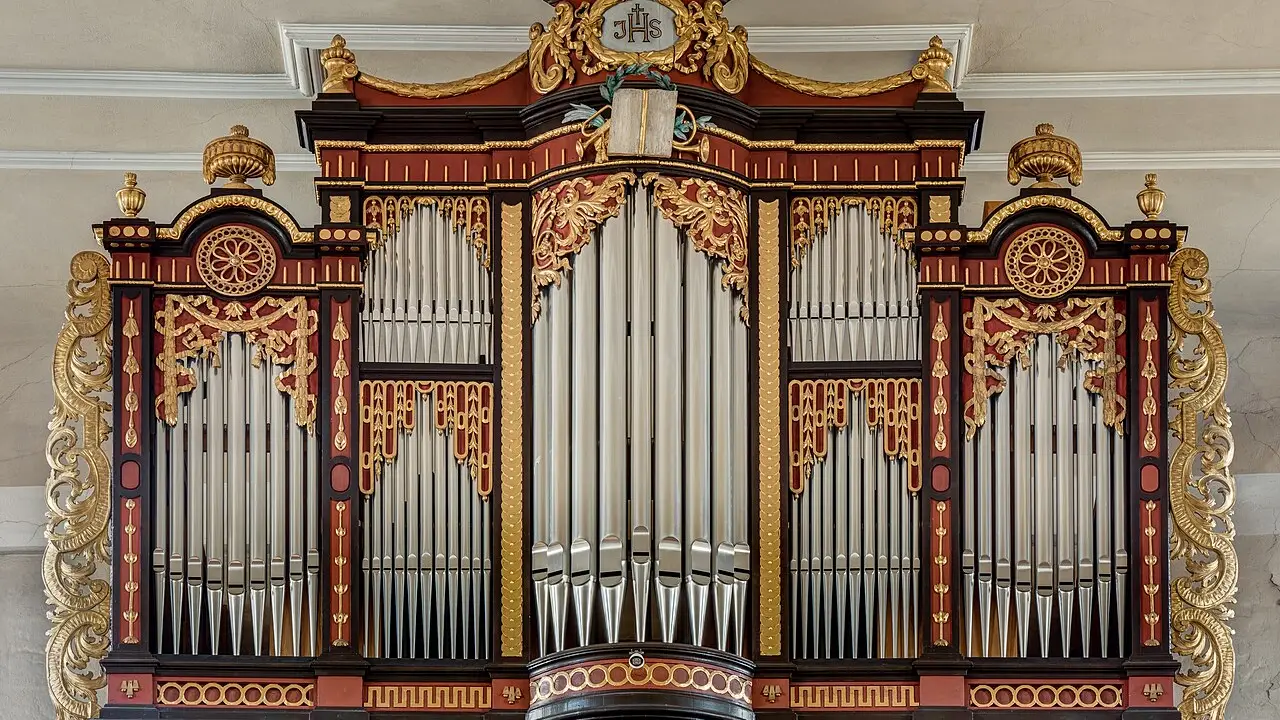
1. What flows through an organ's pipes to make them sing?
2. How does an organist play deep bass notes while both hands are busy on the keyboards?
🤯 Mind-Blowing Fact • Grade 2
Before electric blowers were invented, strong helpers called 'calcants' had to pump giant leather bellows by hand or foot behind the scenes just to keep the organ supplied with wind!
✨ Word Sparks (Grade 2 Glossary)
Tap 🔊 to hear
stops
Knobs that turn whole groups of pipes on
ranks
Matching rows of pipes sharing one tone color
bellows
Folding air bags that pump steady wind
🪝
Why did Wolfgang Amadeus Mozart call the pipe organ 'the king of instruments'?
1
An Orchestra Built Into the Wall
Brrrrr-OOOOOM! Imagine pressing a single chord and hearing flutes, trumpets, strings, and floor-shaking bass thunder roar out of the walls all at once! No wonder composer Mozart crowned the pipe organ the king of all musical instruments.
2
One Pipe for Every Single Sound
Unlike a flute that changes notes with finger holes, each organ pipe plays only one exact pitch and one tone color! To unlock different voices, an organ holds dozens of pipe families called , fed with steady wind from electric blowers below.
3
Pulling Out All the Stops
Sitting at a control desk with stacked keyboards and foot pedals, the organist pulls round knobs called to switch pipe on—giving us the famous saying 'pulling out all the stops'!
1. How many different musical pitches can a single organ pipe play?
2. Where does the everyday phrase 'pulling out all the stops' come from?
🤯 Mind-Blowing Fact • Grade 3
The Boardwalk Hall Auditorium Organ in Atlantic City, New Jersey, holds over 33,000 pipes—including a sixty-four-foot bass pipe so deep (8 hertz) you feel it shaking your chest more than you hear it!
✨ Word Sparks (Grade 3 Glossary)
Tap 🔊 to hear
manuals
Stacked keyboards played with the organist's hands
windchest
Pressurized wooden box feeding air under pipes
hydraulis
Ancient water-pressurized ancestor of the pipe organ
🪝
How could an ancient Greek inventor power the world's first ancestor of the pipe organ using water?
1
Breathing Life Into Tin and Oak
Hsssss—WHOOOM! Step inside a concert hall or cathedral as an organist launches into Bach's Toccata and Fugue, and the entire building seems to breathe! Pressurized wind rushes from hidden chests called up into thousands of gleaming metal and wooden pipes.
2
Flue Pipes and Reed Pipes
Organ builders craft two main kinds of pipes to imitate a whole orchestra. Flue pipes have no moving parts—wind slices across a sharp lip just like a recorder or pennywhistle to create pure, warm flute and diapason tones. Reed pipes hide a thin curved brass tongue at the bottom that buzzes rapidly against a slot, roaring like trumpets, oboes, or clarinets!
3
Manuals, Pedals, and Stops
The player sits at a console featuring two to five stacked hand keyboards—called —plus a radiating wooden pedalboard underfoot. Pulling stop knobs slides channels open inside the so one pressed key can sound ten pipes at once!
4
From Alexandria's Water Organ to Today
Over two thousand years ago in Alexandria, Egypt, Greek engineer Ctesibius invented the , using heavy water pressure to push steady air into bronze pipes!
1. How does a 'flue pipe' in an organ create its musical sound?
2. Who invented the ancient water-powered hydraulis in Alexandria around the third century BCE?
🤯 Mind-Blowing Fact • Grade 4
Until steam engines and telegraph networks arrived in the 1800s, large European cathedral pipe organs were widely considered the most complex mechanical machines on planet Earth!
✨ Word Sparks (Grade 4 Glossary)
Tap 🔊 to hear
tracker
Thin wooden strip linking keys directly to valves
pallet
Hinged valve inside a windchest releasing air
coupler
Mechanism connecting two keyboards or pedals together
🪝
Why aren't two pipe organs anywhere on Earth ever identical—and why are ranks labeled in feet like '8-foot' and '32-foot'?
1
Architecture You Can Play
Unlike violins or grand pianos manufactured in matching factory models, every concert or cathedral pipe organ is custom-engineered for one exact room! Because the building itself acts as the instrument's outer resonating chamber, builders voice thousands of tin-lead alloy, copper, zinc, and aged pine pipes onsite to match the hall's echoes.
2
Why Organists Measure Pitch in Feet
Look at an organ's stop knobs and you will spot numbers like 16', 8', 4', and 2'. What do feet have to do with pitch? An open flue pipe sounding low C two octaves below middle C (C2, the bottom note of a standard organ keyboard) must have a speaking air column roughly eight feet—about 2.4 meters—long! Therefore, any '8-foot' stop plays at normal piano pitch. Pull a '4-foot' stop—whose pipes are half as long—and every key sounds an octave higher; engage a towering '32-foot' pedal stop and the floor rumbles two octaves deeper at 16 hertz, right at the bottom edge of human hearing!
3
Tracker Mechanics vs. Electro-Pneumatic Actions
On classic mechanical '' organs prized since Johann Sebastian Bach's lifetime, pressing a key pulls thin wooden ribbons called trackers that physically tug open a leather valve under the pipe. Huge modern concert organs often use electric relays or fiber-optic cables so consoles can roll anywhere onstage.
4
Two Millennia of Engineering Wonder
Before the Industrial Revolution, Baroque church organs with dozens of bellows, thousands of precision valves, and mechanical stood alongside mechanical clocks as the most complex machines ever built by human hands.
1. Why is normal concert pitch on a pipe organ stop knob labeled `8'` (eight-foot)?
2. What happens when an organist adds a '32-foot' pedal stop?
🤯 Mind-Blowing Fact • Grade 5
When an organist combines an 8' flute stop with 2-2/3' (Nazard) and 1-3/5' (Tierce) mutation stops, three separate flute pipes fuse inside your ear into a brand-new reedy clarinet-like voice called a 'Cornet'—pure acoustic synthesis!
✨ Word Sparks (Grade 5 Glossary)
Tap 🔊 to hear
labium
Sharp upper lip splitting air inside flue pipes
mutation
Organ stop sounding a specific harmonic overtone
shallot
Slotted brass tube against which organ reeds beat
🪝
How did pipe organ builders practice additive Fourier sound synthesis centuries before electricity or computers existed?
1
Acoustic Additive Synthesis in Metal and Timber
Long before nineteenth-century mathematician Jean-Baptiste Joseph Fourier proved that any complex musical tone can be built by summing pure harmonic sine waves—and centuries before electronic synthesizers existed—Baroque organ builders were already constructing new timbres by stacking separate harmonic pipes! Sitting at a multi-manual console, a single organist commands up to ten octaves of frequency (from 8 or 16 hertz to beyond 8,372 hertz) across thousands of individually voiced resonators.
2
Aero-Acoustics of Labial Flues and Lingual Reeds
Classified organologically as a mechanically blown keyboard aerophone combining edge-blown flutes (421.222) and reed pipes (422.12), every pipe organ divides its voices into two acoustic families. In labial (flue) pipes—comprising rich Principals/Diapasons, wide-scaled Flutes, and narrow-scaled keen Strings—pressurized wind from the toe hole forms a thin laminar sheet through the flue slot and oscillates across the sharp upper , driving standing waves inside an open half-wavelength or stopped quarter-wavelength resonator cast from 'spotted metal' (tin-lead alloy) or seasoned timber. In lingual (reed) pipes—such as Trompettes, Bombardes, and Krummhorns—wind forces a curved brass tongue to beat against a slotted brass , feeding harmonic-rich pulses into conical or cylindrical horns.
3
Footage Scaling, Mutations, and Mixtures
Because an open C2 pipe at 65.4 hertz requires a half-wavelength speaking column of roughly 2.44 meters (8 feet), stops are indexed by footage: 32' (16.35 Hz), 16', 8' (unison), 4' (octave), and 2' (super-octave). Even more ingeniously, builders include '' ranks such as the Nazard (2-2/3', sounding the third harmonic) and Tierce (1-3/5', sounding the fifth harmonic), plus glittering multi-rank 'mixtures' that synthesize brand-new composite timbres acoustically in midair!
4
Slider Windchests, Trackers, and Swell Shades
Classic slider windchests route wind regulated at 50 to 100 millimeters of water-column pressure via mechanical trackers that let finger touch subtly shape transient pipe speech ('chiff'), while enclosed Swell divisions place ranks behind Venetian-blind wooden shutters controlled by a foot shoe for seamless crescendos.
5
From Ctesibius's Hydraulis to Modern Concert Halls
Tracing an unbroken 2,250-year lineage from Ctesibius's third-century BCE Alexandrian hydraulis through Byzantine ceremonial organs, Arp Schnitger's North German Baroque masterpieces for Buxtehude and J.S. Bach, Aristide Cavaillé-Coll's nineteenth-century French symphonic titans (inspiring Franck, Widor, and Messiaen), and Frank Gehry-era concert halls, the pipe organ remains humanity's grandest acoustic machine.