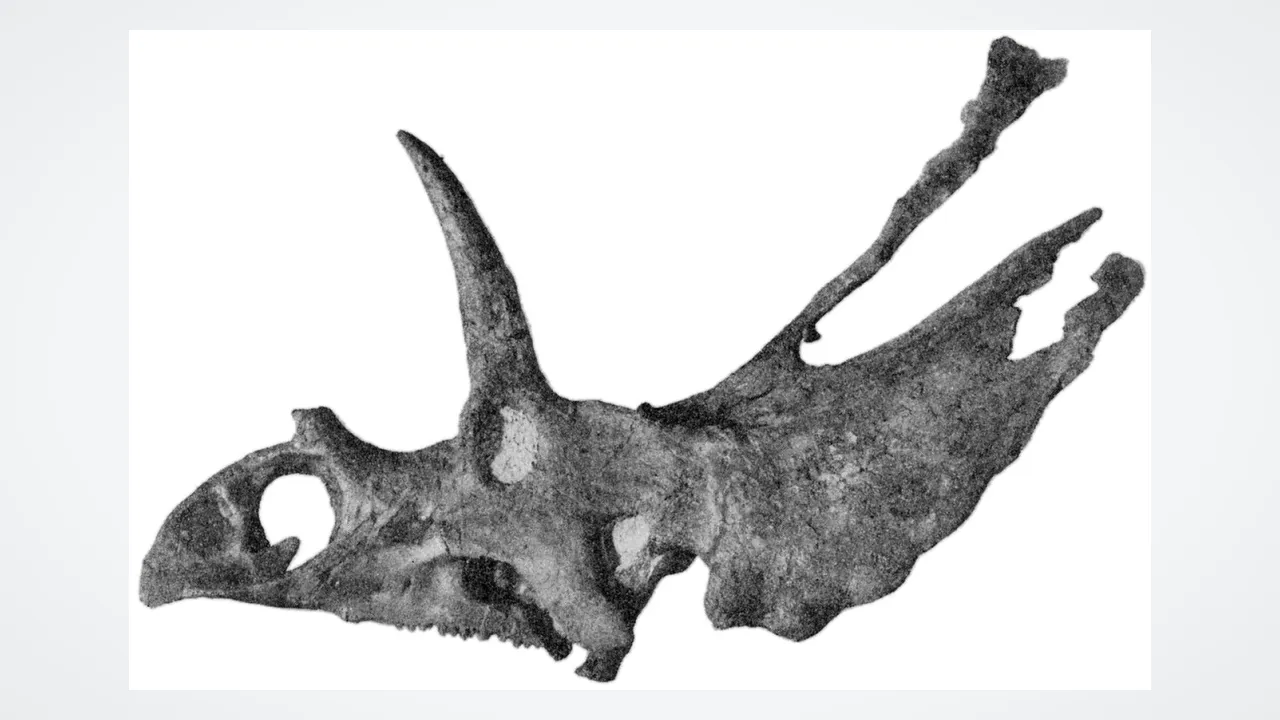
1. Where were the fourth and fifth horn-like points located on Pentaceratops?
2. In which modern U.S. state were Pentaceratops fossils discovered?
🤯 Mind-Blowing Fact • Grade 2
When fossil hunter Charles Sternberg uncovered the first Pentaceratops skulls in New Mexico in 1922, teams of horses had to haul the giant stone crates across roadless badlands!
✨ Word Sparks (Grade 2 Glossary)
Tap 🔊 to hear
Notch
A V-shaped dip along the top edge
Badlands
Dry, rocky canyons carved by wind and rain
Reconstruct
To carefully rebuild missing parts of fossils
🪝
Which dinosaur owned a skull so tall it won a Guinness World Record?
1
Five-Horned Showstopper
Thud, thud! Heavy footsteps echo across a warm swamp in ancient New Mexico 74 million years ago. Out from giant palm trees steps five-ton Pentaceratops! Along with a nose horn and two three-foot brow horns, sharp bony spikes jutted sideways from both cheeks.
2
A Ladder-Sized Frill
Rising high behind its eyes stood an enormous rectangular neck shield notched in a deep V at the top, with two little hooks pointing inward. Huge skin-covered windows kept that massive billboard light enough to carry!
3
Record-Book Giant
One giant skull reconstructed in Oklahoma measured nearly ten feet from beak tip to frill top—earning a world-record title!
1. Why did Pentaceratops's giant skull win a famous world record?
2. What shape sat right in the middle of the top edge of Pentaceratops's frill?
🤯 Mind-Blowing Fact • Grade 3
Triangle-shaped bony studs lined the sides of Pentaceratops's towering frill like teeth on a giant saw blade!
✨ Word Sparks (Grade 3 Glossary)
Tap 🔊 to hear
Ligament
Tough elastic band holding heavy bones steady
Proportion
Size of one part compared to whole
Suspension
Supporting heavy weight using strong overhead cables
🪝
Why did a 22-foot dinosaur carry a skull big enough for a 30-foot giant?
1
Big Head, Compact Body
Stand next to a Pentaceratops skeleton, and something looks wonderfully out of : its skull is nearly half as long as its body! Living in New Mexico 74 million years ago, this five-ton chasmosaurine measured about 22 feet long yet carried a towering eight-to-nine-foot head.
2
Tall Spine Ridge too
Behind its giant frill, extra-tall bony spines rose from its back vertebrae right over its shoulders, anchoring thick neck that acted like cables to hold its massive skull upright.
3
Story of the Record Skull
In 1941, crews dug up a gigantic partial skull and skeleton in New Mexico for the Sam Noble Museum in Oklahoma. Rebuilt to 9.8 feet (3 meters) long, it won the Guinness Record for largest land skull—though some scientists later suggested that giant individual might even belong to an oversized sister genus named Titanoceratops!
4
Named for Sternberg
Henry Fairfield Osborn named Pentaceratops sternbergii in 1923 to honor legendary fossil collector Charles Hazelius Sternberg.
1. How did Pentaceratops's backbone help hold up its giant skull?
2. Who collected the original New Mexico skulls and inspired the species name sternbergii?
🤯 Mind-Blowing Fact • Grade 4
One Pentaceratops skull shipped by Charles Sternberg to Sweden's Uppsala University in the 1920s remains one of Europe's prized North American dinosaur treasures!
✨ Word Sparks (Grade 4 Glossary)
Tap 🔊 to hear
Hypertrophied
Grown extra large compared to relatives
Epijugal
Pointed cap bone jutting from the cheek
Neural Spine
Upward bony blade atop a backbone vertebra
🪝
How did Pentaceratops rule southern Laramidia's subtropical forests with a three-meter visual sail?
1
King of the San Juan Basin
Between 75 and 73 million years ago, lush coastal rivers wound across northwestern New Mexico's Fruitland and Kirtland formations toward the Western Interior Seaway. Dominating this southern wetland ecosystem was Pentaceratops sternbergii, a five-metric-ton chasmosaurine discovered in 1921 by veteran collector Charles H. Sternberg and described by Henry Fairfield Osborn in 1923.
2
Deconstructing the Five Horns
Technically, Pentaceratops possessed the standard three true ceratopsid facial horns: a modest upward-curved nasal horn and two sweeping meter-long postorbital brow horns tilting gently forward. What earned it the Greek name 'five-horned face' were ossifications—dagger-like cheek bosses projecting laterally beneath each eye socket to widen its frontal silhouette!
3
Fenestrated Skyscraper Frill
Towering upward at a steep angle, its elongated rectangular frill featured two cavernous parietal fenestrae bordered by huge triangular episquamosal and epiparietal plates. At the top midline sat a deep U- or V-shaped notch where two hook-like P1 osteoderms folded forward and inward. Supported by tall shoulder and massive neck muscles, this lightweight banner broadcasted status from afar.
4
Debate Over Giant OMNH 10165
Excavated in 1941 and displayed at Oklahoma's Sam Noble Museum with a reconstructed 3-meter frill, giant specimen OMNH 10165 won global fame—before Nicholas Longrich re-examined its solid Triceratops-like snout features in 2011 and proposed it was an early giant cousin, Titanoceratops ouranos!
1. Why aren't the fourth and fifth points on Pentaceratops considered 'true' brow or nose horns?
2. Why did paleontologist Nicholas Longrich rename the famous giant Oklahoma skull OMNH 10165 Titanoceratops in 2011?
🤯 Mind-Blowing Fact • Grade 5
Seventy-one-year-old Charles Sternberg camped alone in New Mexico's remote badlands hauling water by wagon just to excavate the magnificent holotype skulls of Pentaceratops!
✨ Word Sparks (Grade 5 Glossary)
Tap 🔊 to hear
Cantilever
Support a heavy beam sticking out from one end
Nuchal
Relating to the back of the neck
Geriatric
Belonging to a very old adult individual
🪝
What do the towering frill architecture and biogeography of Pentaceratops sternbergii reveal about chasmosaurine evolution?
1
Southern Stronghold of the San Juan Basin
During the late Campanian stage of the Late Cretaceous (roughly 75 to 73 million years ago), northwestern New Mexico's Fruitland and Kirtland formations formed warm deltaic lowlands distinct from contemporaneous northern habitats in Montana and Alberta. Across these cypress-and-palm floodplains strode Pentaceratops sternbergii, a 6.7-meter (22-foot), five-ton chasmosaurine unearthed in 1921–1923 by seventy-one-year-old fossil-hunting pioneer Charles Hazelius Sternberg and named in his honor by Henry Fairfield Osborn.
2
Cranial Geometry and Epijugal Spikes
Etymologically 'five-horned face,' Pentaceratops combined a short, upturned nasal horncore and meter-long, anteriorly curving supraorbital horncores with extraordinarily prominent, laterally projecting epijugal bosses fused to the jugal-quadratojugal cheeks. Behind the orbits soared an immense sub-rectangular parietal-squamosal shield—exceeding two meters even in standard adults—lightened by vast, sub-angular parietal fenestrae and rimmed laterally by large, triangular episquamosals.
3
Diagnostic Midline Emargination and Postcrania
Crowning the posterior parietal bar sat a deep median U- or V-shaped emargination flanked by paired, anteriorly procurved P1 epiparietal hooks, allowing palaeontologists to identify Pentaceratops closely alongside Utahceratops inside a southern chasmosaurine clade. Postcranially, dramatically elongated dorsal neural spines over the pectoral girdle anchored powerful ligaments required to a skull spanning nearly forty percent of its trunk length!
4
Reassessing Giant Specimen OMNH 10165
Collected in 1941 by J. Willis Stovall's crew and mounted at the Sam Noble Oklahoma Museum of Natural History with a reconstructed 3.0-meter skull, colossal specimen OMNH 10165 held the Guinness World Record as the largest terrestrial vertebrate skull. Because its dorsal parietal bar was missing and modeled in plaster after Pentaceratops, Nicholas Longrich re-analyzed its fused premaxillary-nasal struts and deep snout in 2011—erecting Titanoceratops ouranos as the earliest-known member of Triceratopsini, though some researchers still debate whether it represents an extreme morph.
5
Coexisting With Bistahieversor
Sharing New Mexico's coastal rivers with ankylosaurids, parasaurolophins, and the deep-snouted tyrannosauroid Bistahieversor sealeyi, Pentaceratops combined intimidating brow spears with one of prehistory's tallest visual banners.