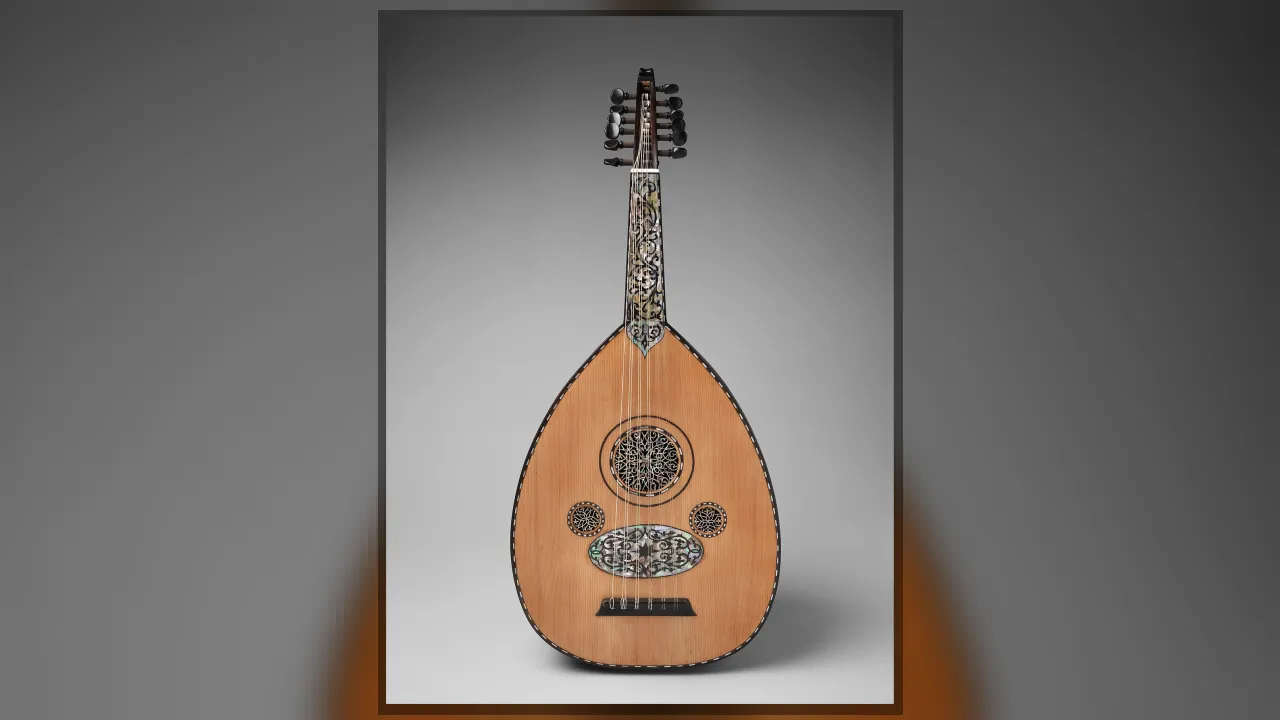
1. What is missing from the short neck of an oud so fingers can slide anywhere?
2. What did musicians long ago use to pluck an oud's strings?
🤯 Mind-Blowing Fact • Grade 2
Artisans leave the front spruce wood of an oud completely unvarnished—with zero shiny paint—so the bare wood can breathe and vibrate as freely as possible!
✨ Word Sparks (Grade 2 Glossary)
Tap 🔊 to hear
risha
Long flexible pick meaning 'feather' in Arabic
unvarnished
Bare natural wood without shiny heavy coating
ancestor
Early family relative from long ago
🪝
Why does the Arabic name 'al-ʻūd' literally mean 'the wood,' and which famous European instrument got its name from it?
1
Grandparent of Guitars and Lutes
Hold a long, bendy pick across your palm, brush five twin pairs of strings plus one deep bass string, and hear a warm, woody voice older than castles! Across the Middle East and North Africa, people call the oud the sultan of instruments.
2
Why It Means 'The Wood'
Thousands of years ago, older string instruments had animal skin stretched over their bellies. When builders crafted a thin wooden soundboard from strips of wood instead, they named it al-ʻūd—meaning 'the wood'—which later became the English word 'lute'!
3
Notes Between the Keys
Three lacy soundholes called shamsiyya, or 'little suns,' decorate its bare spruce top. Because its short ebony neck has no frets, players can play delicate 'quarter-tone' pitches that sit halfway between a piano's black and white keys!
1. Why did early builders name this instrument 'al-ʻūd,' meaning 'the wood'?
2. Why do oud makers leave the pale spruce front bare instead of painting on thick glossy varnish?
🤯 Mind-Blowing Fact • Grade 3
Over a thousand years ago in ninth-century Spain, the legendary musician Ziryab added a fifth pair of strings to the oud and introduced the eagle-feather pick in place of stiff wooden sticks!
✨ Word Sparks (Grade 3 Glossary)
Tap 🔊 to hear
microtone
Musical pitch interval smaller than half step
maqam
Expressive Middle Eastern melodic scale and mood
shamsiyya
Ornate soundhole rosette meaning 'little sun'
🪝
How do eleven strings and a fretless neck unlock hundreds of emotional scales across the Middle East and Mediterranean?
1
Deep Breath of Bare Spruce
What would happen if you cradled a deep striped wooden bowl, swept a flexible risha pick across eleven strings, and slid into a note no fretted guitar could ever reach? Instantly, centuries of poetry and storytelling fill the air!
2
Five Pairs Plus One Bass
Most modern ouds carry eleven strings arranged in five matching nylon and silver-wound pairs—called courses—plus one single deep bass string at the bottom. Like its descendant the Renaissance lute, its pegbox bends sharply backward to balance string tension.
3
Microtones and Maqam Scales
Traditional Arabic, Turkish, and Persian music uses rich scale families called maqamat. Many scales include —subtle pitches halfway between standard half steps—which shine effortlessly on the oud's smooth, fretless ebony fingerboard!
4
Little Suns and Resonant Ribs
Fifteen to twenty-seven bent walnut, maple, or mahogany ribs form the deep pear-shaped resonator, sending warm bass and earthy midrange soaring through three carved 'little sun' rosettes.
1. How are the eleven strings typically grouped on a modern concert oud?
2. Why is a completely fretless fingerboard essential for playing traditional maqam music?
🤯 Mind-Blowing Fact • Grade 4
Golden Age scholar Al-Farabi wrote the tenth-century 'Great Book of Music'—one of history's most detailed acoustics volumes—using precise string-length divisions along the fretless oud!
✨ Word Sparks (Grade 4 Glossary)
Tap 🔊 to hear
taqsim
Expressive solo improvisation exploring a maqam scale
tarab
Deep emotional enchantment awakened by expressive music
polymath
Scholar excelling across many arts and sciences
🪝
Why did ancient philosophers like Al-Kindi and Al-Farabi use the oud's four strings to map mathematics, human emotions, and the cosmos?
1
Three Thousand Years of Resonance
Clay plaques pressed in ancient Mesopotamia more than three thousand five hundred years ago already show musicians cradling pear-shaped short-necked lutes! Evolving into the classical Arabic al-ʻūd by the seventh century, this fretless marvel traveled from Baghdad, Damascus, and Cairo to Istanbul and medieval Spain, seeding both the European lute and Chinese pipa lineages.
2
Philosophers, Strings, and Ziryab
During the Islamic Golden Age, Al-Kindi and Al-Farabi wrote scientific treatises using the oud's string ratios to explain acoustic intervals and emotional healing—linking its four original courses to the four seasons and elements. In ninth-century Córdoba, visionary musician Ziryab added a red fifth course at the center to represent the human soul and swapped stiff wooden plectra for supple eagle quills!
3
Arabic Warmth Versus Turkish Brightness
Two main sister designs thrive today. Arabic ouds carved in Damascus, Cairo, or Baghdad feature slightly longer sixty-centimeter string scales and deeper bowls for dark, meditative resonance; Turkish, Greek, and Armenian ouds use shorter scales, thinner soundboards, and tighter string tension for brighter, nimble brilliance.
4
Taqsim: Painting Emotion in Real Time
Every great performance highlights —an unhurried solo improvisation where the artist explores a maqam's microtonal colors, weaving feathery tremolos, slides, and dramatic silences that move listeners to cheers of 'Allah!' in shared musical rapture called .
1. Which ninth-century musician in Córdoba added a fifth string course to the oud and introduced the eagle-feather pick?
2. How does a traditional Turkish or Greek oud typically compare acoustically to a larger Arabic oud?
🤯 Mind-Blowing Fact • Grade 5
Because an oud's short neck meets the wooden bowl at the exact midpoint of the vibrating string, sliding a finger right to the body's edge naturally finds the one-octave harmonic without needing a twelfth fret!
✨ Word Sparks (Grade 5 Glossary)
Tap 🔊 to hear
neutral third
Microtonal interval halfway between major and minor
wajh
Unvarnished spruce front face of an oud
etymology
Historical origin and journey of a word
🪝
How did tenth-century acoustic treatises on the fretless oud lay mathematical foundations for microtonal maqam theory while inspiring Europe's entire lute family?
1
Fretless Microtonality Across Three Octaves
Draw an elongated flexible risha across five paired nylon-and-silver-wound courses plus a solitary low bass wire—spanning roughly C2 (65.4 hertz) to C5 (523.3 hertz) and beyond—and hear a dark, woody sigh rich in transient breath and subtle . Classified under Hornbostel-Sachs 321.321 as a short-necked, fretless vaulted bowl lute, al-ʻūd stands as the patriarch of Western Asia, North Africa, and Europe's plucked chordophones.
2
Etymology, Ziryab, and Acoustic Treatises
Descending from second-millennium-BCE Mesopotamian lutes and Sassanian Persian barbat prototypes, seventh-century Arab craftsmen adopted a split-spruce wooden soundtable () in place of animal parchment—coining al-ʻūd ('thin strip of wood'), later borrowed into European tongues as laúd, liuto, luth, and lute. Ninth- and tenth-century philosophers Al-Kindi, Al-Farabi (Kitab al-Musiqa al-Kabir), and Ibn Sina mapped Pythagorean and superparticular string ratios along its neck, while Ziryab in ninth-century Córdoba expanded its four courses to five.
3
Vaulted Kas'a Bowl and Unvarnished Wajh Mechanics
Luthiers assemble the deep hemispherical kas'a resonator over a mold from fifteen to twenty-seven heat-bent walnut, rosewood, or maple ribs joined without an internal soundpost. Capping the bowl sits a bare, unvarnished two-millimeter Picea abies spruce belly reinforced by slender transverse harmonic bars and pierced by one large central and two smaller shamsiyya rosettes—creating a complex multi-aperture Helmholtz resonator tuned for earthy low-midrange warmth.
4
Neutral Intervals of Maqam and Regional Tunings
Unconstrained by equal-tempered frets, a short twenty-centimeter neck joining the body at the octave point allows exact placement of three-quarter-tone 'neutral' seconds and thirds—such as the signature E-half-flat of Maqam Rast or Bayati. Arabic tunings (commonly C2–F2–A2–D3–G3–C4) favor resonant depth across a 600-to-615-millimeter scale, whereas Ottoman-Turkish makam tunings (such as D2–E2–A2–B2–E3–A3 on a 585-millimeter scale) elevate tension for crystalline articulation.
5
Taqsim Improvisation to Contemporary Concert Stages
From unmetered taqsim meditations awakening tarab in Cairo and Aleppo salons to twentieth-century Iraqi revolutionary Munir Bashir, Egyptian icon Farid al-Atrash, and contemporary cross-genre soloists like Naseer Shamma and Anouar Brahem, the oud remains a living vessel of Mediterranean and Middle Eastern soul.