🧬 HUMAN BODY
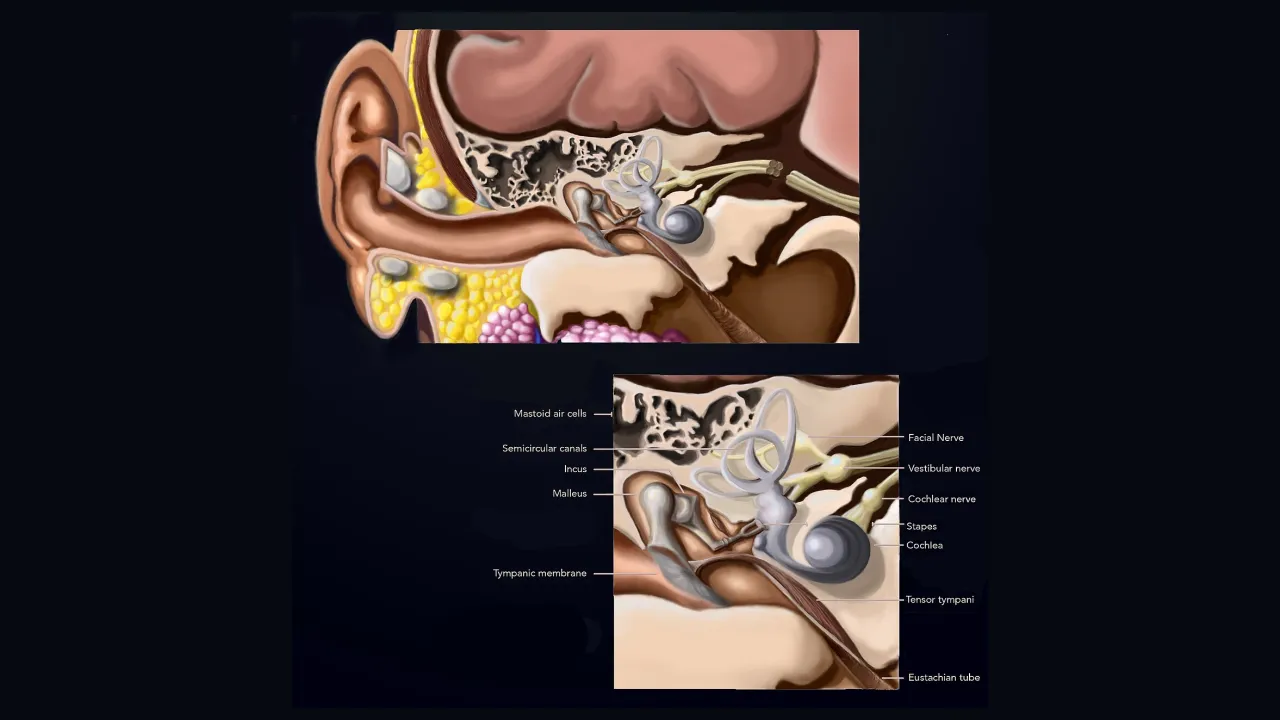
🧬 Ossicula Auditus (Malleus, Incus, Stapes) • Middle Ear Lever Chain
VA Science & Health SOL 1.1, 3.1, 4.2, 5.1 (Cells, Organs & Body Systems)
Ossicles (Hammer, Anvil, Stirrup)
Three Rice-Sized Bones Amplifying Every Sound
Grade 2 • Developing • 100 words
🩺 Body System & LocationSkeletal & Auditory Systems • Air-filled middle ear chamber behind each eardrum
🔬 Size / Cell CountSmallest bones in the human body! • Stirrup (stapes) is just 0.12 in (3 mm) tall & 3 milligrams
⚙️ Core JobLinks together as a miniature lever bridge boosting eardrum vibrations 20+ times stronger
⚡ Body SuperpowerAlready full adult size the day you are born—and all three fit side by side on a single penny!
🤯 Mind-Blowing Fact • Grade 1
Your stirrup bone is the tiniest bone in the human body—shorter than a single grain of rice!
✨ Word Sparks (Grade 1 Glossary)
Tap 🔊 to hear
ossicle
A super tiny bone inside your ear
anvil
Block where a blacksmith taps hot metal
stirrup
U-shaped foot loop hanging from horse saddle
🪝
Where do the three smallest bones in your whole body hide?
1
Smaller Than Rice!
Feel your long leg bone, then touch your ear! Tucked behind each eardrum hide your three tiniest bones of all—called !
2
Tap, Tap, Tap!
Their nicknames are the hammer, the , and the ! When your eardrum wiggles, the hammer taps the anvil, and the anvil taps the stirrup!
3
Fitting on a Penny
All three tiny bones could sit together on one shiny penny! Their gentle taps make quiet sounds loud and clear.
1. Which bone holds the record as the smallest bone in your entire body?
2. In what order do the three middle-ear bones pass vibrations along?
🤯 Mind-Blowing Fact • Grade 2
Out of all 206 bones in an adult skeleton, SIX of them—three ossicles in each ear—hide right inside your head just for hearing!
✨ Word Sparks (Grade 2 Glossary)
Tap 🔊 to hear
lever
Simple machine boosting push like a seesaw
amplify
To boost a tiny vibration much stronger
skeleton
Full framework of bones supporting your body
🪝
Which bones in your body are ALREADY full grown-up size the day you are born?
1
Named After Workshop Tools
Long ago, scientists peered behind the eardrum and smiled at three miniature bones linked in a chain! Because of their cool shapes, they named these ossicles after three everyday objects: a blacksmith's hammer, an iron anvil, and a horse rider's stirrup.
2
A Tiny Lever Boost
Just like a playground seesaw helps lift a heavy friend, this three-bone chain works like a clever ! It boosts gentle eardrum vibrations and taps them onto the liquid-filled inner ear.
3
Full Size at Birth!
While your arm and leg bones stretch for years, your six middle-ear ossicles—three on the left, three on the right—finish growing before you are even born!
1. How much do your middle-ear ossicles grow between first grade and adulthood?
2. Counting both your left ear and your right ear together, how many ossicle bones do you have?
🤯 Mind-Blowing Fact • Grade 3
Attached to your stirrup bone is the 'stapedius'—the smallest skeletal muscle in the entire human body, measuring barely ONE millimeter long!
✨ Word Sparks (Grade 3 Glossary)
Tap 🔊 to hear
malleus
Latin name for the middle-ear hammer bone
incus
Latin name for the middle-ear anvil bone
stapes
Latin name for the tiny stirrup bone
🪝
How does a tiny ear muscle slam on 'seatbelts' for your ear bones right before thunder booms?
1
Latin Names for Tiny Titans
Line up a grain of rice beside models of your middle-ear ossicles and marvel at how small bones can be! Doctors use Latin words for the trio: for the hammer touching your eardrum, for the middle anvil, and for the tiny arch-shaped stirrup.
2
Bridging Air to Water
Suspended by delicate ligaments inside an air-filled chamber, these three hinged bones form a living bridge! By acting as levers and focusing push onto the ' small oval footplate, they multiply sound pressure more than twenty times so waves push inner-ear fluid cleanly.
3
Real Movable Joints!
Believe it or not, tiny fluid-cushioned joints—just like miniature versions of your knee or elbow—let the , , and rock smoothly millions of times a day without squeaking!
4
Built-In Loud-Noise Seatbelt
When a sudden loud drum crashes nearby, the smallest muscle in your body—the stapedius—tugs the stirrup bone sideways in milliseconds to soften the boom and protect your inner ear!
1. Which Latin name matches the U-shaped stirrup bone—the final bone in the chain?
2. What does the tiny one-millimeter stapedius muscle do during a loud crash?
🤯 Mind-Blowing Fact • Grade 4
Every mammal on Earth—from tiny bumblebee bats to hundred-ton blue whales—carries the exact same three-bone malleus, incus, and stapes signature inside its middle ears!
✨ Word Sparks (Grade 4 Glossary)
Tap 🔊 to hear
footplate
Flat base of stapes pressing oval window
ligament
Stretchy tough band suspending bones in place
conduction
Passing vibrations smoothly through air or bone
🪝
Believe it or not, where did mammals' tiny middle-ear bones come from millions of years ago?
1
Twenty-Two-Fold Mechanical Advantage
Imagine trying to wiggle water inside a swimming pool just by fanning it with a paper fan—almost all your push bounces away! Your middle ear solves that exact physics challenge by pairing two simple-machine tricks. First, the wide eardrum funnels air force onto the tiny 3.2-square-millimeter of the stapes (a 17-to-1 area boost). Second, because the malleus handle is about 1.3 times longer than the incus lever arm, lever physics multiplies force further—delivering roughly twenty-two times greater pressure at the inner ear's oval window!
2
The Acoustic Reflex Team
Guarding this sensitive bridge are two pint-sized muscles: the tensor tympani (anchored to the malleus) and the one-millimeter stapedius (anchored to the stapes neck). Loud noises above eighty decibels trigger a brainstem acoustic reflex within fifty milliseconds, stiffening the ossicular chain to cut low-frequency blast transmission—though sudden firecrackers arrive faster than fifty milliseconds, so earplugs at loud concerts still win!
3
Fossil Jaw Bones Recycled Into Ears!
Paleontologists uncovered one of evolution's coolest plot twists inside ancient fossils! Reptiles and amphibians hear with only ONE middle-ear bone (a rod-like stapes) while chewing with multiple lower-jaw bones. As early mammals evolved a single sturdy lower jawbone, two spare rear jaw-hinge bones shrunk, migrated upward, and joined the stapes as our malleus and incus—gifting mammals super-crisp high-frequency hearing!
4
Why You Sound Different on Recordings
When you speak aloud, skull vibrations shake your ossicles directly through bone —adding warm bass you hear inside your head that microphones across the room never pick up!
1. Why does a recording of your own voice always sound higher-pitched than how you hear yourself speak?
2. What fossil surprise distinguishes mammals from reptiles and amphibians?
🤯 Mind-Blowing Fact • Grade 5
Proof of evolution hides right in your nerves: because your malleus bone evolved from an ancient jaw joint, the tensor tympani muscle attached to it is STILL wired by the exact same trigeminal nerve that powers your chewing jaw muscles!
✨ Word Sparks (Grade 5 Glossary)
Tap 🔊 to hear
synovial
Fluid-lubricated joint letting bones rock smoothly
inertia
Tendency of mass to resist rapid motion
prosthesis
Precision artificial part replacing a damaged structure
🪝
How did Renaissance anatomists, comparative embryologists, and microsurgeons decode three bones weighing less than a drop of water?
1
Renaissance Discovery of the Auditory Trio
Because all three auditory ossicles hide encased inside the dense petrous part of the temporal skull bone, ancient physicians missed them completely for over a millennium! During the Italian Renaissance, anatomists Alessandro Achillini and Berengario da Carpi first described the malleus (~25 mg) and incus (~30 mg), before Sicilian physician Giovanni Filippo Ingrassia spotted the minuscule stapes (~3 mg) in 1546—remarking that its twin crura arches and oval footplate resembled the iron stirrups Sicilian horsemen used.
2
Synovial Micro-Joints and Rotational Axes
Linked by true miniature joints—the saddle-shaped incudomalleolar joint and ball-and-socket incudostapedial joint—the ossicles hang suspended in the tympanic cavity by delicate elastic ligaments so their combined center of mass aligns right along their rotational axis! That balanced counterweight geometry minimizes , allowing faithful transmission up to 20,000 hertz while piston-like and rocking motions of the stapes footplate drive fluid waves across the oval window.
3
Reichert-Gaupp Theory: From Jaw Hinge to Ear
In 1837, German embryologist Karl Reichert noticed something astonishing in mammal embryos: the malleus and incus bud straight off Meckel's cartilage of the first pharyngeal (jaw) arch, whereas the stapes arises from the second arch! Combined with transitional synapsid fossils such as Morganucodon, the Reichert-Gaupp theory proved that the reptilian articular and quadrate jaw-joint bones transformed into the mammalian malleus and incus—freeing tiny nocturnal early mammals to hear faint insect rustles.
4
Dual Cranial Nerve Reflexes
Mirroring their separate embryonic origins, the middle ear's twin protective muscles answer two different cranial nerves: cranial nerve V (trigeminal, jaw nerve!) innervates the tensor tympani on the malleus, while cranial nerve VII (facial nerve) powers the stapedius on the stapes to attenuate roaring low frequencies by up to twenty decibels.
5
Titanium Micro-Prostheses in Surgery
When conditions like otosclerosis stiffen the stapes footplate with spongy bone overgrowth, otologic microsurgeons peer through operating microscopes to perform stapedectomy—installing a featherweight four-millimeter titanium piston that restores crisp mechanical hearing!