1. Where did Ornithocheirus wear its special bony crests?
2. What does the name Ornithocheirus mean?
🤯 Mind-Blowing Fact • Grade 2
In the 1800s, English scientists got so excited by broken fossil scraps from Cambridge that they accidentally named over thirty 'species' of Ornithocheirus—before modern science tidied it down to just one!
✨ Word Sparks (Grade 2 Glossary)
Tap 🔊 to hear
Quarry
Open pit dug to mine stone or sand
Streamlined
Smoothly shaped to cut wind or water
Cone-Shaped
Wide at the base with pointed tip
🪝
How did Victorian quarry workers digging fertilizer in England uncover an ocean-crossing sky reptile?
1
Buried in Green Sand
Imagine warm chalk seas washing across England ninety-eight million years ago! Gliding effortlessly on sea winds was Ornithocheirus, a fish-eating pterosaur with a sixteen-to-twenty-foot wingspan. In the 1800s, workers near Cambridge dug up thousands of worn pterosaur bone bits from dark green sand beds.
2
Blunt Snout and Sturdy Teeth
Unlike needle-thin teeth that bend easily, Ornithocheirus grew straight, sturdy teeth right near its tall snout tip. Its species name simus actually means snub-nosed because its upper jaw rose straight up at the front!
3
Dipping Into Waves
As it glided low over schools of fish, its keel snout sliced cleanly into the water to grab lunch on the wing!
1. Why was Ornithocheirus given the species name simus, meaning snub-nosed?
2. What kind of teeth grew at the front of Ornithocheirus's jaws?
🤯 Mind-Blowing Fact • Grade 3
Close relatives of Ornithocheirus have been found in England, Morocco, Brazil, Australia, and the United States—proving this ocean-gliding family crossed entire seas!
✨ Word Sparks (Grade 3 Glossary)
Tap 🔊 to hear
Updraft
Upward current of air lifting gliders
Marathon
Extra-long journey requiring steady endurance
Stabilize
To keep steady without wobbling sideways
🪝
Why did television documentaries once call Ornithocheirus an eighty-foot monster—and what is the real scientific truth?
1
Clearing Up a Giant Mix-Up
If you ever watched an older dinosaur documentary showing a forty-foot Ornithocheirus flying from Brazil to Europe, prepare for a fun paleontology plot twist! That South American giant with huge rounded snout keels actually belongs to a close cousin named Tropeognathus, and neither flyer ever reached forty feet!
2
The Real Ornithocheirus simus
True Ornithocheirus simus lived ninety-eight million years ago over the warm Chalk Sea covering southern England. Even at its true, scientifically verified wingspan of sixteen to twenty feet, it was still a magnificent ocean glider wider than a great white shark is long!
3
Built for Marathon Flights
Members of the ornithocheirid family evolved long, narrow wings anchored to powerful chest muscles and short tails. Riding off ocean swells, they crossed hundreds of miles of open sea while burning remarkably little energy.
4
Snout Keels for Water Entry
When dipping its beak into waves after squid and fish, the narrow crest on its snout tip helped its head against splashing water!
1. Which South American cousin with giant rounded jaw keels was often mixed up with English Ornithocheirus in older TV shows?
2. How did snout-tip crests help Ornithocheirus while hunting at sea?
🤯 Mind-Blowing Fact • Grade 4
In paleontology, a genus accidentally stuffed with dozens of fragmentary mystery fossils—like 19th-century Ornithocheirus once was—is called a 'wastebasket taxon'!
✨ Word Sparks (Grade 4 Glossary)
Tap 🔊 to hear
Holotype
Single original fossil defining a named species
Taxon
Named group of organisms in classification
Hydrodynamic
Shaped to move smoothly through water
🪝
How did paleontologists untangle a 150-year 'wastebasket' puzzle of more than thirty English pterosaur names?
1
Treasure From Phosphate Quarries
During the mid-19th century, miners digging phosphate nodules for farm fertilizer out of the 100-to-95-million-year-old Cambridge Greensand near Cambridge, England, unearthed over a thousand battered pterosaur bone fragments. Studying those wave-tumbled fossils at the Sedgwick Museum in 1869, young paleontologist Harry Govier Seeley coined the genus Ornithocheirus—believing its wrist bones linked reptiles toward birds.
2
Cleaning Out a Taxonomic Wastebasket
Victorian rivalry between Harry Seeley and Sir Richard Owen soon sparked a naming frenzy: every slightly different jaw tip received a brand-new species name, bloating Ornithocheirus to nearly forty species! Over the past two decades, paleontologists David Unwin, Taissa Rodrigues, and Alexander Kellner carefully re-measured every specimen—proving only the steep-snouted Ornithocheirus simus truly belongs in the genus, while others represent cousins like Camposipterus and Cimoliopterus.
3
Heavy-Duty Piscivore Jaws
Unlike slender-toothed relatives whose fangs splayed outward, Ornithocheirus simus possessed a tall, blunt rostral tip carrying relatively straight, vertical, robust teeth. That sturdy front bite excelled at seizing larger, muscular pelagic fish and cephalopods near the ocean surface.
4
Global Cruisers of the Mid-Cretaceous
Spanning roughly 5 to 6 meters (16 to 20 feet) across warplane-sleek wings, ornithocheirids patrolled opening Atlantic and Tethyan seaways across multiple continents.
1. Why did paleontologists call 19th-century Ornithocheirus a 'wastebasket taxon'?
2. How did Ornithocheirus simus's front teeth differ from those of many cousin anhanguerids?
🤯 Mind-Blowing Fact • Grade 5
Sir Richard Owen disliked Harry Seeley's evolutionary theory so strongly in 1874 that he tried to rename Ornithocheirus simus as 'Criorhynchus' ('ram beak')—a name scientific priority rules eventually overturned!
✨ Word Sparks (Grade 5 Glossary)
Tap 🔊 to hear
Cladistic
Grouping organisms by shared evolutionary traits
Rosette
Spoon-shaped widening at a jaw's toothed tip
Priority
Rule keeping the earliest valid scientific name
🪝
How did rigorous cladistic revision rescue Ornithocheirus simus from Victorian rivalry and clarify mid-Cretaceous pelagic pterosaur evolution?
1
Reworked Fossils of the Cambridge Greensand
At the boundary between the Early and Late Cretaceous (~100 to 95 million years ago, Albian–Cenomanian), shallow marine currents reworked older Gault Clay phosphatic concretions into the basal glauconitic marls of England's Cambridge Greensand. Commercial coprolite mining in the 1850s–1880s yielded thousands of three-dimensionally preserved yet fragmented pterosaur bones, prompting Harry Govier Seeley in 1869 to erect Ornithocheirus ('bird hand') under an early evolutionary hypothesis linking pterosaurs with avian origins.
2
Victorian Feuds and Taxonomic Clarification
Fierce scientific competition between Seeley (who embraced Darwinian evolution) and Sir Richard Owen (who renamed the same jaw tip Criorhynchus simus in 1874 to avoid Seeley's evolutionary label!) produced taxonomic chaos spanning thirty-six nominal species. In a comprehensive 2013 monograph, Taissa Rodrigues and Alexander Kellner restricted Ornithocheirus strictly to its diagnostic type species, O. simus—reassigning other English and Brazilian crested jaws to genera including Tropeognathus, Anhanguera, Coloborhynchus, and Camposipterus.
3
Diagnostic Rostral Morphology
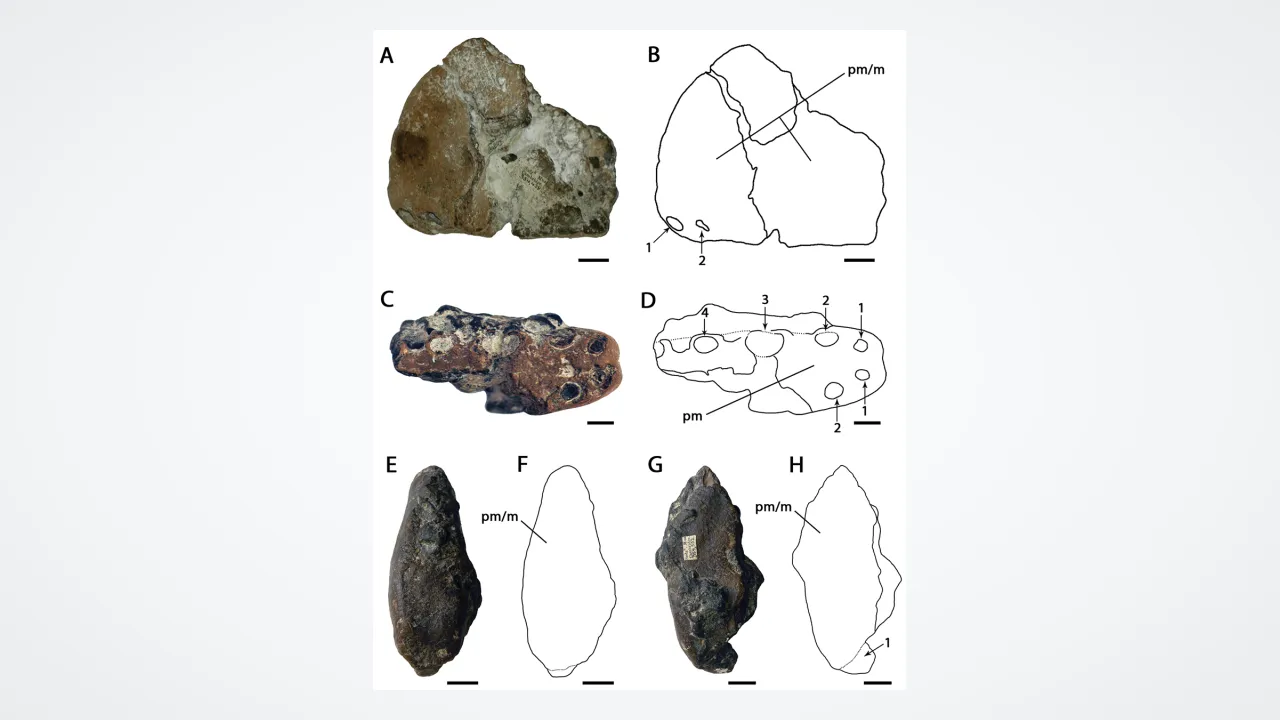
Known definitively from its distinctive anterior premaxillary rostrum and associated postcrania, O. simus exhibits a high, bluff snout tip rising almost vertically before sloping into a dorsal sagittal keel crest, yet lacks the bulbous lateral expansion ('') typical of Anhanguera. Its first pair of alveoli sits high on the anterior face of the rostrum, bearing stout, nearly vertical conical teeth adapted for puncturing larger pelagic teleosts.
4
Pelagic Aerodynamics of Ornithocheirae
Comparative scaling from complete anhanguerian skeletons indicates O. simus spanned roughly 5 to 6 meters—far more realistic than exaggerated 12-meter television estimates derived from dubious fragments! Deeply warped deltopectoral crests on the humerus, pneumatic axial skeletons, and high-aspect-ratio wings enabled dynamic soaring across epicontinental Chalk Seas.
5
Dip-Feeding Mechanics
During low-altitude glides, its compressed premaxillary keel minimized hydrodynamic yaw as the jaw tips sliced briefly into wave crests to snatch surface fish without stalling.