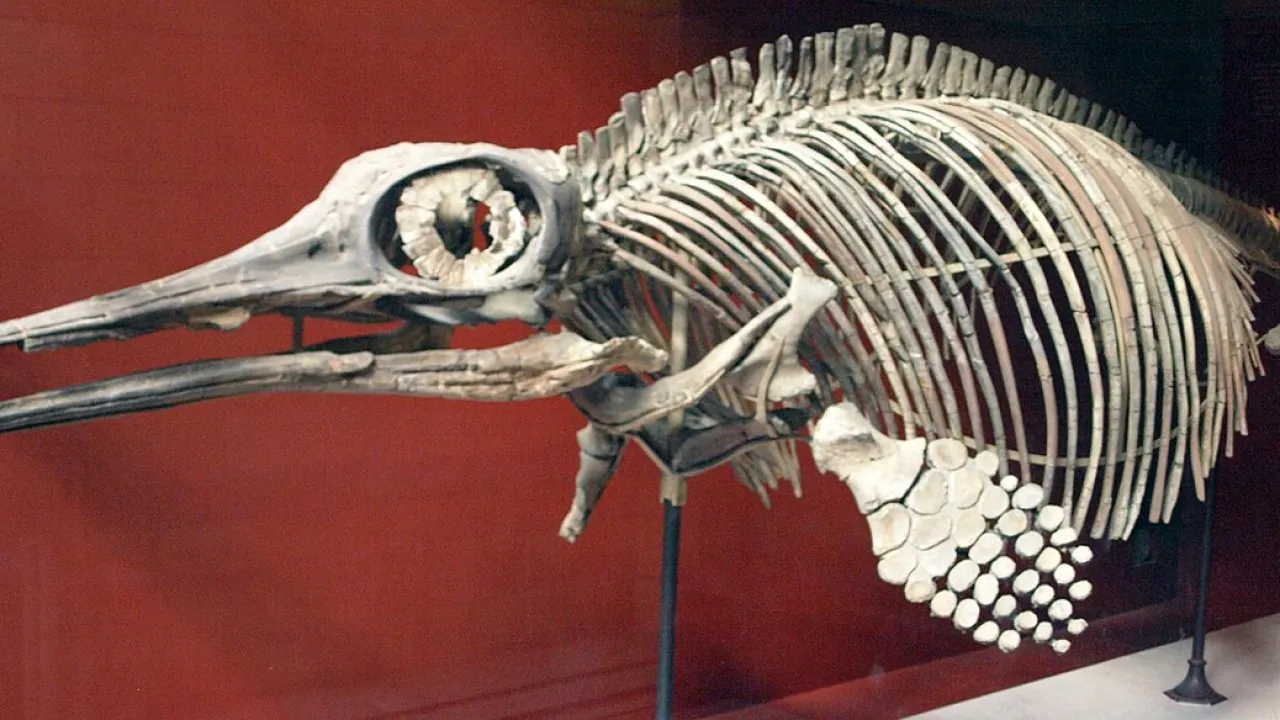
Its eyeballs were so huge that almost no extra room remained in its cheeks, leaving only space for slender jaws!
✨ Word Sparks (Grade 2 Glossary)
Tap 🔊 to hear
plunge
Dive quickly and deeply into water
water pressure
Heavy weight of deep water pushing inward
estimate
Make a careful calculation using science clues
🪝
How could Ophthalmosaurus dive deep into dark water without hurting its giant eyes?
1
Into the Ocean Twilight
Take a deep breath and beneath the Jurassic waves! Sunlight fades quickly as you dive deeper into the sea. Down in that chilly, dim water hunted Ophthalmosaurus, a dolphin-shaped reptile nearly twenty feet long.
2
Bony Goggles Built Inside
Almost all the room inside its skull held two enormous, nine-inch eyeballs! Every eyeball wore an inner circle of fifteen overlapping bones. Like sturdy diving goggles, those bony rings stopped heavy from squishing its eyes.
3
Holding Its Breath
Scientists Ophthalmosaurus could hold a single breath for twenty minutes or more. That gave it plenty of time to dive over a thousand feet deep after tender squid!
1. What protected Ophthalmosaurus's giant eyes during deep dives?
2. About how long could Ophthalmosaurus hold its breath on a dive?
🤯 Mind-Blowing Fact • Grade 3
Fossilized bone pits prove Ophthalmosaurus could ascend so fast when escaping danger that tiny gas bubbles fizzed in its bloodstream!
✨ Word Sparks (Grade 3 Glossary)
Tap 🔊 to hear
twilight zone
Deep ocean layer with very faint sunlight
drag
Water resistance that slows a swimmer down
decompression
Dropping pressure quickly when rising from deep water
🪝
What clues inside fossilized joints proved Ophthalmosaurus sometimes dived too fast for its own safety?
1
Night Vision in the Daytime
Dive 1,500 feet below the Late Jurassic ocean surface, and bright sunshine shrinks to a faint blue glow. While surface predators stayed near sunlit reefs, Ophthalmosaurus plunged straight into this shadowy ! Its nine-inch eyes—nearly four inches across at the pupil alone—collected every stray photon of light to spot darting squid.
2
Teardrop Body Built for Speed
Measuring sixteen to twenty feet long, Ophthalmosaurus had a smooth, teardrop-shaped torso that sliced through water with minimal . Front paddles steered sharp turns while a powerful half-moon tail propelled it swiftly downward and back up toward fresh air.
3
Gentle Jaws for Soft Prey
Adult Ophthalmosaurus carried small, delicate teeth mostly near the front of its narrow beak—or sometimes almost none at all! Instead of crunching thick turtle shells, it snapped up soft-bodied squid and slick deep-sea fish.
4
Signs of 'The Bends'
Paleontologists examining Ophthalmosaurus shoulder and hip bones noticed tiny sponge-like pits caused by sickness, also called 'the bends.' Just like human scuba divers rising too fast, nitrogen bubbles occasionally formed in its blood when fleeing giant pliosaurs!
1. Why did adult Ophthalmosaurus need only small teeth near the front of its snout?
2. What caused tiny sponge-like pits inside some Ophthalmosaurus limb bones?
🤯 Mind-Blowing Fact • Grade 4
Optical scientists calculated that an Ophthalmosaurus eye was sensitive enough to see a house cat moving across a dimly lit courtyard on a moonless night!
✨ Word Sparks (Grade 4 Glossary)
Tap 🔊 to hear
bioluminescent
Living creatures that make their own glowing light
myoglobin
Muscle protein that stores oxygen for long dives
cornea
The clear front window covering an eyeball
🪝
How did physics and optical math prove Ophthalmosaurus could spot prey over 1,600 feet underwater?
1
Optical Engineering at Its Limit
Slipping beneath the waves of the Oxford Clay Sea 160 million years ago, Ophthalmosaurus icenicus carried biological cameras unrivaled among vertebrates. Reaching diameters of 22 to 23 centimeters in a six-meter animal, its eyes filled nearly the entire side of the skull. Optical calculations by paleobiologist Ryosuke Motani revealed an extraordinarily low f-number—meaning a wide lens and huge pupil—allowing Ophthalmosaurus to detect moving silhouettes or flashes at depths exceeding 500 meters!
2
Armor Against Crushing Pressure
At half a kilometer down, seawater exerts fifty times the pressure felt at sea level, plus drag forces push hard against the face during fast swimming. Each Ophthalmosaurus eye contained a sclerotic ring built from fifteen interlocking bony plates. Rather than changing lens focus, this sturdy ring kept the spherical from flattening so images stayed razor-sharp.
3
Flexible Spine and Compact Torso
Compared with earlier Jurassic ichthyosaurs, Ophthalmosaurus featured tightly packed disc-shaped vertebrae and broad, rounded foreflippers containing extra rows of finger bones. This compact fuselage stored massive reserves of oxygen-binding protein inside dark swimming muscles, fueling twenty-minute breath-hold dives.
4
Living Under Threat of Giant Pliosaurs
Sharing Jurassic waters with colossal predators like Liopleurodon and Pliosaurus carried serious risks. Pathological pits called avascular necrosis found in Ophthalmosaurus humerus joints show that panicked, high-speed ascents sometimes triggered decompression bubbles—proof of high-stakes deep-sea chases!
1. How did scientists figure out how well Ophthalmosaurus saw in deep water?
2. Where did Ophthalmosaurus store extra oxygen for twenty-minute dives?
🤯 Mind-Blowing Fact • Grade 5
In Wyoming, paleontologist Othniel Charles Marsh initially named local fossils 'Baptanodon' ('toothless swimmer') before scientists realized they belonged to close American cousins of England's Ophthalmosaurus!
✨ Word Sparks (Grade 5 Glossary)
Tap 🔊 to hear
mesopelagic
Ocean twilight zone between 200 and 1,000 meters
aperture
The opening that lets light enter an eye
necrosis
Damage to bone tissue from blocked blood flow
🪝
How did evolutionary trade-offs between giant visual organs, skull space, and nitrogen physiology shape Ophthalmosaurus?
1
Mastering the Mesopelagic Zone
Descending into the 'twilight' realm between 200 and 600 meters depth during the Middle and Late Jurassic, Ophthalmosaurus icenicus exploited an ecological niche untouched by surface-bound reptiles. Named by Harry Govier Seeley in 1874 from England's Oxford Clay—with sister fossils abundant in Wyoming's Sundance Sea—this five-to-six-meter thunnosaurian ichthyosaur pushed vertebrate visual evolution to its absolute geometric boundary.
2
Photoreception and Optical Physics
Housing eyeballs up to 230 millimeters in diameter with sclerotic spanning nearly ten centimeters, Ophthalmosaurus achieved a light-gathering f-number comparable to nocturnal owls and deep-sea lanternsharks. Because photoreceptor sensitivity scales with aperture diameter while visual acuity scales with focal length, its enormous globes avoided blurry night vision—resolving fast-moving coleoid cephalopods illuminated only by downwelling blue twilight or faint bioluminescence.
3
Cranial Trade-Offs and Dentition
Dedicating almost the entire orbital region of its skull to ocular hardware left restricted space for jaw-closing adductor muscles. Consequently, mature Ophthalmosaurus exhibited extreme dental reduction, retaining small, weakly anchored teeth anteriorly or becoming nearly edentulous in some species such as Baptanodon. Rather than grappling armored prey, it snapped swiftly at soft squid and small teleost fishes.
4
Palaeopathology of Decompression Sickness
Histological cross-sections of Ophthalmosaurus humeral and femoral heads reveal widespread avascular bone —dead bone tissue left when microscopic nitrogen emboli blocked blood vessels. Modern deep-diving whales collapse their lungs at depth to prevent nitrogen absorption, yet Ophthalmosaurus evidently surfaced rapidly enough when evading giant pliosaurids like Liopleurodon to suffer occasional decompression injuries.
5
Global Success of Ophthalmosauridae
Armed with a stiffened, compact vertebral column, high-aspect-ratio lunate tail, and broad paddles showing extreme polydactyly, Ophthalmosaurus founded the family Ophthalmosauridae. This resilient clade survived the Jurassic–Cretaceous transition and carried the ichthyosaur lineage forward for another seventy million years.