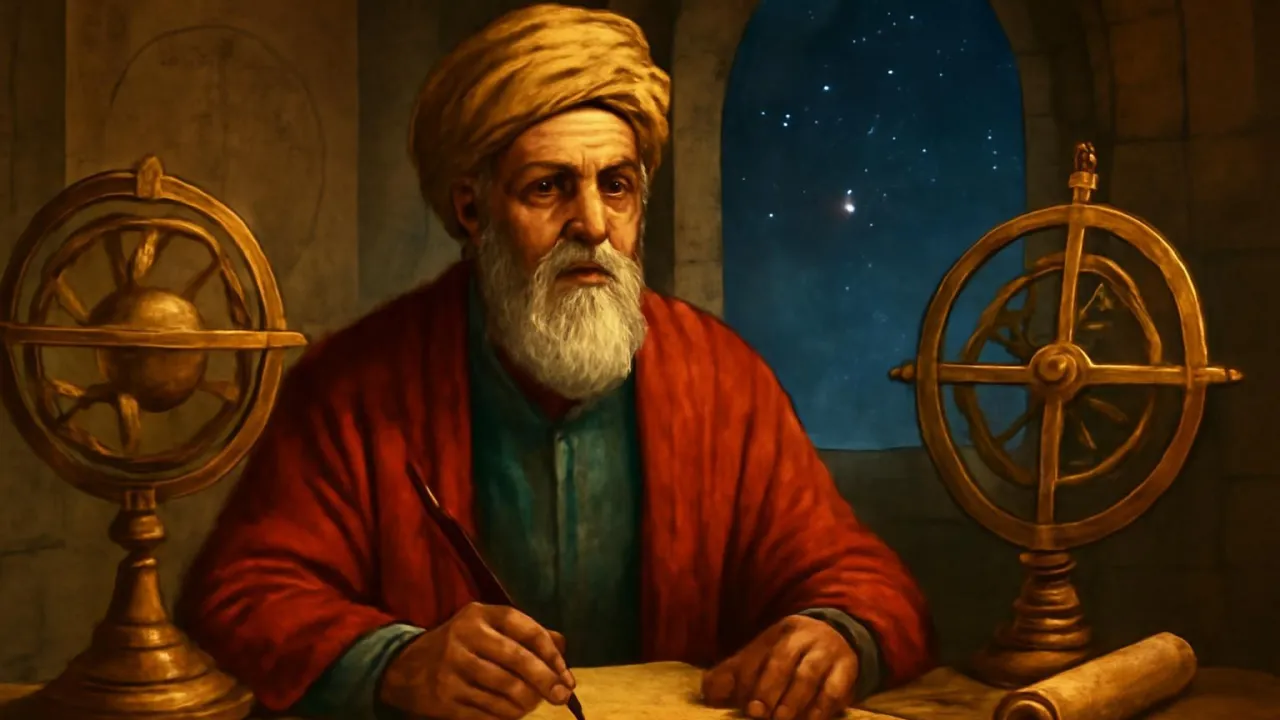
Omar’s calendar was so exact, it stayed correct for over 500 years!
✨ Word Sparks (Grade 2 Glossary)
Tap 🔊 to hear
calendar
A chart that shows days and months
curiosity
Wanting to learn and know more
accurate
Exactly right, with no mistakes
🪝
Have you ever wondered how to measure time using the stars?
1
Curious Omar
Omar asked questions about the world around him. He wanted to know how stars moved. He read many books and learned from teachers. His made him a great thinker.
2
Hard Work with Numbers
Omar practiced math every day and drew shapes in the sand. He solved tricky puzzles and wrote down his ideas. He worked hard to understand patterns. His math skills grew stronger.
3
A Calendar for All
Omar helped make a new for his country. He used math and stars to do this big job. His calendar was very and helped people know the right days. This was his biggest achievement.
Omar Khayyam’s calendar was more accurate than the one used in Europe for centuries!
✨ Word Sparks (Grade 3 Glossary)
Tap 🔊 to hear
astronomy
The study of stars and planets
equation
A math sentence with numbers and symbols
rubaiyat
Short, four-line poems Omar wrote
🪝
What if you could solve math puzzles and write famous poems at the same time?
1
A Child with Big Questions
Omar Khayyam grew up fascinated by the sky and numbers. He often gazed at the stars, wondering how they moved. His curiosity led him to ask teachers many questions about math and science. He dreamed of solving big puzzles.
2
Mastering Math and Astronomy
Omar became skilled in mathematics and as he grew older. He worked hard to solve complex problems, like cubic , which were very challenging. His studies helped him understand how the stars and planets moved. He even built tools to make better observations.
3
Changing Time Itself
Omar was asked to help fix the Persian calendar, which was not very accurate. He used his math knowledge and careful observations of the sky to create a new, more exact calendar. This calendar was so precise that it stayed correct for hundreds of years. People could now celebrate holidays on the right days.
4
Poetry and Patterns
Besides math, Omar wrote beautiful poems called , filled with deep thoughts about life. He found patterns in words just as he did in numbers. His poetry became famous around the world. Omar showed that science and art can work together.
Omar’s Jalali calendar only made a one-day mistake every 5,000 years!
✨ Word Sparks (Grade 4 Glossary)
Tap 🔊 to hear
cubic equation
A math problem with numbers to the third power
constellation
A group of stars forming a picture
legacy
What someone leaves behind for others
🪝
Imagine using math to fix a calendar so well it lasts for centuries—how would you do it?
1
A Young Stargazer in Persia
As a boy in Nishapur, Omar Khayyam was enchanted by the stars and the mysteries of numbers. He spent evenings watching and questioning how the universe worked. His early fascination led him to study with wise teachers in mathematics and science. These childhood experiences sparked a lifelong passion for discovery.
2
Solving Complex Problems
Omar became a master mathematician, tackling problems that puzzled others for centuries. He made groundbreaking progress on , which involve numbers raised to the third power. His work in algebra and geometry helped advance mathematics in the Islamic Golden Age. Omar also designed astronomical instruments to observe the sky more accurately.
3
Reforming the Calendar
The Persian calendar was confusing and often incorrect, causing problems for farmers and religious festivals. Omar was chosen to lead a team of scholars to fix it using careful observations and advanced calculations. The new Jalali calendar he created was so precise, it was more accurate than the European Gregorian calendar for hundreds of years. This achievement made Omar famous across the region.
4
Poetry That Lasts Forever
Omar Khayyam is also celebrated for his rubaiyat, four-line poems that explore life, time, and the universe. His poetry blended deep questions with beautiful language, inspiring readers for generations. Through both math and art, Omar showed that curiosity and creativity can change the world. His still shines today in science and literature.
Omar Khayyam’s Jalali calendar is still considered one of the most accurate solar calendars ever created.
✨ Word Sparks (Grade 5 Glossary)
Tap 🔊 to hear
solar calendar
A calendar based on the sun’s movement
parallel postulate
A famous idea in geometry about straight lines
philosophy
Thinking deeply about life and meaning
🪝
How could one person’s curiosity about the stars and numbers change the way people mark time forever?
1
A Childhood of Wonder and Inquiry
In the bustling Persian city of Nishapur, young Omar Khayyam spent his nights marveling at the endless sky, sketching constellations, and questioning how the universe worked. His early education combined lessons in mathematics, astronomy, and , fueling his hunger to solve the mysteries he saw above him. Omar’s teachers recognized his exceptional curiosity and encouraged him to study advanced texts. By his teenage years, he was already exploring complex mathematical ideas and observing planetary movements. This blend of wonder and rigorous learning set the stage for his later achievements.
2
Mathematical Innovations and Scientific Achievements
Omar Khayyam’s most significant mathematical contribution was his systematic solution of cubic equations, which involve variables raised to the third power. He classified these equations and described geometric methods to solve them, laying groundwork for later algebraic developments. In addition to algebra, Omar wrote influential works on geometry and contributed to the understanding of the . As an astronomer, he designed precise instruments and led observations that improved the accuracy of astronomical tables. His scientific writings were studied by scholars across the Islamic world and beyond.
3
The Jalali Calendar: A Legacy of Precision
One of Omar’s greatest achievements was leading the reform of the Persian calendar under Sultan Malik-Shah. The old calendar’s errors caused confusion in agriculture and religious observance, so Omar and his team used advanced mathematics and astronomical observations to design the Jalali calendar. Their calculations resulted in a so accurate that it would only lose one day every 5,000 years—surpassing the Gregorian calendar’s precision. This calendar guided Persian society for centuries and influenced future calendar systems worldwide.
4
Poetry, Philosophy, and the Search for Meaning
Beyond his scientific genius, Omar Khayyam became world-renowned for his rubaiyat—four-line poems that explore life’s mysteries, the passage of time, and the search for truth. His poetry, written in Persian, blends logical reasoning with deep philosophical questions, inviting readers to ponder existence and enjoy the present moment. Although his poems were not widely known during his lifetime, they later became celebrated worldwide, especially after being translated into English centuries later. Omar’s unique combination of scientific rigor and poetic insight made him a rare thinker who bridged art and science.
5
Enduring Influence and Inspiration
Omar Khayyam’s legacy endures in both mathematics and literature, inspiring generations of scientists, poets, and philosophers. His mathematical treatises influenced later scholars in Europe and the Middle East, while his poetry continues to be read and admired globally. Omar’s life demonstrates how curiosity, hard work, and creativity can lead to discoveries that shape the world for centuries. He reminds us that asking big questions and seeking beauty in both numbers and words can open new paths of understanding. Today, Omar Khayyam stands as a symbol of the power of knowledge and imagination.