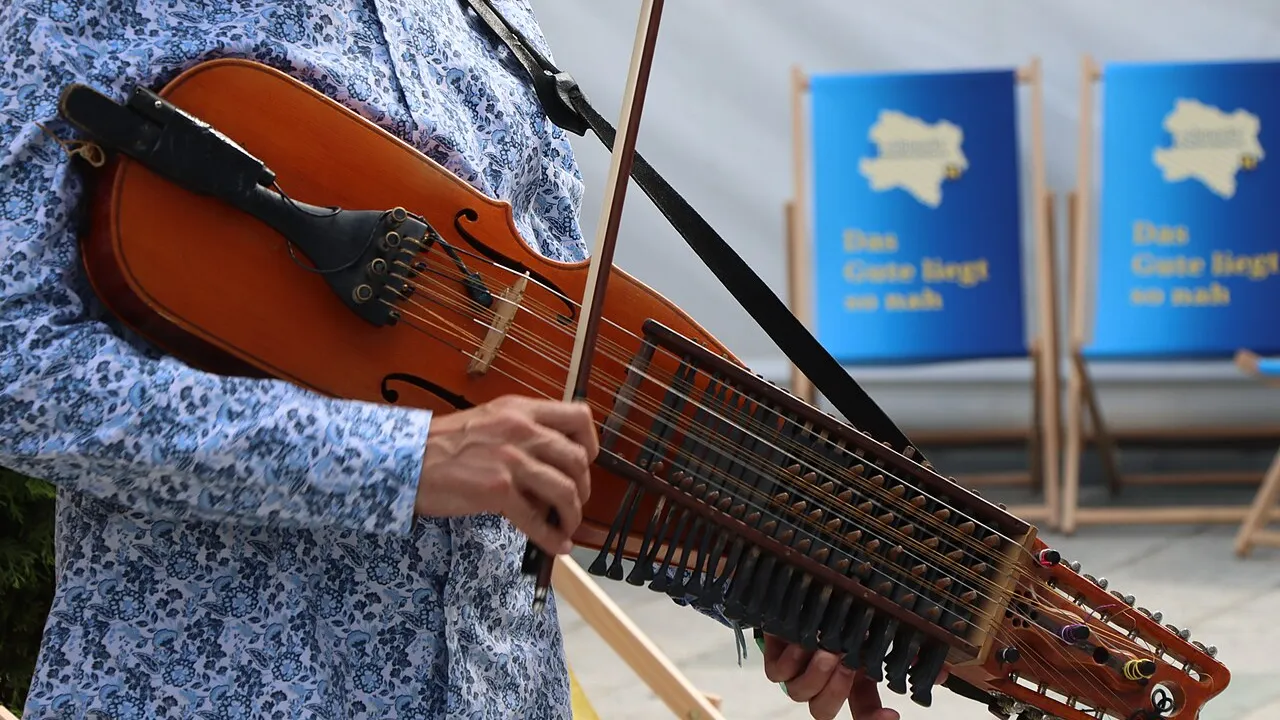
1. How does a nyckelharpa player change notes with their left hand?
2. What do the twelve hidden thin strings underneath do during a song?
🤯 Mind-Blowing Fact • Grade 2
Sweden honors the nyckelharpa so proudly that it appears right on the country's fifty-kronor paper banknote!
✨ Word Sparks (Grade 2 Glossary)
Tap 🔊 to hear
wedge
A small angled wooden peg attached to keys.
halo
A glowing ring of light or echoing sound.
melody
The main singing tune of a song.
🪝
How can twelve strings sing along if neither your fingers nor your bow ever touch them?
1
Cathedral Glow in the Forest
Clack—hum—shimmer! Step into a summer Barn Dance in Sweden and you will hear a fiddle that sounds as grand as a whole string orchestra! Hanging across the player's chest on a shoulder strap sits the sixteen-stringed nyckelharpa.
2
Thirty-Seven Sliding Wooden Keys
Instead of pressing bare fingers onto hot steel strings, the left hand presses thirty-seven sliding wooden keys stacked in three tidy rows. Each key pushes a tiny upright wooden sideways against a string to play a crisp, clear note!
3
Twelve Untouched Helpers
A short curved bow rubs only the top four strings. Tucked safely underneath sit twelve thin steel strings that vibrate all on their own through sound waves, surrounding every with a dreamy, ringing !
1. How many strings in total stretch across a modern Swedish nyckelharpa?
2. Where did Sweden feature a picture of the nyckelharpa to celebrate its musical heritage?
🤯 Mind-Blowing Fact • Grade 3
In 2023, UNESCO added Sweden's nyckelharpa building and music community to its global list of Intangible Cultural Heritage treasures!
✨ Word Sparks (Grade 3 Glossary)
Tap 🔊 to hear
tangent
Small wooden peg on a key stopping strings.
drone
A steady, continuous low note humming underneath.
sympathetic
Ringing automatically in response to matching sound waves.
🪝
Why does a stone gate from 1350 hold the earliest clue to Sweden's sixteen-stringed marvel?
1
Woodland Dances and Whispering Keys
Click—bow—ring! Soft wooden key clicks keep a lively beat right underneath soaring fiddle harmonies that echo long after the bow stops moving! On the Swedish island of Gotland, a stone church relief carved in 1350 shows one of Europe's earliest nyckelharpas—meaning 'key-harp' in Swedish.
2
Tangents Instead of Fingertips
Slung horizontally on a strap while the right arm cradles its pine-and-spruce body, a modern nyckelharpa mounts thirty-seven wooden keys in three tiers. Pressing a key slides an upright wooden wedge called a sideways into a string, acting like an instant movable fret!
3
Four Bowed Strings Plus Twelve Sympathetic Ones
A short, nimble horsehair bow plays three melody strings and one deep C string. Beneath them pass twelve thin steel strings tuned to all twelve notes of the chromatic scale.
4
Natural Acoustic Reverb
Whenever a bowed note matches one of those twelve hidden strings, resonance sets it humming automatically—creating lush, bell-like sustain without electricity!
1. What job do the small wooden 'tangents' perform when a nyckelharpa key is pressed?
2. How are the twelve sympathetic strings beneath the bridge tuned on a modern nyckelharpa?
🤯 Mind-Blowing Fact • Grade 4
Because pressing harder on a wooden nyckelharpa key stretches the string slightly sideways, skilled players can create expressive pitch bends and vibrato right through wooden levers!
✨ Word Sparks (Grade 4 Glossary)
Tap 🔊 to hear
polska
Traditional three-beat Swedish folk dance and music.
diatonic
Using only the seven notes of one scale.
overtone
Higher ringing harmonic frequency within a musical note.
🪝
How did two twentieth-century Swedish innovators rescue a nearly vanished medieval fiddle and make it fully chromatic?
1
Sixteen Strings Singing in Three-Quarter Time
What would happen if a violin borrowed the mechanical keywork of a medieval hurdy-gurdy and the shimmering sympathetic resonance of an Indian sitar? In Sweden's Uppland province, two nyckelharpa players launch into a swirling three-beat dance—their short bows bouncing briskly while wooden keys patter like gentle raindrops inside a halo of metallic .
2
From Medieval Gotland to Baroque Uppland
Carved onto Kallunge Church on Gotland around 1350, early keyed fiddles echoed across Germany, Italy, and Scandinavia during the Middle Ages and Renaissance. While they faded elsewhere in Europe, farmers and village fiddlers north of Stockholm kept the tradition alive, adding sympathetic resonance strings during the seventeenth century.
3
August Bohlin and Eric Sahlstrom's Breakthrough
By the 1920s, older nyckelharpas were struggling to survive against modern accordions. Then in 1929, Uppland builder August Bohlin re-engineered the instrument: he straightened its waist into a violin-like curve, arranged three bowed melody strings (A4, C4, G3) beside one low C3 string, and stacked thirty-seven keys in three chromatic rows. Soon after, virtuoso composer Eric Sahlstrom inspired thousands of new builders and players!
4
Acoustic Physics of the Two-Level Bridge
Peer closely at the carved maple bridge and you will see two stories: four thick gut-or-wound bowed strings ride along the arched upper crest, while twelve thin steel wires thread directly through tiny holes drilled across the bridge's middle, coupling every vibration straight into the spruce soundboard.
1. How do the twelve sympathetic strings pass across the nyckelharpa's wooden bridge?
2. Which two twentieth-century Swedes redesigned and championed the modern three-row chromatic nyckelharpa?
🤯 Mind-Blowing Fact • Grade 5
Unlike soft human fingertips that slightly muffle high overtones on a violin, a nyckelharpa's hard wooden tangents stop strings with pinpoint crispness—magnifying the glow of all twelve sympathetic strings!
✨ Word Sparks (Grade 5 Glossary)
Tap 🔊 to hear
kinematics
How mechanical parts move and link together.
damping
Softening or absorbing vibrations so sound fades.
viola d'amore
Baroque bowed instrument also using sympathetic under-strings.
🪝
How do lateral tangent geometry, multi-tier keywork, and twelve-tone sympathetic coupling unite inside Sweden's chromatic keyed fiddle?
1
Mechanical Precision Wrapped in Sympathetic Halo
Suspended horizontally across the ribcage while a short, outwardly curved horsehair bow dances near the waist, the Swedish nyckelharpa produces one of Europe's most spellbinding acoustic signatures: crisp wooden key-clicks married to a shimmering, cathedral-like cloud of sustained overtones. Spanning more than three chromatic octaves from C3 (130.8 hertz) up to A6 (1,760 hertz), this sixteen-stringed keyed fiddle stands at the crossroads of medieval mechanics and modern lutherie.
2
Six Centuries of Continuity from Gotland to Uppland
Cataloged under Hornbostel-Sachs 321.322-71 as a bowed composite lute stopped by keys, the nyckelharpa first appears in a 1350 limestone portal relief at Kallunge Church on Gotland and in sixteenth-century German organological treatises by Martin Agricola as the Schlüsselfidel. While continental variants vanished after the Renaissance, rural guilds in Sweden's Uppland province preserved older contrabasharpa and silverbasharpa designs, incorporating sympathetic resonance strings—likely inspired by English barytons and violas d'amore—during the seventeenth century.
3
Three-Tier Keybox Kinematics and Tangent Intonation
In 1929, Uppland luthier August Bohlin replaced limited diatonic drone layouts with the modern three-row chromatic nyckelharpa, tuned C3–G3–C4–A4 from lowest to highest bowed string. Mounted atop the neck sits a slotted birch or maple keybox housing thirty-seven sliding keys (nycklar) stacked across three levels—one primary row per melody string—fitted with upright notched hardwood wedges called tangents (lov). Pressing a key drives its tangent laterally into a string; because each tangent stops the string at a single razor-sharp contact point without fleshy finger , upper harmonics ring with extraordinary brilliance, and subtle extra key pressure even bends pitch upward for vibrato.
4
Coupled Bridge Physics of Twelve Resonance Strings
Beneath the four bowed wound strings run twelve thin plain-steel sympathetic strings anchored to guitar-style machine heads on an elongated peghead and tuned chromatically across every semitone from G#3 to G4. Threading through perforations bored directly through the waist of the arched maple bridge, these untouched wires absorb vibrational energy transmitted from the bowed strings into the spruce soundboard, re-radiating phase-delayed sustain for several seconds after the bow lifts.
5
Eric Sahlstrom's Renaissance and UNESCO Recognition
Propelled into twentieth-century concert prominence by Uppland composer-virtuoso Eric Sahlstrom, today's nyckelharpa thrives across Scandinavian folk polskas, baroque ensembles, and film scores—earning inscription on UNESCO's Representative List of the Intangible Cultural Heritage of Humanity in 2023.