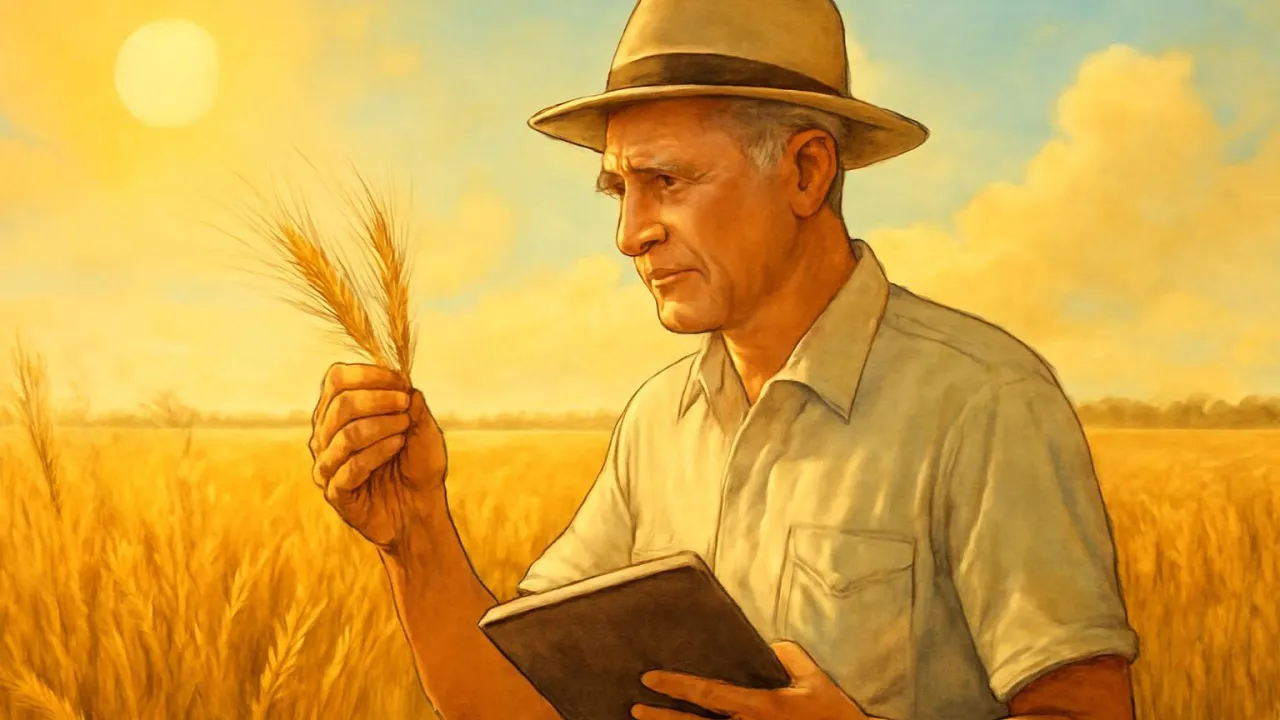
Norman Borlaug’s wheat helped save lives in over 20 countries!
✨ Word Sparks (Grade 2 Glossary)
Tap 🔊 to hear
crop
A plant grown for food
prize
A special award for great work
hunger
When people do not have enough food
🪝
Can one plant scientist help stop hunger around the world?
1
Norman’s Big Idea
Norman loved visiting farms as a child, and he wondered how plants grew. He wanted to help people who did not have enough food. He decided to learn all about growing strong .
2
Working with Wheat
Norman spent years testing wheat seeds, mixing different kinds together. He made wheat plants that could grow in tough places and not get sick. His new wheat helped farmers grow more food than ever before.
3
A World of Thanks
Norman’s wheat spread to many countries, feeding millions of people. He won a famous for helping stop . His work made the world a better place.
Norman Borlaug’s wheat helped launch the Green Revolution and save millions of lives.
✨ Word Sparks (Grade 3 Glossary)
Tap 🔊 to hear
agronomist
A scientist who studies crops and soil
yield
How much food a plant produces
disease resistance
Ability to stay healthy and not get sick
🪝
Have you ever wondered how a scientist could help feed the whole world?
1
Curious About Crops
As a boy in Iowa, Norman Borlaug watched corn and wheat grow on farms. He wondered why some fields grew better than others and wanted to help people who were hungry. His curiosity led him to study plant science in college.
2
Inventing Super Wheat
Norman became an and worked in Mexico, where many people struggled to grow enough food. He experimented with wheat seeds, mixing different types and testing them for and high . His new wheat varieties could grow in harsh conditions and produce much more grain.
3
The Green Revolution
Norman’s wheat sparked the Green Revolution, a time when farming changed worldwide. Farmers in India, Pakistan, and other countries planted his wheat and grew record harvests. Millions of people were saved from hunger because of his hard work and perseverance.
4
A Legacy of Hope
Norman received the Nobel Peace Prize for his life-saving achievements. He believed science could help solve big problems like hunger. Today, his ideas inspire scientists and farmers everywhere to keep finding new ways to feed the world.
Norman Borlaug’s wheat and farming ideas are credited with saving over a billion lives worldwide.
✨ Word Sparks (Grade 4 Glossary)
Tap 🔊 to hear
selective breeding
Choosing plants with the best traits to grow
famine
A time when many people have no food
irrigation
Bringing water to help crops grow
🪝
What happens when one scientist’s idea changes how the world eats?
1
Roots of Curiosity
Norman Borlaug grew up on a small farm in Iowa during the Great Depression, where he saw how hard it was to grow enough food. Inspired by his family’s struggles and his love of science, he studied plant biology and wanted to help people facing hunger. After college, he traveled to Mexico to see if he could make a difference for struggling farmers. His early curiosity about why plants thrived or failed became his lifelong mission.
2
Inventing a New Kind of Wheat
In Mexico, Norman worked as an agronomist, combining different wheat plants to create new varieties that resisted disease and produced more grain. He used careful experiments and to develop wheat that could grow in poor soil and harsh climates. These new wheat strains were stronger, healthier, and grew faster than older types. His scientific approach helped farmers harvest much larger crops than ever before.
3
The Green Revolution Spreads
Norman’s wheat varieties launched the Green Revolution, a time when new farming methods and seeds spread rapidly across the world. Countries like India and Pakistan used his wheat to avoid massive and feed their growing populations. The Green Revolution also included new fertilizers and techniques, making agriculture more productive and reliable. Norman’s work showed how science and teamwork could solve global problems.
4
A Lasting Impact
For his groundbreaking achievements, Norman Borlaug received the Nobel Peace Prize in 1970, recognizing his role in saving over a billion lives from starvation. He continued to teach, share ideas, and inspire young scientists until his late nineties. Today, his legacy lives on in every field of golden wheat and in the scientists who work to end hunger. Norman proved that one person’s dedication can change the world for the better.
2. Why is Norman Borlaug’s work called the Green Revolution?
🤯 Mind-Blowing Fact • Grade 5
Norman Borlaug’s Green Revolution wheat tripled harvests in Mexico, India, and Pakistan within just a few years.
✨ Word Sparks (Grade 5 Glossary)
Tap 🔊 to hear
semi-dwarf wheat
Short, strong wheat that grows lots of grain
food security
Having enough safe, healthy food for everyone
sustainable agriculture
Farming that protects nature and lasts long-term
🪝
How did a farm boy’s scientific curiosity spark a revolution that saved over a billion lives?
1
Early Curiosity and Determination
On the windswept prairies of Iowa, young Norman Borlaug watched his family struggle to coax crops from the stubborn soil during the Great Depression. He wondered why some plants thrived while others withered, and he dreamed of helping families who went hungry. Driven by these childhood questions, Norman studied plant biology at the University of Minnesota, determined to find scientific answers to the world’s food problems. His early experiences with hardship and curiosity shaped his lifelong mission to end hunger. Even as a student, he believed that science could help feed the world’s growing population.
2
Pioneering Plant Science in Mexico
After college, Norman joined a project in Mexico where farmers faced poor harvests and widespread hunger. As an agronomist, he experimented with crossbreeding wheat varieties, searching for plants that could resist rust disease and produce high yields. Through years of tireless fieldwork, he developed that was short, strong, and capable of supporting heavy heads of grain. His scientific breakthroughs required not only technical skill but also resilience, as he often worked in harsh conditions and faced skepticism from others. Norman’s new wheat transformed Mexican agriculture, tripling wheat production within a decade.
3
The Global Green Revolution
Word of Norman’s success spread to countries like India and Pakistan, which were on the brink of famine in the 1960s. Working with local scientists and governments, he introduced his high-yield, disease-resistant wheat varieties and modern farming techniques. The results were astonishing: harvests soared, and millions of people were saved from starvation. This movement became known as the Green Revolution, combining improved seeds, fertilizers, and irrigation to dramatically boost food production worldwide. Norman’s leadership and scientific vision helped transform agriculture on nearly every continent.
4
Recognition and Lifelong Advocacy
In 1970, Norman Borlaug received the Nobel Peace Prize for his extraordinary contribution to humanity. He continued working well into his nineties, training scientists, advising world leaders, and promoting . Norman was known for his humility, practical problem-solving, and unwavering belief that science and teamwork could solve global challenges. He often reminded others that the fight against hunger was never finished, urging new generations to keep innovating. His legacy is a reminder that dedicated individuals can have a profound impact on the world.
5
Legacy: Feeding the Future
Norman Borlaug’s achievements are credited with saving over a billion lives and transforming the way we think about . His methods remain the foundation for modern crop science and global efforts to end hunger. Today, scientists continue to build on his work, developing new crops to face climate change and growing populations. Norman’s story inspires us to ask big questions, use science for good, and never give up on making the world a better place. The fields of golden wheat around the globe stand as a living tribute to his vision and perseverance.