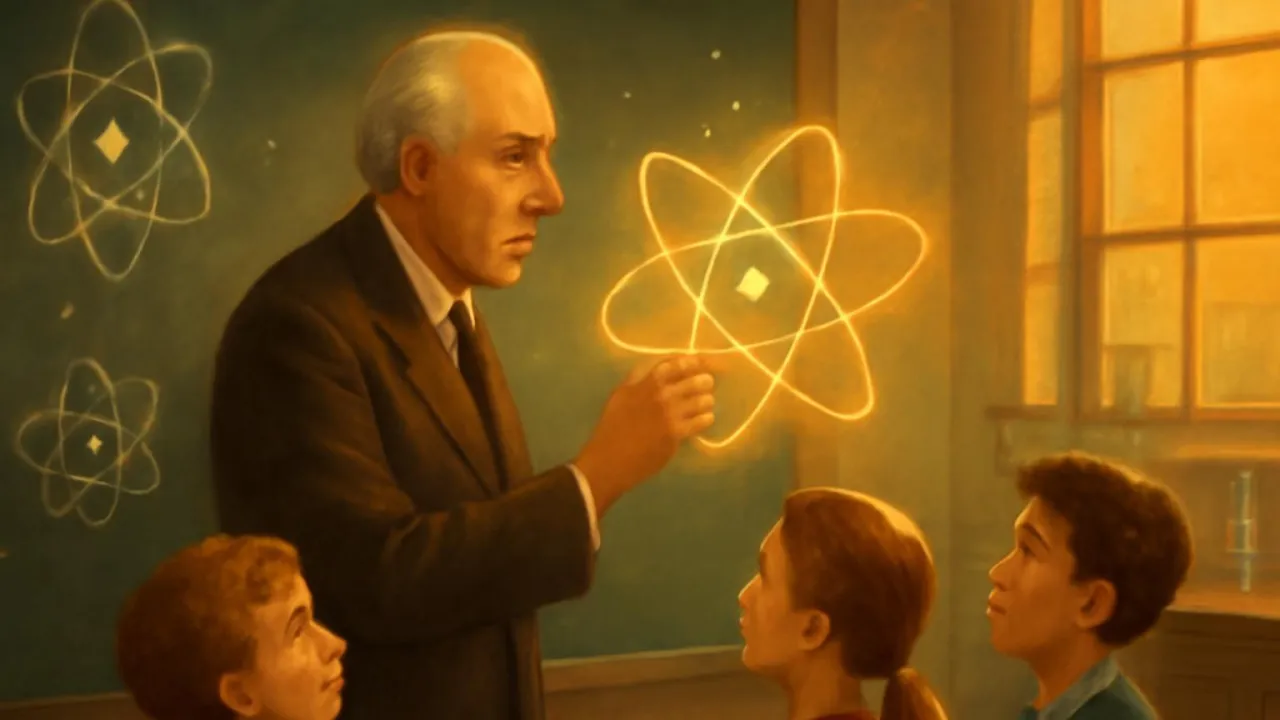
Niels Bohr’s ideas helped invent computers and new medicines.
✨ Word Sparks (Grade 2 Glossary)
Tap 🔊 to hear
experiment
A test to learn something new
matter
Anything that takes up space
famous
Known by many people
🪝
Have you ever wondered what makes up everything around you?
1
Curious Young Mind
Niels Bohr loved to ask questions about the world. He wanted to know how things worked, even things too tiny to see. He read science books and did simple with his brother.
2
Hard Work and Practice
Niels studied hard in school and practiced solving tough problems. He spent hours drawing pictures of atoms and thinking about their parts. He did not give up when things were hard.
3
A Big Science Idea
Niels made a new model to show how atoms work. His idea helped other scientists understand better. He became for changing how we see tiny things.
Niels Bohr’s face is on Denmark’s 500-kroner banknote because of his impact!
✨ Word Sparks (Grade 3 Glossary)
Tap 🔊 to hear
electron
A tiny particle that moves around an atom
nucleus
The center part of an atom
perseverance
Not giving up, even when it is hard
🪝
Can you imagine a world where atoms have tiny orbits, like planets around the sun?
1
A Curious Boy in Copenhagen
As a child in Denmark, Niels Bohr was always curious about how things worked. He loved to solve puzzles and read about science with his younger brother. His father, a professor, encouraged him to ask questions and explore new ideas.
2
Thinking About the Invisible
Niels became fascinated by atoms, which are too small to see even with a microscope. In school, he learned about , protons, and neutrons, the parts that make up an atom. He wondered how these pieces fit together and move.
3
Creating the Bohr Model
After many experiments and lots of , Niels made a new model of the atom. He showed that travel in orbits around the , similar to how planets move around the sun. This idea helped scientists understand atomic structure and energy.
4
Changing Science Forever
Niels Bohr’s work led to huge changes in physics and chemistry. His discoveries helped explain how light and energy work at the atomic level. He won the Nobel Prize and inspired many future scientists to keep exploring the unknown.
Niels Bohr helped protect scientists during World War II by inviting them to his lab in Denmark.
✨ Word Sparks (Grade 4 Glossary)
Tap 🔊 to hear
quantum theory
The science of very tiny particles
orbit
A path that something follows around another thing
mentor
A wise teacher who helps others learn
🪝
What if you could unlock the secrets inside every atom in the universe?
1
A Childhood Full of Questions
Growing up in early 1900s Copenhagen, Niels Bohr was surrounded by science and curiosity. His father was a respected professor who encouraged Niels and his brother to experiment and ask questions about nature. Niels loved to tinker, often building gadgets and testing ideas with his family at home.
2
The Puzzle of the Atom
As a young man, Niels became fascinated by the mysteries of atoms—tiny particles making up all matter. Scientists at the time could not explain why atoms behaved in strange ways. Niels studied physics at university, learning about electrons, energy, and the new field of .
3
Inventing the Bohr Model
In 1913, after countless experiments and deep thinking, Niels introduced a revolutionary model of the atom. He proposed that electrons move in set around the nucleus, absorbing or releasing energy as they jump between these orbits. This idea explained patterns in light and changed how scientists understood atomic structure forever.
4
A Legacy of Discovery
Niels Bohr’s discoveries transformed physics and led to new inventions, including computers and medical tools. He won the Nobel Prize in Physics in 1922 and became a to other great scientists. Today, his ideas are still taught in classrooms around the world, inspiring new generations to explore the mysteries of science.
Niels Bohr’s Nobel Prize medal was secretly dissolved in acid during World War II to keep it safe from the Nazis, then later recovered and restored!
✨ Word Sparks (Grade 5 Glossary)
Tap 🔊 to hear
quantum mechanics
The science of how tiny particles behave
energy level
A place where electrons can move in an atom
collaboration
Working together to solve problems
🪝
Imagine peering deep inside matter and discovering a hidden order to the universe’s tiniest building blocks.
1
A Childhood of Curiosity and Experimentation
In bustling Copenhagen, young Niels Bohr was always eager to understand how nature worked, often conducting creative experiments with his younger brother Harald. Encouraged by his father, a physiology professor, Niels developed a passion for asking questions and solving scientific puzzles. He spent hours tinkering with household objects, inventing clever ways to test his ideas about physics and chemistry. His early experiments, such as measuring the surface tension of liquids, won him recognition in school science contests. This spirit of curiosity and hands-on learning set the foundation for his groundbreaking discoveries.
2
The Atomic Puzzle and Quantum Leap
As Bohr advanced in his studies, he became fascinated by the mysterious structure of atoms, which defied easy explanation. At the time, physicists struggled to explain why electrons did not simply spiral into the nucleus and why atoms emitted light in specific colors. Drawing on the new ideas of quantum theory, Bohr proposed that electrons travel in fixed orbits, or , around the nucleus and can only gain or lose energy by jumping between these levels. His revolutionary 'Bohr Model' explained the patterns of light seen in hydrogen and became a cornerstone of modern atomic physics.
3
Collaboration, Mentorship, and the Copenhagen Spirit
Bohr’s laboratory in Copenhagen became a global center for scientific , attracting young physicists from all over the world. He believed in open discussion, teamwork, and sharing ideas freely, which helped launch the careers of many future Nobel Prize winners. During World War II, Bohr courageously helped Jewish and refugee scientists escape danger by inviting them to work in his lab or helping them flee to safety. His generosity and leadership made Copenhagen a beacon of hope for science and humanity.
4
Legacy in Science and Society
Bohr’s discoveries transformed not only physics but also technology and medicine. His atomic model paved the way for , nuclear energy, and the development of computers, lasers, and new medical treatments. He received the Nobel Prize in Physics in 1922 and published many influential papers that shaped scientific thinking for decades. Even after the war, Bohr advocated for responsible use of atomic energy and international cooperation among scientists to promote peace.
5
Inspiration for Future Generations
Today, Niels Bohr’s name stands as a symbol of curiosity, creativity, and scientific courage. His face appears on Denmark’s currency, and his ideas are taught in classrooms worldwide. Bohr’s approach to science—asking bold questions, embracing teamwork, and persevering through challenges—continues to inspire students and researchers. His life reminds us that exploring the unknown can change the world and that anyone, with enough curiosity and effort, can unlock the secrets of nature.