1. Why does 'plastic' show up inside the word neuroplasticity?
2. What happens inside your brain when you keep trying a tricky puzzle?
🤯 Mind-Blowing Fact • Grade 2
People who learn to juggle three balls for just a few weeks show measurably thicker motion-tracking zones on brain scans!
✨ Word Sparks (Grade 2 Glossary)
Tap 🔊 to hear
pathway
Connected trail of neurons carrying brain signals
adapt
Adjust smoothly to new challenges or changes
growth mindset
Knowing effort and practice grow your abilities
🪝
How is learning a new language or sport like blazing a hiking trail through the woods?
1
Trails Through a Forest
Picture walking through tall grass in a sunny meadow for the very first time. On your first trip, pushing through takes real effort! Your brain works the exact same way when you learn fractions, chess, or cartwheels.
2
Neurons Spark Across Gaps
Inside your brain, billions of star-shaped cells called neurons pass tiny electrical and chemical notes across microscopic meeting spots. The more you walk a mental trail, the wider, clearer, and faster that becomes!
3
Tidying Unused Paths
Meanwhile, grassy trails you never use slowly fade back down so your favorite highways get extra energy. Your brain isn't fixed at birth—curiosity, reading, and practice keep remodeling it every single day!
1. In the forest-trail example, what makes a brain pathway wider and faster?
2. What happened on brain scans when volunteers practiced juggling for several weeks?
🤯 Mind-Blowing Fact • Grade 3
London taxi drivers who memorize 25,000 winding city streets grow a significantly larger back hippocampus—their brain's built-in GPS hub!
✨ Word Sparks (Grade 3 Glossary)
Tap 🔊 to hear
synapse
Tiny gap where two neurons trade signals
dendrite
Branching neuron arm that receives incoming messages
synaptic pruning
Trimming unused nerve links to boost efficiency
🪝
What does the famous brain rule 'neurons that fire together, wire together' mean?
1
Trillions of Tiny Bridges
Close your eyes and listen to birds chirping outside—right now, electrical sparks are leaping across trillions of microscopic junctions in your brain! Each neuron stretches out root-like branches called and long cables called axons, meeting neighbor cells across tiny gaps named .
2
Fire Together, Wire Together!
Canadian scientist Donald Hebb discovered a golden rule of brain power: neurons that fire together, wire together! Whenever two neurons team up while you read Spanish words or solve multiplication, they sprout extra receptor buds and send stronger chemical signals across their .
3
Synaptic Pruning Cleans House
Young kids actually have more than grown-ups! As you grow, your brain acts like a clever gardener, trimming away weak, unused connections—a process called —so the pathways you care about run at top speed.
4
Super-Senses and Recovery
Neuroplasticity also helps brains adapt in amazing ways. In people who are blind, visual cortex neurons rewire themselves to help read Braille bumps by fingertip touch or pinpoint quiet echoes!
1. What happens when two neurons 'fire together' repeatedly while you learn?
2. How did memorizing 25,000 streets physically change London taxi drivers' brains?
🤯 Mind-Blowing Fact • Grade 4
In the 1960s, UC Berkeley anatomist Marian Diamond proved for the first time that rats given puzzles, wheels, and playmates grew measurably thicker cerebral cortices than bored rats!
✨ Word Sparks (Grade 4 Glossary)
Tap 🔊 to hear
dendritic spine
Tiny bud on neuron branch forming synapses
BDNF
Brain protein nourishing neuron growth and links
cerebral cortex
Wrinkled outer brain layer handling complex thought
🪝
Why did scientists once believe adult brains couldn't change—and what proved them completely wrong?
1
Shattering the 'Fixed Brain' Myth
Imagine a machine that upgrades its own circuit board every time it solves a harder problem—that living marvel sits right inside your skull! For much of the twentieth century, doctors believed the human brain hardened like concrete after childhood. Pioneering neuroscientists Marian Diamond, Michael Merzenich, and Eleanor Maguire overturned that myth, proving that enriched environments, music, and navigation remodel cortical maps across every decade of life.
2
Functional Versus Structural Plasticity
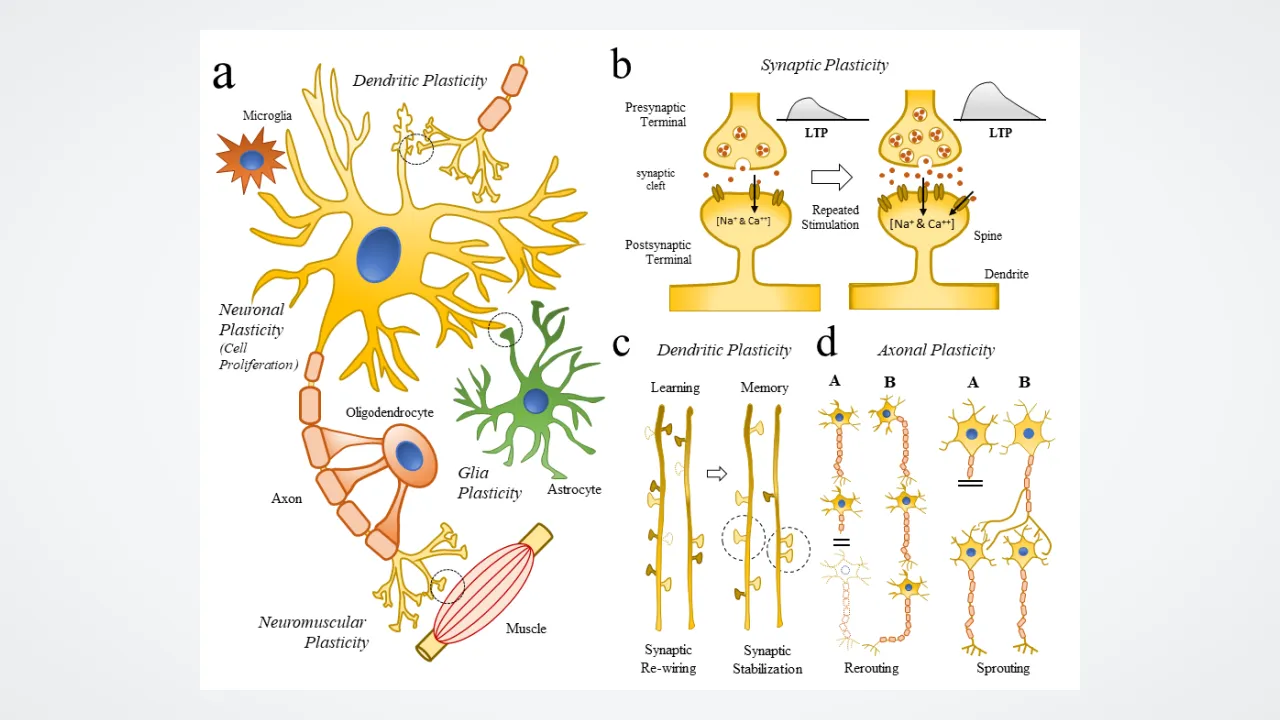
Neuroplasticity operates on two timescales. Functional plasticity happens within minutes to hours—strengthening existing synapses through a chemical boost called long-term potentiation, or shifting tasks from an injured brain area to healthy neighbors. Structural plasticity unfolds over days and months as dendrites sprout microscopic mushroom-shaped spines, support cells thicken myelin, and blood capillaries expand to feed active zones.
3
Childhood Critical Periods
Childhood and adolescence are peak construction seasons! Because young brains produce extra growth factors like —nicknamed 'Miracle-Gro for the brain'—kids soak up spoken accents, instruments, and sports faster than adults.
4
Habits That Supercharge Plasticity
Aerobic exercise boosts levels, deep sleep cements fresh , and tackling productive mistakes releases acetylcholine and norepinephrine—chemicals that spotlight exact synapses marked for an upgrade!
1. What did Marian Diamond's classic 1960s experiments reveal about enriched environments?
2. Which everyday habits boost BDNF and help cement new dendritic spines?
🤯 Mind-Blowing Fact • Grade 5
Two-photon laser microscopy lets modern neuroscientists watch living neurons sprout brand-new mushroom-shaped dendritic spines within minutes of learning a challenging task!
✨ Word Sparks (Grade 5 Glossary)
Tap 🔊 to hear
long-term potentiation
Lasting strengthening of synapses firing repeatedly together
How do calcium ions, NMDA glutamate receptors, and two-photon laser microscopes let scientists watch single memory spines sprout in real time?
1
From Santiago Ramón y Cajal to Modern Connectomics
Peer through a two-photon laser microscope into living cortex while a mammal learns a new tactile task, and you can literally watch microscopic dendritic spines bud, swell, and lock onto neighboring axon terminals within hours! Over a century ago, Spanish Nobel laureate Santiago Ramón y Cajal sketched intricate neuron arbors and boldly proposed that mental exercise might sprout new protoplasmic branches. Yet dogma held fast to an immutable adult brain until Marian Diamond's cortical thickness studies in 1964 and Michael Merzenich's somatosensory remapping experiments proved cortical real estate is dynamically competitive.
2
Molecular Machinery of Long-Term Potentiation
At the molecular core of Donald Hebb's 1949 postulate lies (LTP), first demonstrated in rabbit hippocampal slices by Terje Lømo and Timothy Bliss in 1973. When a presynaptic axon repeatedly releases glutamate while the postsynaptic dendrite is simultaneously depolarized, magnesium ions pop out of channels. Calcium ions rush inward, activating CaMKII enzymes that insert extra AMPA receptors into the postsynaptic membrane and polymerize actin filaments to enlarge the spine head—doubling synaptic sensitivity!
3
Long-Term Depression, Microglia, and Pruning
Runaway excitation would overwhelm neural networks with noise, so brains balance LTP with Long-Term Depression (LTD) and homeostatic scaling. Immune-like glial cells called patrol cortical neighborhoods, tagging underused synapses with complement proteins to prune redundant wiring—peaking during childhood and adolescence so signal-to-noise efficiency soars.
4
Cross-Modal Reorganization and Neurorehabilitation
In Eleanor Maguire's famous MRI studies of London cabbies completing 'The Knowledge,' years of spatial mapping enlarged posterior hippocampal gray matter. Even more dramatically, after focal stroke or congenital blindness, surviving perilesional or occipital visual circuits undergo cross-modal recruitment—processing Braille somatosensory input or echolocation clicks—guided by targeted physical therapy and brain-derived neurotrophic factor (BDNF).
5
Lifelong Agency Over Your Connectome
While developmental 'critical periods' close partially as inhibitory perineuronal nets stabilize adult circuits, focused attention—gated by nucleus basalis acetylcholine—keeps neuroplasticity active from infancy into old age, turning every deliberate challenge into living architecture.