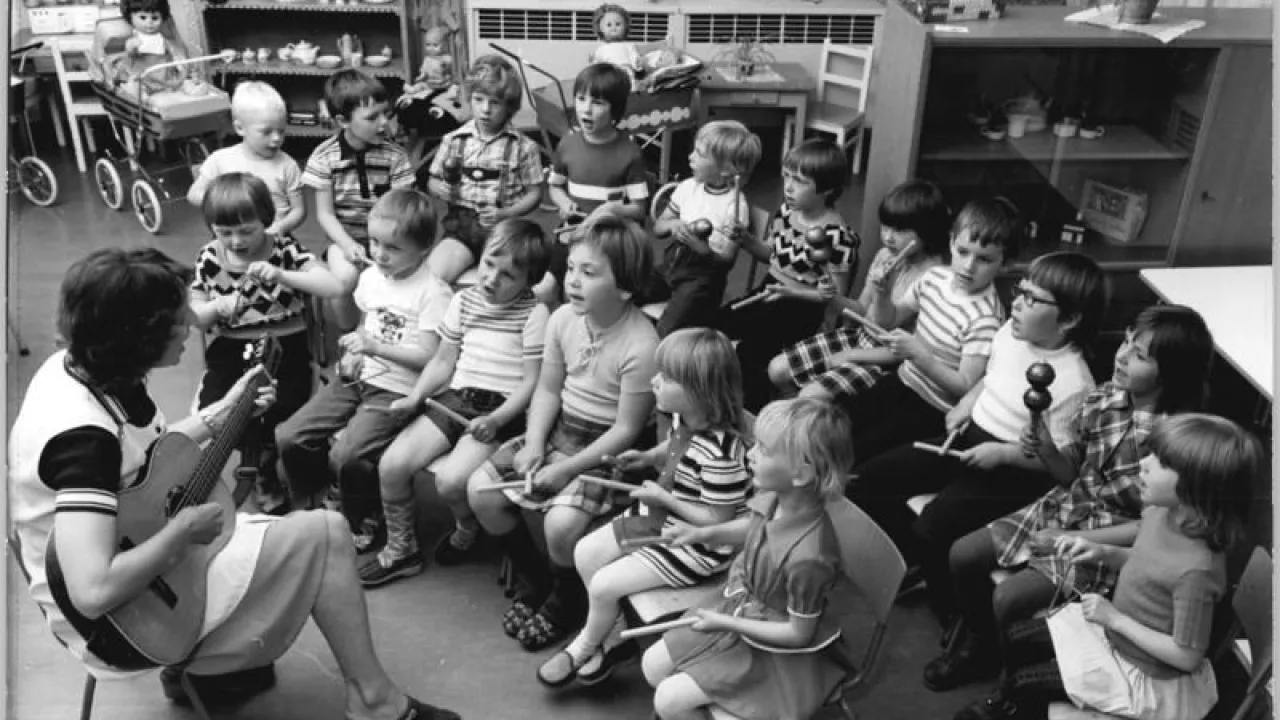
1. Which instruments might first graders explore with their music teacher?
2. What do we call the main tune of a song that you can hum?
🤯 Mind-Blowing Fact • Grade 2
During college, future school music teachers take hands-on classes learning how to play almost EVERY single band and orchestra instrument!
✨ Word Sparks (Grade 2 Glossary)
Tap 🔊 to hear
staff
Five lines and four spaces holding notes
pitch
How high or low a note sounds
metronome
Clicking tool keeping a steady practice beat
🪝
How does one music teacher know how to play trumpets, violins, pianos, AND drums?
1
A Room Full of Music
Step across the rainbow rug of an elementary music room! Colorful posters of musical notes line the walls while ukuleles, recorders, and hand drums wait neatly on wooden shelves.
2
Reading Secret Note Codes
Music teachers show kids how five horizontal lines—called a —turn round black dots into real melodies! Funny sayings like 'Every Good Boy Does Fine' help students remember note names fast.
3
Band, Strings, and Chorus
As students grow older, music teachers coach beginning band, string orchestra, and chorus, fixing stuck trumpet valves and cheering every brave solo!
1. How many lines make up a standard musical staff for reading notes?
2. What clicking tool helps music students practice at a steady speed?
🤯 Mind-Blowing Fact • Grade 3
Public school music education in America began in Boston in 1838 when pioneer teacher Lowell Mason proved to the school board that every child—not just a lucky few—could learn to sing and read music!
✨ Word Sparks (Grade 3 Glossary)
Tap 🔊 to hear
scale
Ladder of musical notes stepping up or down
quarter-note
Musical note receiving one beat in 4/4
folk-song
Traditional community song passed down through generations
🪝
Why does clapping quarter notes and eighth notes secretly make you stronger at fractions?
1
Where Math and Music Meet
Count 'one-and-two-and-three-and-four-and' while tapping your foot! Music teachers love showing how rhythm is living fractions: one whole note splits into two half notes, four quarter notes, or eight quick eighth notes!
2
Do-Re-Mi Hand Signs
Many elementary music teachers teach 'Solfege'—singing Do, Re, Mi, Fa, Sol, La, Ti, Do—paired with special Curwen hand shapes held from waist to forehead so students can see and feel pitch climbing up a musical .
3
Exploring World Music Heritage
Through American folk songs, West African djembe drumming circles, Virginia Appalachian fiddle tunes, jazz blues, and historic spirituals, music teachers connect songs directly to social studies and geography.
4
Private Studio Mentors Too
Outside K–12 public schools, private studio music teachers offer encouraging one-on-one piano, acoustic guitar, violin, flute, percussion, or voice lessons inside community arts centers, churches, and neighborhood studios.
1. How many quarter notes equal one whole note in 4/4 time?
2. Who proved in 1838 in Boston that music belonged in American public schools for every child?
🤯 Mind-Blowing Fact • Grade 4
Every year since 2014, the Recording Academy presents a special GRAMMY Music Educator Award to honor an inspiring American school teacher whose classroom sparked lifelong love of music!
✨ Word Sparks (Grade 4 Glossary)
Tap 🔊 to hear
improvise
Create new musical melodies on the spot
harmony
Two or more notes sounding pleasing together
fluency
Reading or playing smoothly with confident accuracy
🪝
What happens inside your brain when a music teacher teaches you to play an instrument?
1
A Full-Brain Fireworks Workout!
Neuroscientists studying live brain scans discovered something remarkable: while quietly listening to a song lights up several brain regions, actively playing a musical instrument sparks a 'full-brain fireworks show'! Decoding note symbols on a staff, moving left and right hands independently, checking pitch by ear, and counting steady beats strengthen working memory, attention, and reading .
2
Proven Teaching Methods: Orff and Kodály
Elementary music specialists train in joyful, research-backed teaching methods created by composers Carl Orff and Zoltán Kodály. Classroom Orff instruments—warm rosewood xylophones and shimmering metal metallophones with removable tone bars—let fourth graders arrange five-note pentatonic scales and team harmonies right away without clashing notes!
3
Repair Tech, Conductor, and Cheerleader
Middle and high school band, string orchestra, and choral teachers wear ten different hats before lunchtime! Between coaching healthy posture, steady breath support, and expressive dynamics, they replace snapped cello strings, oil sticky trumpet valves, seat seventy nervous beginners, and organize winter and spring community concerts.
4
Building Lifelong Patience and Grit
Learning a tricky sixteen-measure clarinet or piano melody teaches a superpower useful in every school subject: breaking a tough challenge into slow, four-note practice chunks with a steady metronome until patient effort turns into proud, confident mastery on stage.
1. Why are Carl Orff's classroom xylophones great for young composers?
2. What have brain-scan scientists discovered about learning to play a musical instrument?
🤯 Mind-Blowing Fact • Grade 5
Neuroscience studies show that musicians have a measurably larger corpus callosum—the thick bundle of over 200 million nerve fibers connecting the brain's analytical left hemisphere and creative right hemisphere!
✨ Word Sparks (Grade 5 Glossary)
Tap 🔊 to hear
pedagogy
Science and art of effective classroom teaching
embouchure
How lips and facial muscles shape wind-playing
repertoire
Collection of musical pieces prepared for performance
🪝
How do music educators combine acoustic pedagogy, developmental psychology, and ensemble leadership?
1
Sound Before Symbol Pedagogy
Research-driven music instruction mirrors the natural way young children master their first spoken language: 'sound before symbol.' Drawing upon Edwin Gordon's Music Learning Theory, Zoltán Kodály's folk-song solfège sequence, and Émile Jaques-Dalcroze's kinesthetic eurhythmics, certified music educators build internal tonal and rhythmic audiation through singing, movement, and call-and-response echoing long before introducing written five-line notation, time signatures, and key signatures.
2
Vocal Physiology and Instrumental Mechanics
Licensed K–12 music specialists study human anatomy and acoustic physics alongside music theory. Choral directors safeguard growing pediatric vocal folds—coaching relaxed diaphragmatic breathing and pure vowel resonance without vocal strain—while band and orchestra educators diagnose brass lip angles, woodwind reed vibrations, timpani rebound strokes, and violin bow weight across more than fifteen distinct acoustic instruments.
3
Virginia Fine Arts and National Standards
Aligned with the Virginia Music Standards of Learning (SOL) and National Core Arts Standards, sequential school music programs cultivate four interconnected artistic literacies: Creating original compositions and melodic improvisations, Performing varied ensemble expressively, Responding thoughtfully to musical form, and Connecting American jazz, classical symphonies, Appalachian folk ballads, and global traditions to civic history.
4
Adaptive Music Technology and Inclusion
Contemporary music classrooms champion universal accessibility through adaptive instruments—including 3D-printed one-handed recorder brackets, color-coded resonant Boomwhacker tubes, wheelchair-accessible mallet stands, and tablet-based digital audio workstations—ensuring students of every physical and neurodiverse profile experience genuine ensemble belonging and creative pride.
5
Academic Preparation and Licensure
Public-school music teachers complete an intensive four-year Bachelor of Music Education (B.M.E.) degree combining harmony, ear training, conducting, woodwind, brass, string, and percussion laboratory courses, full-time classroom student teaching, and state educator licensure exams.