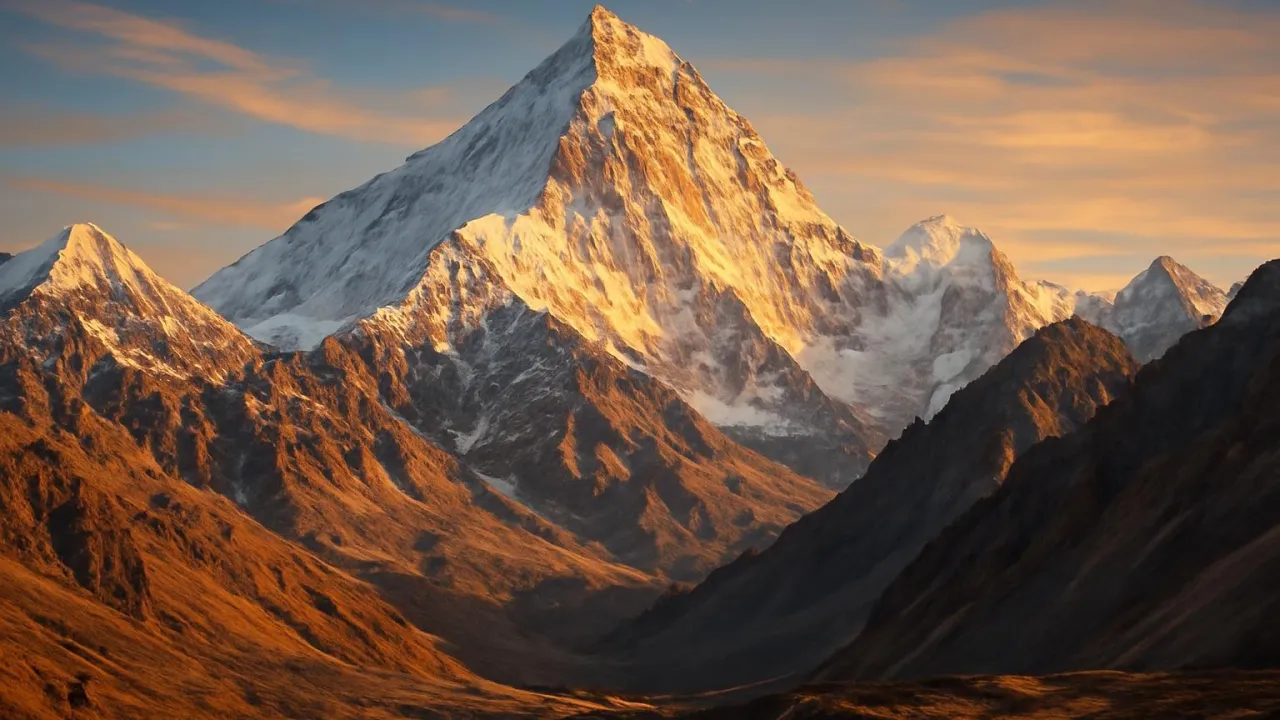
The air at Everest’s top is so thin, jet planes sometimes fly even lower!
✨ Word Sparks (Grade 3 Glossary)
Tap 🔊 to hear
tectonic
Huge plates that move Earth's crust
erosion
Wearing away by wind or water
summit
The very top of a mountain
🪝
What sounds do you think echo at the top of the world?
1
The Roof of the World
Mount Everest rises high above the clouds, making it the tallest peak on Earth. Its is covered in thick snow and ice, with fierce winds that howl day and night. The mountain sits on the border between Nepal and China, in the mighty Himalayas. People call it 'Sagarmatha' in Nepal and 'Chomolungma' in Tibet.
2
How Everest Was Formed
Millions of years ago, giant plates collided and pushed up the land. This collision created the Himalayas, including Everest, which is still rising today. The mountain’s rocky layers show how Earth’s crust was folded and lifted. from wind and snow slowly shapes its steep slopes.
3
Climbing Challenges
Climbers face freezing temperatures and thin air at high altitude. They need oxygen tanks and special gear to survive the dangerous journey. Local guides called Sherpas and strong yaks help carry supplies up the mountain. Only a few people reach the each year because it is so difficult.
4
A Symbol of Adventure
Everest is a monument to nature’s power and human courage. Its height is measured at 29,032 feet, but it grows a little each year. Scientists study its rocks and weather to learn about Earth’s history. Many dream of standing on its windy, snowy .
Everest’s summit is so high, you could see the curve of Earth on a clear day!
✨ Word Sparks (Grade 4 Glossary)
Tap 🔊 to hear
geology
The study of rocks and Earth
glacier
A huge, slow-moving river of ice
oxygen
The air we need to breathe
🪝
What would you hear if you stood on Everest’s summit—wind, silence, or your own heartbeat?
1
Earth’s Tallest Wonder
Mount Everest towers above the Himalayas, reaching 29,032 feet into the sky on the border of Nepal and Tibet. Its summit is so high that the air contains only about one-third as much as at sea level. The mountain’s Nepali name, Sagarmatha, means 'Forehead of the Sky,' while Tibetans call it Chomolungma, or 'Goddess Mother of the World.'
2
How Everest Came to Be
Everest formed when the Indian and Eurasian tectonic plates collided around 60 million years ago, forcing rock layers upward. This ongoing collision continues to push Everest higher by a few millimeters each year. The mountain’s steep slopes are shaped by erosion from wind, snow, and glacial ice. Scientists study Everest’s to understand the powerful forces that shape our planet.
3
The Climb of a Lifetime
Climbing Everest is extremely challenging due to freezing temperatures, hurricane-force winds, and dangerously thin air. Most climbers use tanks and wear insulated suits to survive near the summit. Sherpa guides and yaks are essential for carrying heavy loads and setting up camps along the route. Only experienced climbers attempt the final ascent, which tests both physical strength and mental determination.
4
Everest’s Global Impact
Mount Everest inspires explorers, scientists, and adventurers from all over the world. Its provide water for millions of people living downstream in Asia. The mountain is a symbol of natural beauty and human achievement, but it also faces threats from climate change and overcrowding. Protecting Everest’s environment is important for future generations.
1. Why do climbers need oxygen tanks near Everest’s summit?
2. What is one way Everest helps people far away?
🤯 Mind-Blowing Fact • Grade 5
Everest’s summit is so high, climbers can see over 200 miles into Tibet and Nepal on a clear day!
✨ Word Sparks (Grade 5 Glossary)
Tap 🔊 to hear
tectonic uplift
Earth’s plates pushing land higher
acclimatize
Getting used to thin mountain air
jet stream
Fast, high winds in the upper atmosphere
🪝
If you could measure the wind at Everest’s summit, would it sound like a whisper or a roaring jet?
1
A Peak Above All Others
Mount Everest stands as the highest mountain on Earth, soaring 29,032 feet (8,849 meters) above sea level at the border of Nepal and China’s Tibet Autonomous Region. Its summit pierces the , where winds can exceed 200 miles per hour and temperatures plunge to -76°F (-60°C). The mountain’s immense height is a result of ongoing , with the Indian Plate pushing beneath the Eurasian Plate, causing Everest to rise by about 4 millimeters every year.
2
Geological Origins and Dynamic Growth
Everest’s formation began approximately 60 million years ago, when the collision of continental plates forced ancient seafloor rocks skyward. The summit’s rocks, called limestone and shale, were once part of the ocean bed, now visible at the very top of the world. Erosion from glaciers, avalanches, and fierce winds sculpts Everest’s steep faces, while periodic earthquakes can shift its height by several centimeters. Scientists use GPS and satellite technology to track these changes with remarkable precision.
3
Climbing Everest: Engineering and Human Limits
Ascending Everest requires overcoming the 'Death Zone,' a region above 26,000 feet where oxygen levels are dangerously low. Climbers rely on supplemental oxygen, insulated clothing, and advanced climbing gear to survive the extreme cold and unpredictable weather. Sherpa guides, renowned for their endurance and expertise, establish fixed ropes and ladders across deep crevasses and icefalls. The journey to the summit typically takes weeks, with climbers acclimatizing at multiple camps to prevent altitude sickness.
4
Everest’s Global Significance and Environmental Challenges
Mount Everest is not only a symbol of adventure but also a vital water source, as its glaciers feed major Asian rivers like the Ganges, Brahmaputra, and Yangtze. The mountain attracts thousands of climbers and trekkers each year, boosting Nepal’s economy but also creating environmental concerns, such as waste accumulation and ecosystem disruption. Melting glaciers due to global warming threaten water supplies for millions and alter the mountain’s delicate balance.
5
Preserving the Summit for Future Generations
Scientists, governments, and local communities are working together to protect Everest’s fragile environment. New regulations limit the number of climbers and require the removal of trash and equipment from the slopes. Ongoing research on climate change, geology, and high-altitude biology provides valuable insights into Earth’s processes and the impacts of human activity. As the tallest point on the planet, Everest challenges us to balance exploration with responsibility.