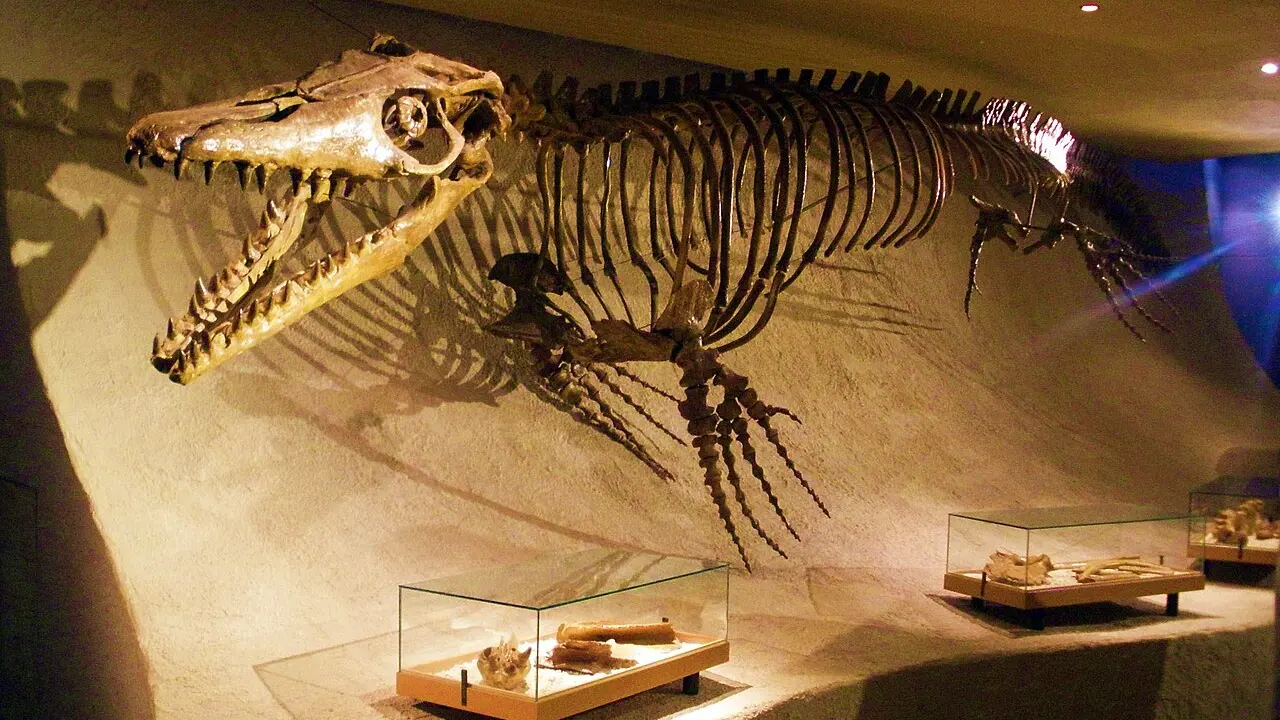
2. Where did Mosasaurus have a surprising extra set of teeth?
🤯 Mind-Blowing Fact • Grade 2
Studying the giant Maastricht skull in Paris helped French scientist Georges Cuvier prove for the very first time that whole species could go completely extinct!
✨ Word Sparks (Grade 2 Glossary)
Tap 🔊 to hear
Extinct
No longer having any living members anywhere
Ammonite
Extinct squid cousin inside coiled spiral shell
Crescent
Curved shape like a new moon
🪝
How did chalk miners in the Netherlands find the skull that taught the world about extinction?
1
Found Under a Hill
Picture dark candlelit tunnels under Mount Saint Peter near Maastricht in the Netherlands! In the 1700s, limestone miners uncovered enormous four-foot jaws lined with stout cone teeth. Named Mosasaurus—meaning lizard of the Meuse River—it became one of the first giant prehistoric reptiles ever studied by scientists!
2
Built Like a Shark Torpedo
Early artists drew Mosasaurus wiggling like a slow eel with a flat ribbon tail. Modern fossils with skin outlines revealed something way cooler: its powerful tail ended in a tall fluke just like a shark's!
3
Top Hunter of the Sea
Stretching roughly fifty feet long, Mosasaurus used its four webbed flippers to steer while chasing giant sea turtles, sharks, and .
2. What shape did modern skin-impression fossils prove Mosasaurus had at the end of its tail?
🤯 Mind-Blowing Fact • Grade 3
Fossilized scales show Mosasaurus cousins were dark on top to blend into deep water from above and pale underneath to blend into bright sky from below!
✨ Word Sparks (Grade 3 Glossary)
Tap 🔊 to hear
Countershading
Dark back and light belly ocean camouflage
Palate
Bony roof inside an animal's mouth
Leviathan
Enormous, powerful creature of the sea
🪝
Why did Mosasaurus give birth to live swimming babies far out at sea instead of laying eggs on beaches?
1
Rulers of the Final Cretaceous Seas
Dive seventy million years back into the warm Late Cretaceous Atlantic! Earlier sea reptiles like ichthyosaurs had vanished, leaving an open ocean throne. Rapidly evolving from three-foot land lizards into fifty-foot , Mosasaurus hoffmannii became the undisputed apex predator of global seas!
2
Snake-Style Hinged Jaws
Because mosasaurs were close cousins of snakes and Komodo dragons, their lower jaws possessed a flexible middle hinge! When biting large fish, plesiosaurs, or spiral-shelled ammonites, its jaws bowed wide while two rows of hooked pterygoid teeth on the walked meals down its throat.
3
Born Ready to Swim
Weighing over ten tons with paddle limbs instead of walking legs, an adult Mosasaurus could never crawl onto sandy beaches to bury eggs. Instead, fossilized embryos in cousin mosasaurs prove mothers gave birth to live, active youngsters right in the water!
4
Countershaded Camouflage
Microscopic pigment fossils show mosasaurs wore dark backs and pale bellies—the exact camouflage pattern great white sharks and orcas wear today!
1. How did Mosasaurus mothers bring babies into the ocean?
2. How did dark-top, light-belly countershading help Mosasaurus?
🤯 Mind-Blowing Fact • Grade 4
Mosasaurus received its scientific name in 1822—nearly twenty years before Sir Richard Owen invented the word 'Dinosauria' in 1842!
✨ Word Sparks (Grade 4 Glossary)
Tap 🔊 to hear
Squamate
Reptile order uniting lizards and snakes
Viviparity
Giving birth to live developed offspring
Carangiform
Swimming powered mainly by rear tail strokes
🪝
How did a four-foot fossil skull dug from a Dutch quarry in 1780 launch the modern science of paleontology?
1
The Grand Beast of Maastricht
In 1780, chalk quarrymen working beneath St. Peter's Mountain near Maastricht in the Netherlands unearthed an astonishing 1.2-meter skull bristling with heavy, faceted teeth. Claimed by retired army surgeon Dr. Johann Leonard Hoffmann and later carried to Paris in 1794, the 'Grand Beast of Maastricht' puzzled Europe's finest thinkers: was it a crocodile, a toothed whale, or a giant fish?
2
Proving Extinction Was Real
Examining its jaw joints and palate teeth in Paris, comparative anatomist Georges Cuvier realized the creature was a gigantic extinct marine lizard unlike anything still swimming in modern oceans! Named Mosasaurus hoffmannii in the 1820s—sixteen years before the word 'dinosaur' was even coined—it helped convince science that entire prehistoric worlds had vanished.
3
Biomechanics of a 15-Meter Predator
Reaching 14 to 17 meters (45 to 56 feet) and 10 to 15 metric tons—far more realistic than exaggerated 100-foot movie monsters, yet still rivaling a humpback whale!—Mosasaurus hoffmannii combined raw bite power with hydrofoil steering. Downward-angled tail vertebrae supported a tall dorsal tail lobe, driving thrust while keeled scales channeled water smoothly across its skin.
4
Sensory Mastery
Large eyes, forked scent-sampling tongues, and pressure-sensitive snout pits allowed Mosasaurus to ambush turtles, ammonites, sharks, and smaller mosasaurs across global Maastrichtian seas.
1. Why was Georges Cuvier's study of the Maastricht Mosasaurus skull a turning point in science history?
2. What tiny feature on mosasaur scales reduced water drag much like modern fast-swimming shark denticles?
🤯 Mind-Blowing Fact • Grade 5
Chemical oxygen isotopes locked inside Mosasaurus tooth enamel show it kept its body temperature warm—around 95 to 102°F (35–39°C)—letting it hunt even in chilly polar Cretaceous seas!
✨ Word Sparks (Grade 5 Glossary)
Tap 🔊 to hear
Hyperphalangy
Evolving extra finger bones inside long flippers
Hypocercal
Tail spine bending down into lower fin
Endothermy
Generating internal warmth to keep body warm
🪝
How did terrestrial squamate lizards transform in fewer than thirty million years into whale-sized ocean apex predators?
1
Birth of Vertebrate Paleontology at Maastricht
Excavated around 1780 from late Maastrichtian (~68–66 MYA) bioclastic limestones near Maastricht, Netherlands, specimen MNHN AC 9648—the famed 'Grand Animal de Maestricht'—catalyzed modern paleontology. Collected by army surgeon Johann Leonard Hoffmann and transported to Paris's Muséum National d'Histoire Naturelle in 1795, the 1.2-meter cranium enabled Georges Cuvier in 1808 to demonstrate squamate affinities and prove catastrophic species extinction—years before William Conybeare (1822) and Gideon Mantell (1829) formalized Mosasaurus hoffmannii.
2
Rapid Adaptive Radiation in Cretaceous Seas
Originating ~98 million years ago from littoral, one-meter varanoid or anguimorph-related squamates (aigialosaurs), mosasaurids capitalized on mid-Cretaceous extinctions of ichthyosaurs and giant pliosaurs. Within twenty-five million years, limbs remodeled via into hydrofoil paddles, pelvic girdles detached from the vertebral column—mandating pelagic viviparity—and tail flukes evolved convergently with sharks and ichthyosaurs.
3
Cranial Kinesis and Pterygoid Ratchet
Stretching 14 to 17 meters long and weighing 10 to 15 metric tons, M. hoffmannii sacrificed extreme skull flexibility for sheer crushing power! Its robust, faceted conical marginal teeth shattered giant cheloniid sea turtle carapaces and pachydiscid ammonite shells, while intramandibular joints between the dentary and splenial-angular bones absorbed violent prey thrashing. Twin rows of recurved pterygoid teeth anchored on the palate functioned as a unidirectional ratchet guiding prey into the esophagus.
4
Endothermy and Melanosome Camouflage
Oxygen-isotope thermometry of mosasaur tooth enamel indicates elevated body temperatures (~35–39°C) sustained above ambient seawater—regional or full fueling active pursuit across high-latitude oceans from New Zealand to Antarctica! Meanwhile, fossilized eumelanosomes confirm dark dorsal countershading.
5
Twilight of the Sea Lizards
Thriving globally until the very end of the Maastrichtian, M. hoffmannii vanished only when the Chicxulub asteroid impact collapsed marine planktonic food webs 66 million years ago.