1. What happens when a harder mineral rubs firmly against a softer mineral?
2. Which two minerals sit at number 1 (softest) and number 10 (hardest) on the Mohs scale?
🤯 Mind-Blowing Fact • Grade 2
Tough quartz sits at number 7 on the Mohs scale—and because floating household dust is full of tiny quartz bits, wiping dry dust across eyeglass lenses can slowly scratch them!
✨ Word Sparks (Grade 2 Glossary)
Tap 🔊 to hear
Mineralogist
A scientist who studies crystals and minerals
Quartz
Common crystal ranked number 7 in hardness
Groove
A real scratch mark left after wiping powder
🪝
How can a copper penny and a fingernail help you solve a rock mystery?
1
Friedrich Mohs's Clever Idea
Over two hundred years ago in 1812, German mineral scientist Friedrich Mohs noticed that plants were grouped by flowers, so he wanted a quick field test for rocks! He picked ten common minerals and ranked them from 1 to 10 by seeing which ones scratched each other.
2
Everyday Pocket Tools
You do not need fancy machines to use the Mohs scale! Your fingernail has a hardness of 2.5, a copper coin is 3.5, window glass is 5.5, and a steel file is 6.5.
3
Wipe Away the Powder!
Smart rock detectives always brush away loose white powder after a scratch test! Sometimes a soft rock just crumbles like chalk against a hard rock without leaving a real .
1. Why should you always brush away loose powder after doing a scratch test?
2. If a mystery crystal easily scratches window glass (5.5), what do you know about its Mohs number?
🤯 Mind-Blowing Fact • Grade 3
Geologists remember all 10 Mohs minerals in order with the silly sentence: 'Tall Gyroscopes Can Fly Around Orbiting Quaking Tornadoes Carrying Diamonds!'
✨ Word Sparks (Grade 3 Glossary)
Tap 🔊 to hear
Apatite
Phosphate mineral at Mohs 5, similar to teeth
Corundum
Mohs-9 mineral that forms rubies and sapphires
Brittle
Hard material that can still crack if hit
🪝
Can you name all ten champion minerals on the Mohs Hardness Scale in order?
1
Meet the Ten Reference Minerals
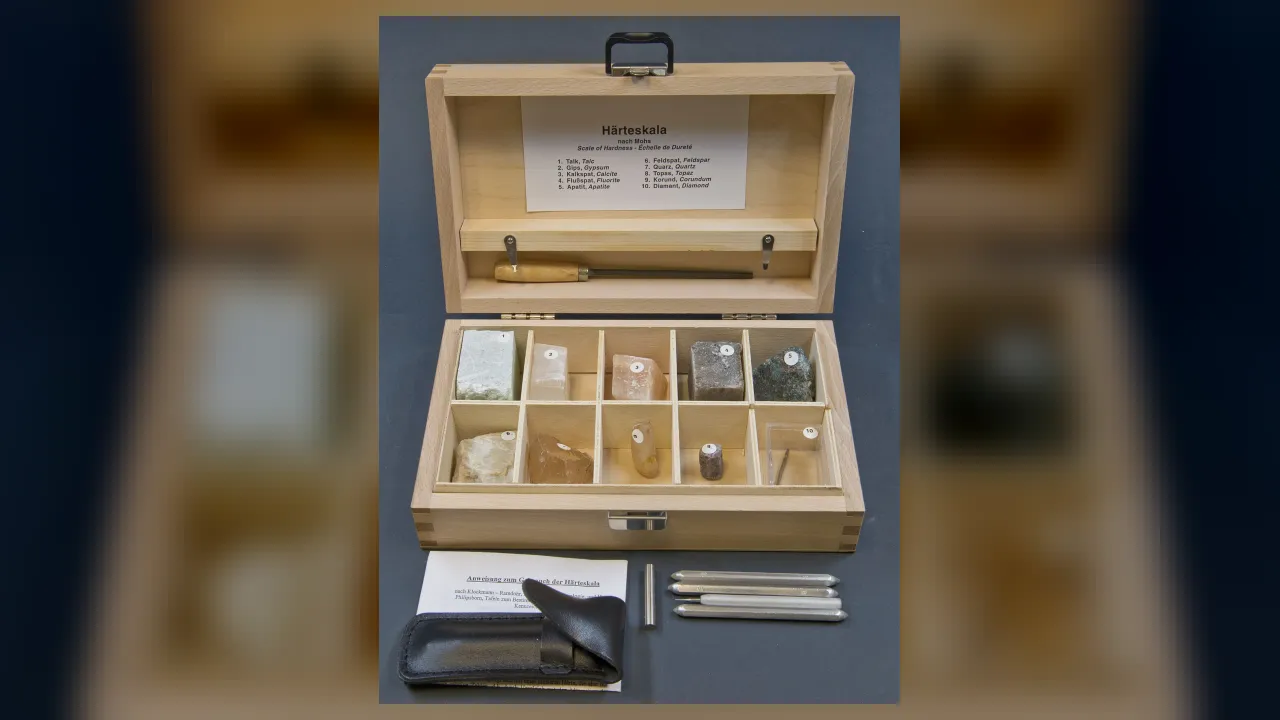
Open a geologist's hardness kit and ten numbered compartments greet you! From softest to hardest, the lineup runs: 1 Talc, 2 Gypsum, 3 Calcite, 4 Fluorite, 5 , 6 Orthoclase Feldspar, 7 Quartz, 8 Topaz, 9 (rubies and sapphires!), and 10 Diamond.
2
A Secret Inside Your Smile
Spot number 5——might sound unfamiliar, yet you carry a form of it everywhere you go! Your tooth enamel is built from tiny crystals related to apatite (hardness 5), which makes your teeth harder than iron nails and fluorite, though softer than quartz sand.
3
Hardness Is Not Unbreakability
Watch out for a tricky science mix-up: 'hardness' only measures scratch resistance, NOT whether a rock shatters when hit with a hammer! Even a level-10 diamond can split along cleavage planes if struck hard, so never whack gemstones with hammers to test them.
4
Spotting Fool's Gold From Real Gold
Gold prospectors love the Mohs scale: real gold is quite soft (2.5–3), while shiny brassy pyrite ('fool's gold') ranks above 6 and scratches steel!
1. Which famous gemstones are actually colorful varieties of Mohs-9 corundum?
2. What is the important difference between a mineral's Mohs 'hardness' and its 'toughness'?
🤯 Mind-Blowing Fact • Grade 4
Virginia hosts one of the largest kyanite mines on Earth at Willis Mountain—producing the remarkable blue 'two-hardness' crystal that tests at 4.5 lengthwise and 7 crosswise!
✨ Word Sparks (Grade 4 Glossary)
Tap 🔊 to hear
Ordinal Scale
A ranking list without equal gaps between steps
Covalent Bond
Super-strong atomic bond formed by sharing electrons
Abrasive
Hard gritty mineral used to grind or polish
🪝
Why is the jump in real hardness from ruby (9) to diamond (10) bigger than the jump from talc (1) all the way to ruby (9)?
1
An Ordinal Scale, Not Evenly Spaced Rungs
Climb a ten-rung wooden ladder, and every rung sits the exact same distance apart. Friedrich Mohs's 1812 hardness scale works differently! It is an ordinal (ranking) scale, meaning number 8 scratches number 7, and number 10 scratches number 9—yet the gaps between numbers are wildly uneven. When engineers measure 'absolute' hardness with diamond-tipped micro-indenters, corundum (9) is roughly twice as hard as topaz (8) and four times harder than quartz (7), while diamond (10) leaps nearly FOUR TIMES harder than corundum!
2
Why Atomic Bonds Control Scratching
What makes one mineral shrug off a steel blade while another crumbles under a thumbnail? Everything comes down to internal crystal chemistry! Soft minerals like talc (1) and gypsum (2) contain weak van der Waals or water-layered bonds that shear apart easily. In contrast, quartz (7), corundum (9), and diamond (10) pack small atoms tightly together with short, powerful three-dimensional covalent or ionic bonds.
3
Directional Hardness Mystery: Kyanite
One blue metamorphic mineral found in Virginia's Piedmont—kyanite—actually breaks the single-number rule! Because kyanite's aluminum silicate chains bind tightly lengthwise and loosely sideways, scratching along the length of a blue kyanite blade yields Mohs 4.5, while scratching straight across its width measures Mohs 7!
4
Smartphone Screens and Industrial Abrasives
Engineers rely on Mohs principles every day: chemically strengthened smartphone glass ranks near 6 to 6.5 (resisting keys and coins in your pocket, though quartz beach sand at 7 can still scratch it!), while corundum sandpaper and diamond-tipped saw blades cut granite and concrete.
1. Why can metal house keys (around Mohs 5) ride in your pocket without scratching a smartphone screen (around 6.5), while a few grains of beach sand can scratch it?
2. Why do scientists describe the Mohs scale as an 'ordinal' (relative) scale rather than a linear scale?
🤯 Mind-Blowing Fact • Grade 5
Graphite pencil lead (Mohs 1.5) and diamond (Mohs 10) are made of the exact same pure carbon atoms—proving that atomic bond geometry alone can turn one of Earth's softest minerals into its hardest!
✨ Word Sparks (Grade 5 Glossary)
Tap 🔊 to hear
Vickers Test
Precision hardness test measuring microscopic diamond indents
Anisotropy
Different physical properties along different crystal directions
Gigapascal
Unit measuring extreme pressure and material stiffness
🪝
How do modern materials scientists measure exact quantitative hardness in gigapascals—and have physicists ever created anything harder than diamond?
1
From Classical Pliny to Vickers and Knoop Indentation
Long before modern X-ray crystallography, ancient naturalists like Theophrastus (c. 300 BCE) and Pliny the Elder noted that diamond scratched every gem. In 1812, Austrian-German mineralogist Friedrich Mohs formalized ten reference standards into a portable qualitative protocol still used on every continent. To quantify true mechanical resistance for engineering, twentieth-century metallurgists developed Vickers and Knoop microhardness tests—pressing a microscopic pyramid of diamond into a polished surface under a calibrated load and measuring indentation area in kilograms-force per square millimeter or (GPa). On the Vickers scale, talc registers ~2.4 kgf/mm², quartz ~1,100, corundum ~2,050, and diamond an astonishing ~10,000 kgf/mm² (~70–100 GPa)!
2
Crystal Lattice Density, Bond Valence, and Pauling's Rules
At the atomic level, mineral hardness reflects bond energy per unit volume. High hardness requires small, highly charged ions or sp3-hybridized atoms packed tightly with high coordination efficiency and zero weak cleavage planes. Compare graphite and diamond—both 100 percent pure carbon (C)! Graphite arranges carbon into flat sp2 sheets held by weak van der Waals forces (Mohs 1–2, soft enough for pencil lead), whereas high-pressure mantle conditions lock diamond's carbon atoms into a rigid 3D tetrahedral sp3 covalent cage (Mohs 10).
3
Hardness Anisotropy and Solid-Solution Trends
Because atomic bond density can vary with crystallographic orientation, hardness is strictly a vector property! Triclinic kyanite (Al2SiO5) famously spans Mohs 4.5–5 parallel to its c-axis chains and 6.5–7 perpendicular to them; even diamond polishers must orient cutting wheels along softer cubic or dodecahedral directions because diamond's octahedral faces resist abrasion almost completely.
4
Superhard Materials Beyond Traditional Minerals
In high-pressure physics labs, engineers synthesize 'superhard' compounds exceeding 40 GPa Vickers hardness—such as cubic boron nitride (c-BN, ~50 GPa), which machines red-hot steel without dissolving like carbon diamond would! Rare meteoritic hexagonal diamond (lonsdaleite) and nanostructured nanotwinned diamond have even shown localized indentation resistance rivaling or slightly surpassing single-crystal terrestrial diamonds.
5
Best Practices in Diagnostic Mineralogy
In field geology, scratch testing is always paired with luster, streak, specific gravity, and cleavage—testing fresh unweathered crystal faces (since surface clay alteration lowers apparent hardness) and performing mutual cross-checks ('Does A scratch B, and does B fail to scratch A?') to distinguish equal-hardness minerals that leave slight mutual marks.