2. What everyday object has stitches shaped like Earth's connected mid-ocean ridges?
🤯 Mind-Blowing Fact • Grade 2
On the island of Iceland, the Mid-Atlantic Ridge rises right out of the ocean so you can walk between two continents on dry land!
✨ Word Sparks (Grade 2 Glossary)
Tap 🔊 to hear
sonar
Using sound echoes to map the ocean floor.
pillow lava
Rounded lava blobs cooled fast in cold seawater.
valley
Low land sitting between two lines of hills.
🪝
How could Earth's longest mountain range stay hidden from people for thousands of years?
1
A Secret Beneath the Sea
Drain away all the water in Earth's oceans in your imagination! Stretching across the seafloor is a connected mountain chain 40,000 miles long. Because miles of salty water cover nearly all of it, explorers did not map mid-ocean ridges until submarines and came along.
2
Pulling Apart in the Middle
Along the top of these mountains runs a steep central . Here, two giant plates slowly pull apart. Hot melted rock squeezes up from below to fill the gap.
3
Pillow-Shaped Lava
When glowing lava touches icy-cold seawater, its outside hardens right away into rounded blobs called . In one special place—the island of Iceland—this underwater ridge actually pokes right above the waves!
1. How did scientists finally discover and map mid-ocean ridges?
2. Where can you walk across part of a mid-ocean ridge on dry land?
🤯 Mind-Blowing Fact • Grade 3
Cartographer Marie Tharp's hand-drawn ocean floor maps in the 1950s discovered the central rift valley along the Mid-Atlantic Ridge and helped prove plate tectonics!
✨ Word Sparks (Grade 3 Glossary)
Tap 🔊 to hear
divergent boundary
A plate border where two slabs pull apart.
rift valley
A steep trench formed where crust pulls apart.
abyssal plain
Vast, flat, sediment-covered deep ocean floor.
🪝
Why did mapping the Atlantic Ocean floor shatter an old belief that the deep sea was completely flat?
1
Marie Tharp's Big Discovery
For centuries, sailors assumed the deep ocean bottom was a flat, muddy plain. In the 1950s, geologist and mapmaker Marie Tharp plotted thousands of sonar depth measurements across the Atlantic—and revealed a towering mountain range split down its crest by a deep !
2
A Global Divergent System
Scientists soon realized the Mid-Atlantic Ridge connects with ridges in the Pacific, Indian, and Southern oceans to form one continuous 65,000-kilometer mountain system. Along these divergent boundaries, tectonic plates pull apart and fresh basaltic crust forms.
3
Why Ridges Stand Tall
Mid-ocean ridges rise 2,000 to 3,000 meters above the surrounding because the newly formed rock is super hot. Warm rock expands and floats higher on the mantle, then slowly cools, shrinks, and sinks lower as it moves away.
4
Oases in the Dark
Seawater seeping into cracks near the hot magma shoots back out through mineral chimneys called hydrothermal vents, supporting tube worms and crabs in total darkness!
Why does the Mid-Atlantic Ridge have a rugged, steep canyon on top while the East Pacific Rise has a smooth, gentle dome?
1
Earth's 65,000-Kilometer Crust Factory
Winding through every major ocean basin on Earth is a single interconnected volcanic mountain system stretching roughly 65,000 kilometers—over four times the length of the Andes, Rockies, and Himalayas combined! Rising an average of 2,500 meters above the deep abyssal plains, mid-ocean ridges mark divergent plate boundaries where tectonic plates separate and 75 percent of Earth's annual volcanic output quietly erupts underwater.
2
Decompression Melting and Pillow Basalt
How does magma form beneath a ridge? As two plates pull apart, solid mantle rock wells upward to fill the space. Because overhead pressure drops rapidly while the rock stays scorching hot, part of the mantle melts—a process called . Buoyant basaltic magma rises into crust-level chambers and squeezes onto the frigid two-degree-Celsius seafloor, chilling instantly into bulbous 'pillow lavas' that pave brand-new oceanic crust.
3
Fast Spreaders vs. Slow Spreaders
Not all mid-ocean ridges look alike, and spreading speed explains why! Along the Mid-Atlantic Ridge, North America and Eurasia separate slowly at about 2.5 centimeters per year. Because magma arrives in smaller pulses, cooling crust faults and drops into a dramatic, rugged rift valley up to two kilometers deep. By contrast, the tears apart at up to 15 centimeters per year, supplying so much hot magma that it swells into a wide, smooth dome without a deep rift canyon.
4
Fracture Zones and Transform Offsets
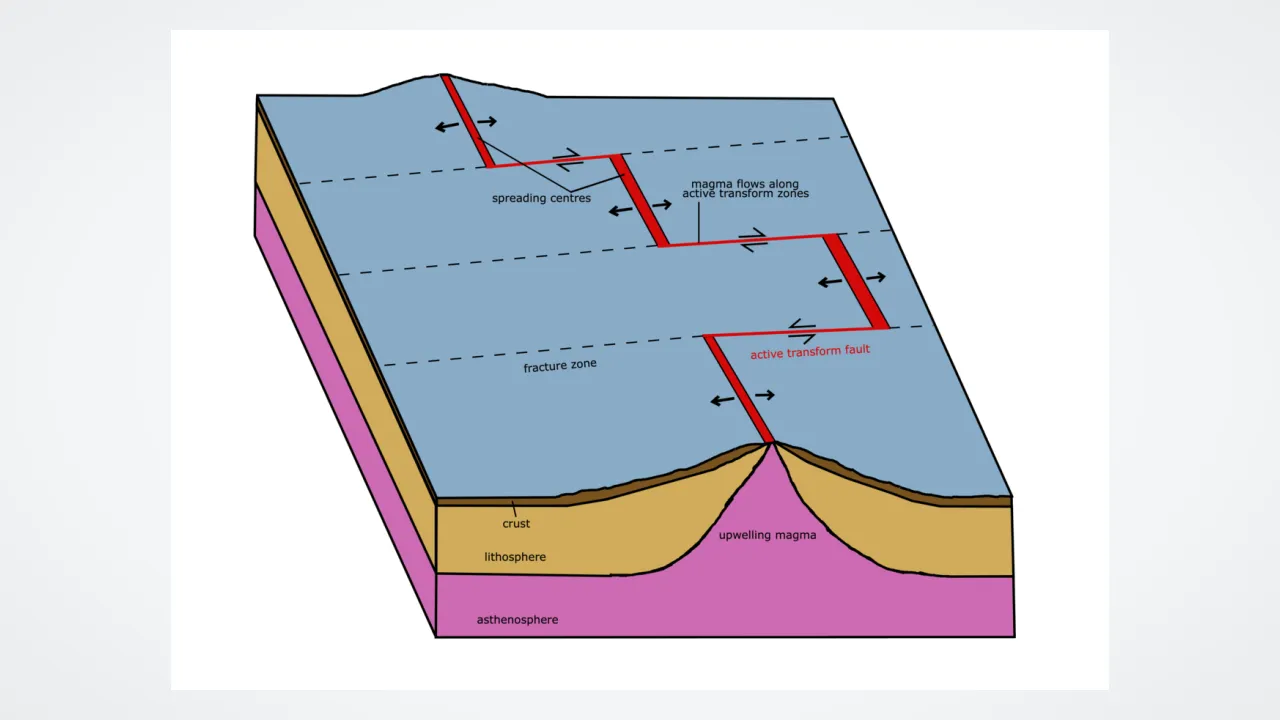
Because flat rigid plates spread across a curved sphere, mid-ocean ridges break into stair-step segments connected by perpendicular transform faults, giving the ridge crest its unmistakable zigzag pattern on Virginia Earth science maps.
1. Why does mantle rock melt beneath a mid-ocean ridge as plates pull apart?
2. How does the fast-spreading East Pacific Rise differ from the slow-spreading Mid-Atlantic Ridge?
🤯 Mind-Blowing Fact • Grade 5
Every drop of water in Earth's oceans circulates down through hot cracked rock along mid-ocean ridges and back out again roughly once every 10 million years!
✨ Word Sparks (Grade 5 Glossary)
Tap 🔊 to hear
ophiolite
Ancient oceanic crust uplifted onto continental land.
gabbro
Coarse-grained dark rock cooled inside seafloor magma chambers.
sheeted dikes
Parallel vertical rock walls frozen inside ridge cracks.
🪝
How does a three-layer 'layer cake' of rock form beneath every mid-ocean ridge—and why does ridge volume change global sea levels?
1
Architecture of Oceanic Lithosphere
Spanning roughly 65,000 kilometers around the planet, the global mid-ocean ridge system is Earth's premier volcanic and crustal factory, generating about 3 cubic kilometers of new oceanic crust each year. Geologists studying —slices of ancient seafloor thrust onto dry land in places like Oman and Cyprus—discovered that mid-ocean ridges construct a remarkably uniform, seven-kilometer-thick 'layer cake' of igneous rock everywhere they spread.
2
Gabbros, Sheeted Dikes, and Pillow Lavas
When upwelling asthenospheric peridotite undergoes decompression melting beneath a ridge axis, basaltic melt collects in an axial magma lens. Magma that cools slowly at the base crystallizes into coarse-grained . Above it, vertical cracks repeatedly split open and freeze full of rising magma, creating parallel walls called sheeted basalt dikes. Finally, melt breaching the seabed quenches in near-freezing deep water to form bulbous pillow basalts, later dusted by microscopic marine snow.
3
Morphology, Ridge Push, and Transform Offsets
Thermal buoyancy elevates hot young ridge crests to water depths near 2,500 meters; as lithosphere ages, conducts heat away, and thickens, it subsides isostatically to abyssal depths of 5,000 to 6,000 meters. That gentle outward slope creates 'ridge push,' a gravitational body force helping slide plates apart. Meanwhile, spherical geometry segments the ridge axis along perpendicular transform faults whose inactive outer scars stretch thousands of kilometers as seafloor fracture zones.
4
Hydrothermal Circulation and Ocean Chemistry
Cold seawater percolating kilometers down through fractured ridge crust strips metals and exchanges magnesium for calcium before jetting out at 350 to 400 degrees Celsius through black-smoker chimneys. Remarkably, the entire volume of Earth's oceans circulates through mid-ocean ridge hydrothermal systems roughly once every 10 million years, regulating seawater chemistry!
5
Spreading Rates and Global Sea Level
During geologic eras of rapid global spreading, wide, swollen ridges displace enormous volumes of ocean water—pushing shallow inland seas onto the continents even without melting polar ice!