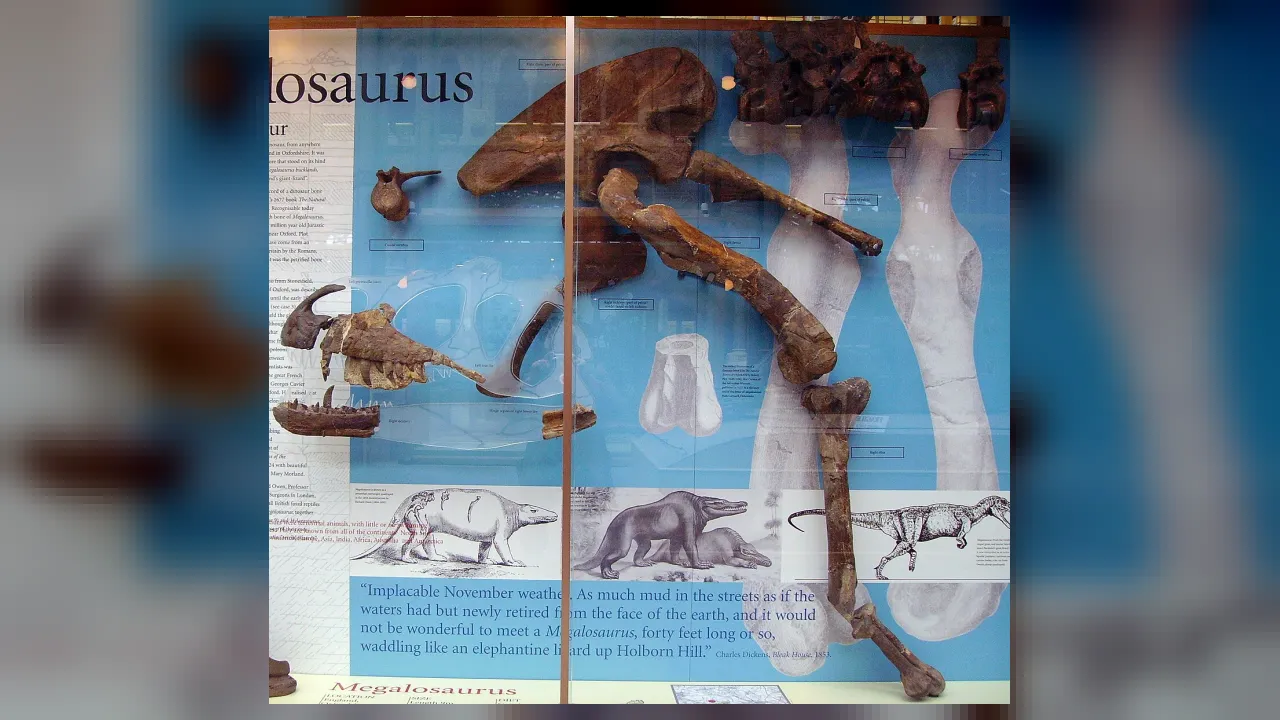
⚡ Survival SuperpowerBlade-like serrated teeth set in powerful jaws—the historic fossil that launched dinosaur science
🤯 Mind-Blowing Fact • Grade 1
You can still visit giant brick-and-concrete statues of four-legged Megalosaurus built in a London park back in 1854!
✨ Word Sparks (Grade 1 Glossary)
Tap 🔊 to hear
pioneer
the very first one to lead
jawbone
the strong bone holding lower teeth
statue
a carved figure of an animal
🪝
Which dinosaur was the very first one ever given a real scientific name?
1
Number One in History!
Step right up to meet a true ! Before the word dinosaur was even invented, scientists found a huge in England and named it Megalosaurus—meaning great lizard!
2
Funny First Guess
At first, people guessed it walked on four heavy legs like a giant bear! Later fossils proved it raced upright on two strong back legs.
3
Island Hunter
Longer than a family van, it patrolled warm sandy beaches and forests 166 million years ago.
1. Why is Megalosaurus so famous in science history?
2. How did early artists in the 1850s mistakenly draw Megalosaurus?
🤯 Mind-Blowing Fact • Grade 2
Scientific artist Mary Morland drew the crisp, detailed 1824 illustrations of the Megalosaurus jawbone that made it famous around the world!
✨ Word Sparks (Grade 2 Glossary)
Tap 🔊 to hear
slate
flat layered stone split for roofs
coin
to invent a brand-new word
horizontal
held level and parallel to ground
🪝
How did a mystery jawbone from an English stone quarry launch two hundred years of dinosaur discoveries?
1
A Jawbone From Stonesfield
Clang, tap, clink! Over two hundred years ago in Oxfordshire, England, roof- quarry workers split open golden limestone and found a foot-long jawbone bristling with curved, saw-edged teeth! In 1824, Professor William Buckland stood before excited scientists in London and named the mystery creature Megalosaurus.
2
Named Before 'Dinosaur' Existed!
When Buckland named Megalosaurus in 1824, nobody had ever heard the word dinosaur! Eighteen years passed before Sir Richard Owen grouped Megalosaurus, Iguanodon, and Hylaeosaurus together in 1842 to Dinosauria.
3
Real Life on Jurassic Islands
Real Megalosaurus balanced horizontally on two muscular hind legs, using stout three-clawed arms and sharp teeth to hunt across tropical British islands.
1. In what year did William Buckland scientifically name Megalosaurus?
2. Who coined the word Dinosauria eighteen years later using Megalosaurus as one of the three founding examples?
🤯 Mind-Blowing Fact • Grade 3
In 2024—exactly two hundred years after Megalosaurus was named—researchers uncovered a giant 'dinosaur highway' in Oxfordshire packed with dozens of fresh Megalosaurus footprints!
✨ Word Sparks (Grade 3 Glossary)
Tap 🔊 to hear
bipedal
walking upright on two hind legs
trackway
a trail of fossilized footprints in stone
replacement
a fresh new tooth taking another's place
🪝
Why did Megalosaurus even appear on the very first page of a famous Charles Dickens novel?
1
Dinosaur Mania Sweeps London
Imagine walking into London's Crystal Palace gardens in 1854 and staring up at a thirty-foot concrete Megalosaurus with a hump on its shoulders! Even novelist Charles Dickens joked about a Megalosaurus waddling up muddy London streets on page one of Bleak House. Everybody wanted to know about Britain's 'great lizard.'
2
Fixing the Scientific Picture
As more complete theropod skeletons turned up in North America and Europe, paleontologists realized Megalosaurus was no lumbering four-legged lizard. Instead, it was a sleek, twenty-three-foot, one-ton hunter with muscular thighs, three-toed tracks, and powerful three-fingered hands.
3
New Tooth Growing Inside Old
Inside the original Oxfordshire jawbone, little teeth could already be seen sprouting right inside sockets beneath the big curved cutting teeth!
4
Jurassic Highway Footprints
preserved in Oxfordshire limestone quarries show three-toed Megalosaurus footprints crisscrossing wide mudflats beside giant long-necked Cetiosaurus tracks!
1. What could be seen peeking inside the sockets of Buckland's original Megalosaurus jawbone?
2. Whose giant tracks cross paths with Megalosaurus footprints in Oxfordshire quarries?
🤯 Mind-Blowing Fact • Grade 4
One Oxfordshire trackway shows a Megalosaurus suddenly lengthening its stride from a casual walk into a fast sprint across wet Jurassic mud!
✨ Word Sparks (Grade 4 Glossary)
Tap 🔊 to hear
taxon
a named group of related organisms
ziphodont
blade-shaped teeth with serrated cutting edges
meticulous
showing extreme care for tiny details
🪝
Why did scientists once dump hundreds of unrelated meat-eating dinosaurs into Megalosaurus like a messy closet?
1
Birth of Dinosaur Paleontology
On February 20, 1824, geologist William Buckland presented a fossilized lower jaw from Stonesfield, Oxfordshire, to the Geological Society of London—supported by anatomical plates drawn by his future wife, naturalist Mary Morland. Naming the creature Megalosaurus, Buckland published the first valid scientific description of a non-avian dinosaur, sparking a revolution in Earth history.
2
Cleaning Out a 'Wastebasket Taxon'
Because Megalosaurus was the first big carnivorous dinosaur named, nineteenth- and early-twentieth-century researchers carelessly assigned stray serrated teeth from every continent and era to the genus! Modern paleontologists call such an overstuffed group a wastebasket . Careful bone-by-bone audits led by Roger Benson between 2008 and 2010 cleaned out the clutter, proving true Megalosaurus bucklandii lived specifically in Middle Jurassic England 166 million years ago.
3
Anatomy of an Island Apex Hunter
Authentic Oxfordshire fossils reveal a robust, seven-meter megalosaurid weighing nearly one metric ton. Unlike slender coastal spinosaurids, Megalosaurus possessed a deep lower jaw, sturdy forearm bones, massive shoulder blades, and blade-like teeth engineered to slice flesh from stegosaurs and juvenile Cetiosaurus.
4
Walking Across Tropical Lagoons
Preserved trackways at Ardley and Dewars Farm record Megalosaurus striding calmly at three miles per hour—and occasionally breaking into a thirty-mile-per-hour sprint!
1. What do paleontologists mean when they say Megalosaurus used to be a 'wastebasket taxon'?
2. Who illustrated the landmark 1824 scientific plates of the Megalosaurus jawbone?
🤯 Mind-Blowing Fact • Grade 5
In 1676—nearly 150 years before Buckland named Megalosaurus—Oxford chemist Robert Plot illustrated the broken end of a giant Oxfordshire Megalosaurus thighbone, making it the first dinosaur bone ever published in a book!
✨ Word Sparks (Grade 5 Glossary)
Tap 🔊 to hear
nomenclature
the formal scientific system of naming species
ichnology
scientific study of fossilized tracks and traces
tridactyl
having three weight-bearing toes on feet
🪝
How did two centuries of science transform Megalosaurus from a Victorian mystery monster into a sharply defined Middle Jurassic predator?
1
1824: A Paradigm Shift in Oxfordshire Limestone
Quarried twelve meters underground from Bathonian marine-lagoonal calcareous sandstones of the Taynton Limestone Formation at Stonesfield, Oxfordshire, right dentary OUMNH J.13505 changed natural history forever. Illustrated by Mary Morland and presented to the Geological Society of London by Oxford geologist William Buckland on February 20, 1824, Megalosaurus—later formalized with species epithet Megalosaurus bucklandii by Gideon Mantell in 1827—became the first non-avian dinosaur granted valid scientific , eighteen years before Richard Owen erected Dinosauria.
2
From Quadrupedal Pachyderm to Wastebasket Cleanup
Working solely from scattered limb and pelvic elements, Owen and sculptor Benjamin Waterhouse Hawkins famously reconstructed Megalosaurus in 1854 at Crystal Palace Park as a shoulder-humped, quadrupedal reptile. Simultaneously, fragmentary theropod teeth from Triassic to Cretaceous strata worldwide were dumped indiscriminately into the genus—ballooning Megalosaurus into over fifty dubious species until comprehensive osteological revisions by Roger Benson in 2010 restricted the genus strictly to diagnostic Bathonian material from southern England.
3
Osteology of a Robust Megalosaurid
Verified Oxfordshire elements—comprising dentaries, maxillae, vertebrae, pectoral girdles, robust humeri, and pelvic bones—define a heavily muscled seven-to-eight-meter basal tetanuran weighing roughly 700 to 1,000 kilograms. Distinguished by a straight ventral dentary margin, thirteen to fourteen ziphodont teeth per jaw side, and a stout forearm bearing enlarged claws, Megalosaurus anchored family Megalosauridae alongside European Torvosaurus and North American cousins.
4
Ichnological Evidence on Dinosaur Highways
Extensive Middle Jurassic limestone surfaces at Ardley and Dewars Farm in Oxfordshire preserve Eutynichnium trackways attributed to Megalosaurus intersecting sauropod footprints, documenting routine coastal foraging speeds near five kilometers per hour alongside explosive bursts approaching twenty-nine miles per hour.
5
Island-Hopping Apex Predator
Washed occasionally into shallow oolitic lagoons bordering subtropical British islands, Megalosaurus reigned atop a vibrant coastal ecosystem of cetiosaurids, early stegosaurs, pterosaurs, and marine crocodylomorphs.