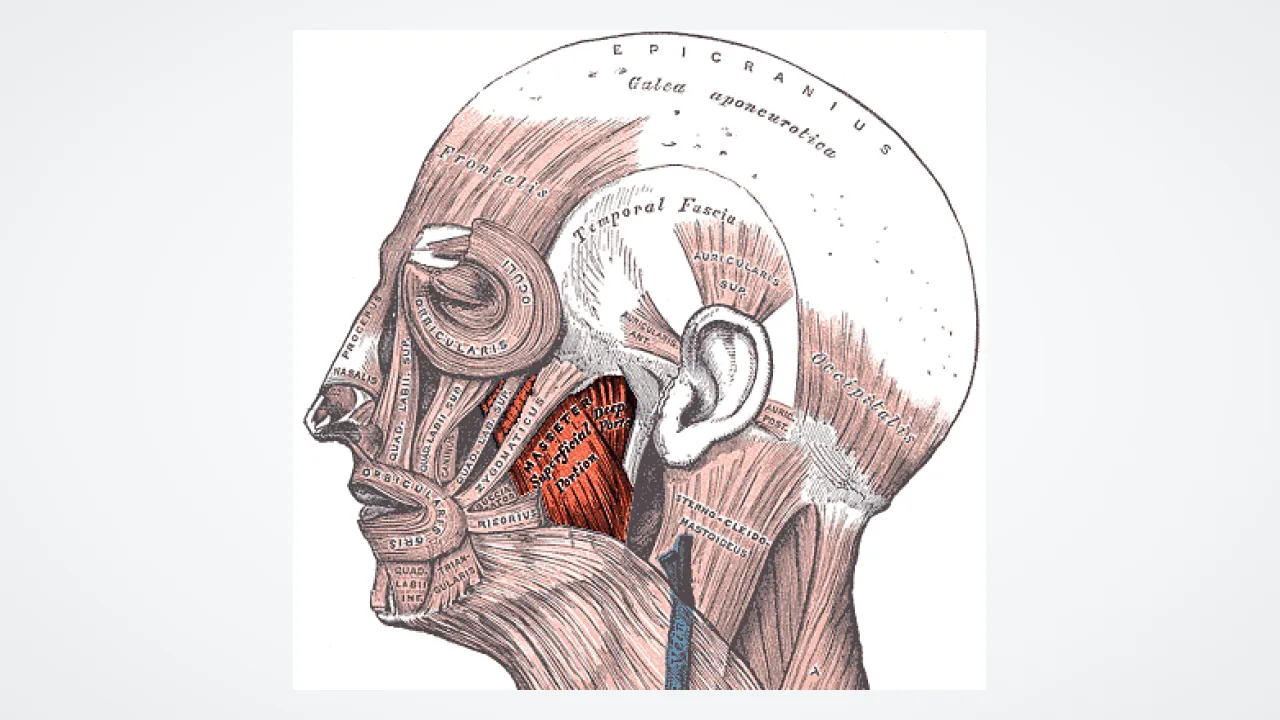
1. Where can you feel your masseter muscle pop out with your fingers?
2. What main job does the masseter do at lunchtime?
🤯 Mind-Blowing Fact • Grade 2
In 1986, a Florida man set a Guinness World Record by biting down on a medical sensor with 975 pounds of jaw force for two seconds!
✨ Word Sparks (Grade 2 Glossary)
Tap 🔊 to hear
Molars
Wide flat back teeth built for grinding
Leverage
Positioning advantage multiplying a muscle's pulling force
Mandible
Movable lower jawbone holding your bottom teeth
🪝
How can a muscle no bigger than a deck of cards bite down with the weight of a grown adult?
1
Cheekbone to Jawbone
Trace a short line from the bony arch of your cheek straight down to the back corner of your lower jaw. Tucked in that little square on both sides of your face sits the masseter—whose Greek name literally means 'the chewer'!
2
200 Pounds of Crunch
Because the masseter is packed densely with thick muscle fibers and attaches close to your back , it gives you astonishing . Working with neighbor jaw muscles, human back molars can clamp down with up to two hundred pounds of force!
3
Gentle Touch When Needed
Smart sensors around your teeth tell your masseter to crunch hard on almonds yet close feather-soft on raspberries without biting your tongue!
1. What does the Greek word behind 'masseter' literally mean?
2. Roughly how much bite force can normal adult back molars generate thanks to the masseter and its teammates?
🤯 Mind-Blowing Fact • Grade 3
Your jaw joint right in front of your ears is the busiest joint in your body, moving more than two thousand times a day as you eat, talk, yawn, and swallow!
✨ Word Sparks (Grade 3 Glossary)
Tap 🔊 to hear
Temporalis
Fan-shaped temple muscle helping your masseter chew
Saliva
Mouth liquid softening food to start digestion
Fused
Joined permanently together into one solid bone
🪝
Why does ONLY your bottom jaw move up and down while your top teeth stay completely still?
1
One Movable Skull Bone
Open wide and say 'Ahhh!' Look in a mirror and notice a cool secret: your upper teeth never budge because your upper jaw is solid into your skull! Every bite, laugh, and word comes from swinging one sturdy U-shaped lower bone—the mandible—up, down, and side to side.
2
Like Nutcracker Handles
Why are your back molars way stronger at cracking popcorn kernels than your front teeth? Your jaw hinge sits right in front of your ear, and the thick masseter pulls upward right over your back molars—just like placing a walnut deep near the hinge of a nutcracker!
3
Teaming Up With Temple Muscles
Place your fingertips up on the sides of your forehead above your ears and chew again. Feel another muscle ripple? That fan-shaped muscle helps your masseter snap the jaw shut and grind sideways!
4
First Step of Digestion
Crushing food into tiny pieces mixes it with enzymes so your stomach can unlock energy way faster.
1. Why can your back molars bite with much higher force than your front incisors?
2. Which skull bone actually moves up and down when your masseter contracts?
🤯 Mind-Blowing Fact • Grade 4
In late 2021, Swiss scientists surprised the medical world by discovering a previously overlooked THIRD layer deep inside the human masseter muscle!
✨ Word Sparks (Grade 4 Glossary)
Tap 🔊 to hear
Mastication
Medical term for biting and grinding food
Zygomatic Arch
Curved cheekbone bridge anchoring top of masseter
Trigeminal Nerve
Fifth cranial nerve powering your chewing muscles
🪝
How did scientists discover a brand-new third layer inside the human masseter muscle as recently as 2021?
1
Champion of Specific Force
When physiologists crown a 'strongest muscle,' they measure force per square inch of cross-section. While the gluteus maximus and quadriceps are much larger overall, the compact, quadrilateral masseter packs densely angled multipennate fibers between your (cheekbone) and the angle of your mandible. Pulling nearly straight up across a short lever arm, it delivers roughly 55 pounds of force on front incisors and up to 200 pounds across back molars!
2
The 2021 Third-Layer Discovery!
For hundreds of years, anatomy textbooks taught that the human masseter consisted of just two layers: one superficial and one deep. Then, in December 2021, Dr. Szilvia Mezey and Dr. Jens Christoph Türp at the University of Basel in Switzerland used high-resolution CT scans and careful dissections to reveal a distinct, deeper third layer! They named it Musculus masseter pars coronidea because it anchors onto the mandible's coronoid projection to steady and pull the jaw backward.
3
Four Muscles of Mastication
—the scientific term for chewing—is actually a four-muscle symphony powered by the trigeminal cranial nerve. While the masseter and fan-shaped temporalis elevate the mandible for vertical crunches, deep medial and lateral pterygoid muscles swing your jaw side-to-side in smooth rotary grinding loops.
4
Periodontal Pressure Brakes
Microscopic pressure sensors inside tooth root ligaments detect something as thin as a human hair—instantly relaxing your masseter if you bite an unexpected olive pit!
1. What major discovery did University of Basel scientists announce about the masseter muscle in 2021?
2. What protects your teeth if you accidentally bite down on a hard popcorn kernel hidden in a bowl?
🤯 Mind-Blowing Fact • Grade 5
Tiny nerve sensors around your teeth communicate so finely with your masseter that you can feel a crumb just 20 micrometers thick—thinner than a single strand of hair—between your molars!
Biting force measured where upper-lower teeth meet
🪝
How did cooking food reshape the human masseter compared to our prehistoric relatives—while preserving pinpoint chewing power?
1
Multipennate Architecture and Mechanical Advantage
Celebrated across comparative biomechanics for generating the highest force relative to its compact mass in the human body, the musculus masseter spans from the inferior border of the zygomatic arch to the lateral ramus and angle of the mandible. Internally interwoven tendinous septa organize its myofibers into a grid—multiplying physiological cross-sectional area so a muscle weighing barely thirty grams per side helps generate molar routinely reaching 700 to 900 newtons.
2
Trilaminar Revision: Pars Coronidea
Classical anatomical treatises from Vesalius to Gray partitioned the masseter into two strata: an obliquely angled superficial part that protracts and elevates the jaw, and a vertical deep part. In 2021, Basel anatomists Szilvia Mezey and Jens Christoph Türp definitively established a third, deepest lamina—Musculus masseter pars coronidea—running from the posterior zygomatic arch to the root of the mandibular coronoid process, uniquely positioned to retract and stabilize the (TMJ).
3
Neuromuscular Control via Cranial Nerve V
Innervated by the masseteric branch of the mandibular division of the trigeminal nerve (CN V3), the masseter integrates brain-stem central pattern generators with ultra-sensitive periodontal mechanoreceptors. Capable of detecting a twenty-micrometer foil thickness between opposing cusps, this feedback loop modulates motor unit firing from delicate speech articulation to walnut-cracking force—and powers the diagnostic jaw-jerk monosynaptic reflex.
4
Evolutionary Gracility and the MYH16 Shift
Fossil hominins like Paranthropus boisei possessed colossal flared cheekbones housing massive masseters nicknamed 'Nutcracker Man.' Around 2.4 million years ago, as Stone-Age ancestors adopted tool-assisted food processing and later fire cooking, a genetic shift inactivated the heavy-myosin MYH16 jaw gene in humans—streamlining our masticatory muscles while freeing cranial space for a larger braincase.
5
Temporomandibular Joint Harmony
Sliding and hinging across a biconcave fibrocartilage articular disc, the TMJ relies on balanced masseter tone; mindful relaxation prevents nocturnal bruxism (teeth clenching) from fatiguing this mighty craniofacial engine.