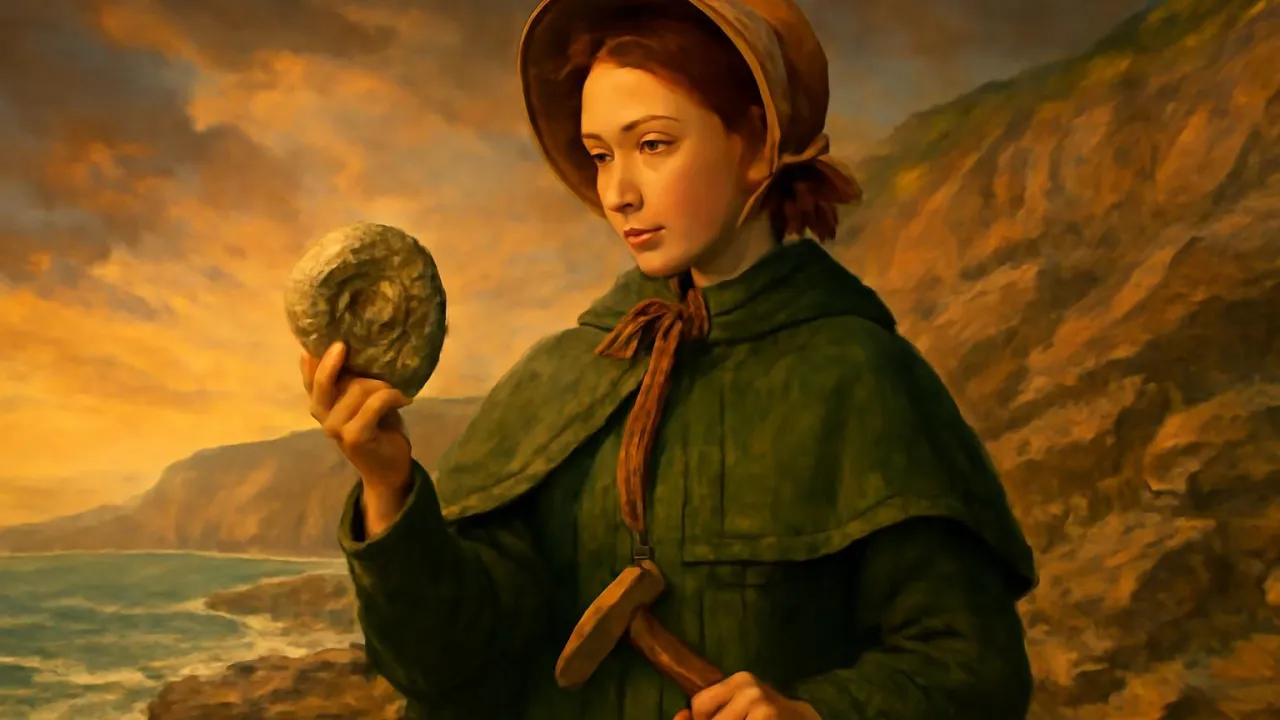
Mary discovered the first complete Ichthyosaur skeleton when she was just twelve!
✨ Word Sparks (Grade 2 Glossary)
Tap 🔊 to hear
skeleton
All the bones in a body
ancient
Very, very old
patience
Waiting and working without giving up
🪝
Have you ever wondered what secrets hide inside rocks?
1
Curious Mary
Mary loved exploring the beach for special rocks and shells. She was always curious about what was inside. One day, she found a huge fossil hidden in the cliff.
2
Hard Work Pays Off
Mary used her hammer and brush to dig carefully. She worked for days, even when it rained. Her helped her uncover the whole fossil.
3
Fossil Fame
People from all over came to see Mary’s discovery. Scientists were amazed by the sea creature. Mary became famous for her fossil finds.
Mary’s Plesiosaur discovery was so strange, some scientists thought it was fake at first!
✨ Word Sparks (Grade 3 Glossary)
Tap 🔊 to hear
perseverance
Keep trying, even when it’s hard
prehistoric
From a time before people wrote
paleontology
The science of studying fossils
🪝
Imagine finding a creature’s bones from millions of years ago!
1
A Beach Full of Mysteries
Mary Anning grew up on the rocky beaches of Lyme Regis. She spent her days searching for strange shapes in the cliffs. Her sharp eyes spotted fossils that others missed. Mary wondered about the ancient animals hidden in stone.
2
Learning by Doing
Mary used simple tools like a hammer and brush to dig carefully. She studied books to learn about the fossils she found. Even though she was not allowed in many science clubs, she kept learning. Her curiosity and helped her become an expert fossil hunter.
3
The Ichthyosaur Discovery
One day, Mary uncovered a huge skeleton with a long jaw and sharp teeth. Scientists called it an Ichthyosaur, meaning 'fish lizard.' This was the first complete skeleton ever found. Her discovery changed how people understood life.
4
Mary’s Lasting Impact
Mary’s fossils helped scientists learn about Earth’s history and extinct animals. She inspired other fossil hunters, especially girls, to explore science. Today, museums display her discoveries for everyone to see. Mary Anning became a legend in .
1. What did Mary’s Ichthyosaur discovery help scientists understand?
2. Why is Mary Anning important to science?
🤯 Mind-Blowing Fact • Grade 4
Mary Anning’s fossil shop became famous across Europe, attracting scientists from many countries.
✨ Word Sparks (Grade 4 Glossary)
Tap 🔊 to hear
extinction
When a kind of animal disappears forever
geologist
A scientist who studies rocks and Earth
chisel
A tool for carving or cutting rock
🪝
What would you do if you uncovered a secret from Earth’s ancient past?
1
Exploring the Jurassic Coast
On the wild shores of Lyme Regis, Mary Anning spent her childhood searching for fossils among the cliffs. The early 1800s were a time when few women studied science, but Mary’s curiosity set her apart. She learned to spot fossilized bones and shells that had been hidden for millions of years. Each new discovery made her wonder what other secrets the rocks might hold.
2
From Curiosity to Expertise
Mary’s family was poor, so she sold fossils to help them survive. She taught herself how to carefully excavate delicate bones using simple tools like hammers and . Even though she couldn’t attend university, Mary read scientific books and shared ideas with visiting . Her perseverance and careful methods made her respected among scientists, even when some doubted her because she was a woman.
3
Changing the World of Paleontology
Mary’s most famous discovery was the first complete Ichthyosaur skeleton, which she found when she was only twelve. Later, she unearthed the first Plesiosaur and a rare Pterosaur, creatures that amazed the world. These fossils proved that strange, extinct animals once lived in the sea. Her discoveries helped scientists understand Earth’s prehistoric past and the idea of .
4
Mary’s Enduring Legacy
Although Mary never became rich or received many awards during her life, her work changed science forever. Today, museums proudly display her fossils, and paleontologists honor her as a pioneer. Mary Anning’s story inspires young scientists everywhere to explore, ask questions, and never give up. Her legacy lives on in every fossil hunter who searches for clues about our planet’s history.
A famous tongue-twister—‘She sells seashells by the seashore’—was inspired by Mary Anning’s fossil-selling days.
✨ Word Sparks (Grade 5 Glossary)
Tap 🔊 to hear
ammonite
A spiral-shaped fossil from ancient sea animals
ecosystem
All living things and their environment together
adversity
Hard times or difficult challenges
🪝
Can you picture yourself discovering a creature no one has ever seen before?
1
A Childhood Spark on the Jurassic Coast
Stormy mornings on the Lyme Regis cliffs often brought Mary Anning and her dog, Tray, to the rocky shoreline. As a child, Mary’s keen eyes spotted unusual shapes and patterns in the crumbling cliffs, sparking her lifelong fascination with fossils. Growing up in early 19th-century England, she faced poverty and limited schooling, but her curiosity and sharp observation skills set her apart. She learned to identify , belemnites, and other fossils, selling them to help support her family. Each find deepened her desire to unlock the secrets of Earth’s distant past.
2
Developing Paleontological Mastery
Mary’s fossil hunting was far from simple beachcombing; it required scientific observation, patience, and careful technique. Using hammers, chisels, and brushes, she meticulously excavated fragile bones embedded in layers of limestone and clay. She recorded her discoveries in notebooks and compared them to scientific illustrations, teaching herself anatomy and geology. Despite being excluded from scientific societies because of her gender and class, Mary corresponded with leading geologists and contributed critical fossil specimens to their research. Her perseverance and expertise earned her quiet respect among the scientific community.
3
Groundbreaking Discoveries
At age twelve, Mary uncovered the world’s first complete Ichthyosaur skeleton, a marine reptile with a dolphin-like body and fierce teeth. Later, she discovered the first complete Plesiosaur and one of the earliest British Pterosaurs, each find challenging existing beliefs about prehistoric life. Her fossils provided evidence for extinction and ancient , reshaping scientific understanding of Earth’s history. By the time she died in 1847, Mary had found dozens of remarkable specimens, many of which are still displayed in major museums today.
4
Historical Context and Scientific Impact
Mary Anning’s discoveries arrived during a period when paleontology was a new and controversial science. Many people believed Earth was only a few thousand years old, so her fossils of long-extinct marine reptiles challenged traditional ideas. Although she was rarely credited in scientific papers, her specimens and observations were crucial to early paleontological research. Over time, scientists recognized the significance of her work, and her methods became the foundation for modern fossil excavation and identification.
5
A Lasting Legacy of Curiosity and Resilience
Mary Anning’s life demonstrates the power of curiosity, resilience, and self-education in the face of . She inspired generations of paleontologists, especially women, to pursue scientific discovery. Today, the Natural History Museum in London and other institutions honor her contributions, and her story is celebrated in books, exhibitions, and even a species of ichthyosaur named after her. Mary’s journey reminds us that groundbreaking discoveries can come from anyone with determination and a passion for learning.