2. What was surprising about the tiny arms of Majungasaurus?
🤯 Mind-Blowing Fact • Grade 2
Majungasaurus had an older spelling—Majungatholus—when scientists first mistook the dome horn on top of its head for a dome-headed plant-eater!
✨ Word Sparks (Grade 2 Glossary)
Tap 🔊 to hear
ambush
To wait quietly and surprise passing prey
drought
A long dry spell with very little rain
dome
A smooth, rounded bump shaped like half a ball
🪝
How did a short-legged, bulldog-faced dinosaur become king of prehistoric Madagascar?
1
A Bulldog Snout and Unicorn Bump
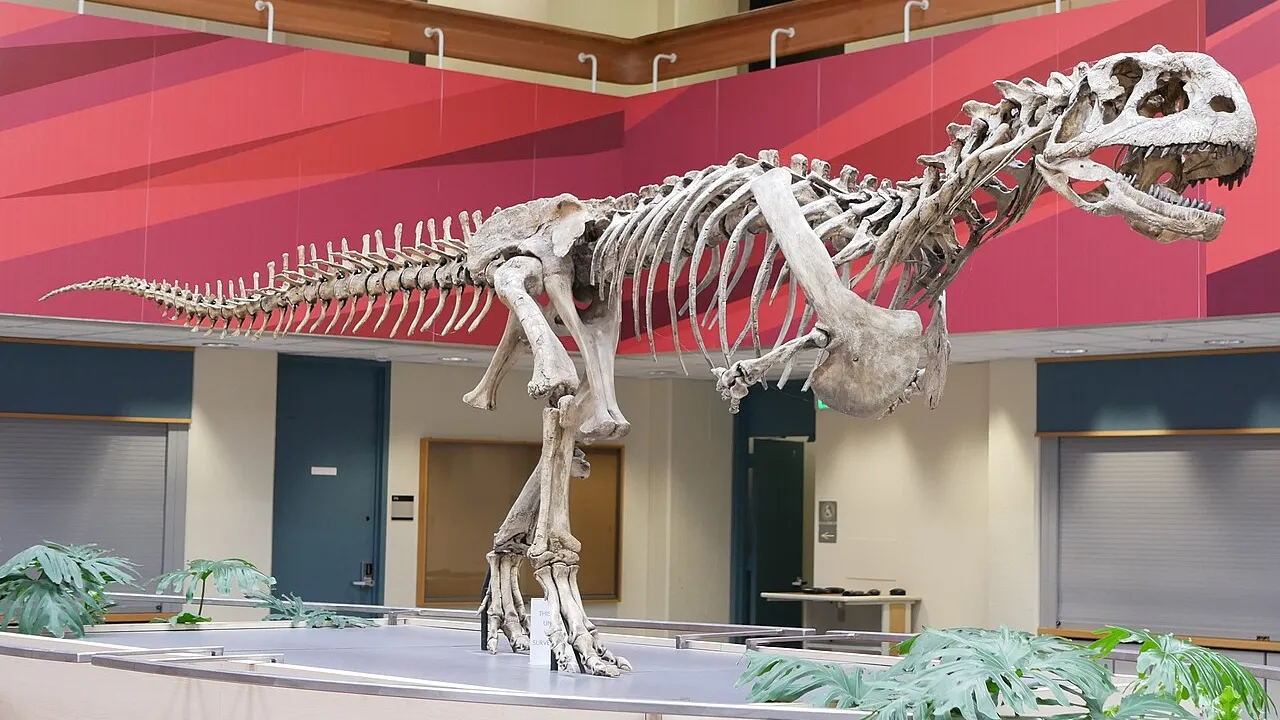
Imagine visiting the island of Madagascar 68 million years ago during the Late Cretaceous Period. Most big meat-eating dinosaurs had long, narrow snouts, but Majungasaurus had a short, wide face covered in rough, bumpy bone like crocodile skin! Above its eyes rose a single -shaped horn used to show off to other dinosaurs.
2
Built Low and Strong
Instead of long sprinter legs, Majungasaurus walked on stout, muscular legs suited for ambushing slow, heavy plant-eaters like long-necked Rapetosaurus.
3
Nonstop Tooth Factory
Because it gnawed right against hard bones during tough dry seasons, Majungasaurus replaced every tooth in its mouth roughly every fifty-six days!
1. Why did scientists once mistake the top of Majungasaurus's skull for a plant-eating dinosaur?
2. How often did Majungasaurus grow fresh replacement teeth?
🤯 Mind-Blowing Fact • Grade 3
Microscopic growth rings inside Majungasaurus teeth revealed it replaced teeth two to thirteen times faster than most other meat-eating dinosaurs!
✨ Word Sparks (Grade 3 Glossary)
Tap 🔊 to hear
abelisaurid
A southern family of short-snouted, tiny-armed meat-eating dinosaurs
scavenge
To feed on animals that have already died
vestigial
Shrunken over evolution until no longer used for grabbing
🪝
How did Majungasaurus survive harsh island droughts 68 million years ago?
1
Isolated Island Apex Predator
Hot winds sweep across a dry seasonal riverbed in northwestern Madagascar 68 million years ago. By the Late Cretaceous Period, Madagascar had drifted apart as an isolated island in the Indian Ocean. Ruling this unique ecosystem was Majungasaurus crenatissimus, a twenty-three-foot, one-ton member of the southern dinosaur family.
2
Bite-and-Hold Champion
Unlike northern tyrannosaurs or blade-toothed hunters that sliced and pulled back, Majungasaurus possessed a short, wide, heavily roughened skull built for a 'bite-and-hold' grip. Thick neck muscles kept its head steady once its stout jaws clamped onto medium-sized titanosaurs like Rapetosaurus.
3
Vestigial Forearms
Its forelimbs shrank to comical extremes: short upper arms connected to tiny wrist bones and four stubby fingers completely lacking claws.
4
Surviving Tough Dry Seasons
Ancient Madagascar experienced severe droughts. Matching tooth marks found on dinosaur bones—including other Majungasaurus skeletons—show these adaptable survivors wasted nothing, scavenging fallen neighbors whenever food grew scarce.
1. How did Majungasaurus's 'bite-and-hold' skull differ from long-snouted slashing hunters?
2. What fossil clue showed how Majungasaurus coped during harsh seasonal droughts?
🤯 Mind-Blowing Fact • Grade 4
The 1996 Majungasaurus skull from Madagascar fell apart cleanly along natural bone sutures during fossilization, allowing scientists to CT-scan every single skull bone in 3D like a puzzle!
✨ Word Sparks (Grade 4 Glossary)
Tap 🔊 to hear
conspecific
An individual belonging to the very same species
suture
A natural seam where two skull bones meet
pulmonary
Connected to the lungs and breathing system
🪝
How did paleontologists match tooth scratches on 68-million-year-old bones to one exact species?
1
Solving the Dome-Head Mystery
Picture the semi-arid floodplains of Madagascar's Maevarano Formation 68 million years ago, where brief rainy floods alternated with punishing dry seasons. Prowling the riverbeds was Majungasaurus crenatissimus, first named from fragmentary fossils in the nineteenth century and briefly misidentified in 1979 as a pachycephalosaur ('Majungatholus') based on its bumpy frontal horn. In 1996, paleontologist David Krause and a Stony Brook University team unearthed an astonishingly complete, undistorted skull that revealed a classic abelisaurid predator.
2
Armored Face and Pneumatic Bones
Deep pits and grooves sculpted its nasal and facial bones, anchoring tough, keratinized skin that protected its face while feeding. Meanwhile, CT scans revealed bird-like air sacs invading its vertebrae, keeping its trunk light despite short, robust hind limbs.
3
Forensic Tooth-Mark Evidence
Because Majungasaurus was the sole large theropod in the Maevarano Formation, paleontologist Raymond Rogers and colleagues compared parallel grooves on Rapetosaurus and Majungasaurus bones directly against Majungasaurus tooth spacing and serration density. The exact match proved these predators thoroughly scraped bone during lean droughts, including scavenging .
4
Conveyor-Belt Dentition
A 2019 study by Michael D'Emic showed that gnawing bone wore crowns rapidly, driving Majungasaurus to replace teeth every fifty-six days—a record pace among theropods.
1. Why did Majungasaurus need to replace its teeth every 56 days?
2. How did the 1996 Madagascar skull discovery clear up a 17-year scientific mix-up?
🤯 Mind-Blowing Fact • Grade 5
Vertebral fossils of Majungasaurus provided landmark 2005 proof that bird-like flow-through air sacs evolved deep near the base of the meat-eating dinosaur family tree!
✨ Word Sparks (Grade 5 Glossary)
Tap 🔊 to hear
brachyrostral
Having an unusually short, wide, deep snout structure
What does Majungasaurus crenatissimus reveal about island evolution, avian respiration, and abelisaurid feeding mechanics?
1
Insular Apex of Maastrichtian Madagascar
After separating from Africa and later from the Indian subcontinent around eighty-eight million years ago, Madagascar evolved in splendid isolation during the Maastrichtian stage (70–66 MYA). Commanding the semi-arid Maevarano Formation floodplains was Majungasaurus crenatissimus, a six-to-seven-meter, 1,100-kilogram abelisaurid theropod. Originally coined Megalosaurus crenatissimus by Charles Depéret in 1896 and revised by René Lavocat in 1955, the genus became one of paleontology's best-known Gondwanan theropods following the 1996 discovery of an exquisitely disarticulated skull by the Mahajanga Basin Project.
2
Brachyrostral Skull and Osteological Rugosity
Unlike long-snouted carcharodontosaurids, Majungasaurus evolved a (short, deep, broad) cranium reinforced by mineralised dermal rugosities and crowned by a hollow, single midline frontal horn. Finite-element and anatomical analyses indicate its arched jaws and hypertrophied cervical musculature executed a 'bite-and-hold' strategy suited for subduing juvenile and subadult titanosaurians such as Rapetosaurus krausei.
3
Extreme Forelimb Reduction and Stocky Limbs
Abelisaurid forelimb reduction reached remarkable extremes in Majungasaurus: a short, bowed humerus articulated with miniature, globular radius and ulna bones, unossified carpals, and four tiny, fused digits completely lacking ungual claws. Simultaneously, unusually stocky tibiae and shortened metatarsi—measuring far shorter proportionally than equal-sized tyrannosaurids—indicate a powerful, broad-bodied ambush walker tailored to rolling floodplain terrain rather than a high-speed cursorial sprinter.
4
Avian-Like Flow-Through Ventilation
In 2005, Patrick O'Connor and Leon Claessens documented intricate vertebral pneumaticity patterns in Majungasaurus matching modern bird cervical and abdominal air sacs. By invading the presacral vertebral column from multiple pulmonary diverticula, these air sacs supported unidirectional, flow-through lung ventilation—proving sophisticated avian-style respiratory physiology evolved early near the base of Neotheropoda.
5
Taphonomy and Ultra-Rapid Tooth Replacement
Diagnostic tooth-drag spacing and serration striae on Maevarano dinosaur bones—analyzed by Raymond Rogers and colleagues—confirmed extensive bone-scraping and intraspecific scavenging during severe seasonal mass-mortality droughts. In 2019, histological counts of daily incremental von Ebner dentin lines by Michael D'Emic revealed that heavy crown wear drove Majungasaurus to replace every tooth in its jaws every fifty-six days, up to thirteen times faster than blade-slicing allosauroids.