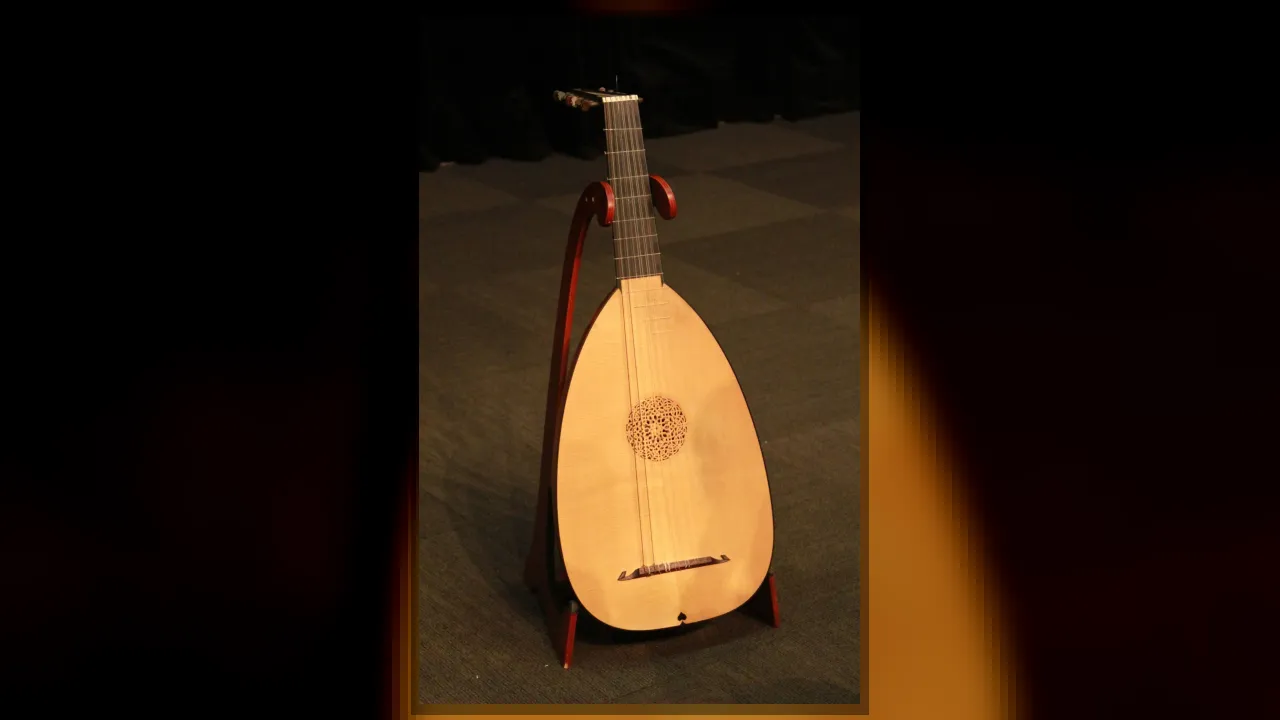
1. How heavy does a full-size wooden lute feel when you pick it up?
2. What sits right in the middle of a lute's flat wooden front?
🤯 Mind-Blowing Fact • Grade 2
The English word 'lute' comes directly from the Arabic name 'al-ʻūd,' which traveled into Europe through Spain and Italy nearly a thousand years ago!
✨ Word Sparks (Grade 2 Glossary)
Tap 🔊 to hear
ribs
Curved wooden strips forming a lute bowl
pegbox
Angled top section holding wooden tuning pegs
Renaissance
European era of art, science, and music
🪝
Why does the top of a lute's neck bend sharply backward like a folded elbow?
1
Music for Poets and Royals
Hush your voice as bare fingertips brush paired strings, filling a quiet stone hall with sweet, silvery chords! Five hundred years ago in Europe, the lute was the most famous instrument for royal dances and bedtime songs.
2
Striped Ribs and Tied Frets
Builders steamed and bent thin strips of maple or yew wood into a striped, rounded bowl. Instead of metal frets glued into wood, soft strings were tied snugly right around the neck so players could slide them into tune!
3
A Pegbox Bent Backward
At the top of the neck, the wooden bends sharply backward almost like a square corner. That clever bend helps keep the gentle strings steady over the nut while keeping the long instrument balanced in the player's arms!
1. How were frets placed on the neck of a traditional Renaissance lute?
2. Which older Middle Eastern instrument is the direct ancestor of the European lute?
🤯 Mind-Blowing Fact • Grade 3
Queen Elizabeth I, King Henry VIII, and astronomer Galileo Galilei—whose father Vincenzo was a famous lute composer—were all skilled lute players!
✨ Word Sparks (Grade 3 Glossary)
Tap 🔊 to hear
tablature
Music chart showing exact string and fret
quill
Hollow stiff shaft of a bird feather
vaulted
Curved into a high rounded arch shape
🪝
Why did Renaissance lutenists toss aside their feather picks and start plucking with bare fingertips?
1
Delicate Strings, Shimmering Air
What would happen if you built a hollow wooden shell barely thicker than heavy cardboard and strung it with pairs of gentle gut strings? One soft fingertip touch awakens a warm, silvery vibration that feels almost magical!
2
Paired Courses and One Solo Top
Like a mandolin, a lute groups most of its strings into side-by-side pairs called courses—tuned either in unison or an octave apart for rich resonance. Only the highest melody string, called the chanterelle, stands all by itself!
3
From Feather Quill to Fingertips
Medieval players originally plucked single melodies using a flexible bird-feather . Around the late 1400s, musicians switched to bare fingertips so they could pluck low bass notes, middle harmonies, and high melodies all at the same time!
4
Tablature Finger Maps
Instead of standard five-line musical notes, lute music was written in clever finger maps called , showing exactly which course and fret to press.
1. Why did late-1400s lutenists stop using feather quills and switch to bare fingertips?
2. Which string on a Renaissance lute usually stands alone instead of in a pair?
🤯 Mind-Blowing Fact • Grade 4
Inside old historical lutes, restorers often discover recycled strips of medieval handwritten parchment books glued along the wooden rib seams to reinforce the paper-thin bowl!
✨ Word Sparks (Grade 4 Glossary)
Tap 🔊 to hear
diapasons
Extra unfretted deep bass courses on lutes
parchment
Thin prepared animal skin used for writing
theorbo
Giant long-necked bass lute with two pegboxes
🪝
How did Baroque lute builders add so many deep bass strings that some lutes grew nearly six feet long with two separate pegboxes?
1
The Crown Jewel of Early Europe
Step into an Elizabethan candlelight chamber as English composer John Dowland plucks a sighing pavane: paired gut courses murmur with silvery intimacy while a carved spruce rose scatters delicate overtones. For over three hundred years, no European instrument rivaled the lute in prestige or expressive subtlety.
2
Ultralight Shell Engineering
Building a lute demanded astonishing woodworking precision. Over a wooden mold, luthiers steam-bent nine to thirty-seven paper-thin ribs of yew, sycamore, or maple—each barely a millimeter and a half thick—reinforcing interior seams with strips of ! Topped by a featherlight Alpine spruce belly barred transversely and pierced by an intricate geometric rosette carved directly from the soundboard wood, the entire shell vibrated at the faintest fingertip caress.
3
Growing From Six Courses to Thirteen
Early Renaissance lutes carried six courses, soon expanding to seven, eight, and ten as composers craved deeper harmonies. By the Baroque era of Johann Sebastian Bach and Silvius Leopold Weiss, lutes boasted eleven to thirteen courses, often adding unfretted bass diapason strings stretched to an extended second neck—creating towering archlutes and six-foot chitarrones!
4
Why Quieter Meant More Expressive
Low string tension attached directly to a glued front bridge without a heavy tailpiece let players shape whisper-soft dynamics, until nineteenth-century public concert halls favored louder pianos and guitars—before twentieth-century early-music pioneers revived the lute's timeless voice.
1. How is the decorative 'rose' in a traditional lute's soundboard made?
2. Why did giant Baroque relatives like the archlute and theorbo have extra-long necks with a second pegbox?
🤯 Mind-Blowing Fact • Grade 5
Galileo Galilei grew up helping his father Vincenzo test string tensions with hanging weights on lutes—hands-on music experiments that helped inspire Galileo's famous laws of pendulum motion and physics!
✨ Word Sparks (Grade 5 Glossary)
Tap 🔊 to hear
counterpoint
Interlocking independent melodies harmonizing together gracefully
torque
Twisting rotational force acting on bridge
damping
Gradual loss of energy silencing vibrations
🪝
How did pairing octave-tuned gut bass courses with a 1.5-millimeter spruce belly allow the Renaissance and Baroque lute to project intricate four-voice counterpoint?
1
Intimate Counterpoint in Whispered Air
Pluck a low G2 bass course alongside three independent upper voices weaving contrapuntal lines up to A5 (880.0 hertz), and discover why Renaissance poets called the lute 'omnium regina'—queen of all instruments. Classified under Hornbostel-Sachs 321.321 as a vaulted-back composite chordophone, the European lute prioritizes ultra-fast transient response and harmonic transparency over sheer decibel volume.
2
Andalusian Lineage and Ultralight Ribbed Mechanics
Entering Europe via ninth-to-thirteenth-century Islamic Al-Andalus and Sicily from the fretless Arabic al-ʻūd, European makers gradually added tied gut frets and expanded string courses. Over a removable wooden form, luthiers edge-join nine to over thirty heat-bent ribs of yew, cypress, or flamed maple shaved to roughly 1.2 to 1.6 millimeters, capped by a resonant split-spruce belly braced with slender transverse spruce bars positioned above and below an intricately pierced geometric rosette.
3
Low-Tension Gut Courses and Octave Doubling
Unlike modern guitars whose strings cross a tall saddle, lute strings tie directly through a low fruitwood bridge glued to the belly, exerting minimal —roughly 25 to 35 newtons per individual string. Classic six-to-eight-course Renaissance tuning follows intervals of fourths framing a central major third (such as G2–C3–F3–A3–D4–G4). Because thick pure-gut bass strings suffer dull high-frequency , lower courses pair a fundamental bass string beside a thin string tuned one octave higher, tricking the ear into hearing crisp low pitch!
4
Baroque D-Minor Tunings and Extended Archlutes
Seventeenth-century French and German masters reconfigured the instrument into eleven-to-thirteen-course Baroque D-minor tuning (F2–G2–A2–B-flat2–C3–D3–F3–A3–D4–F4–A4–D5–F5), inspiring towering suites by Silvius Leopold Weiss and Johann Sebastian Bach, while long-necked theorbos and chitarrones stretched unfretted diapasons nearly two meters to accompany early Italian operas by Claudio Monteverdi.
5
Tablature Preservation and Modern Revival
Recorded in French, Italian, and German tablature systems mapping finger placements independent of absolute pitch, thousands of surviving manuscripts enabled twentieth-century pioneers like Julian Bream, Diana Poulton, and Paul O'Dette to resurrect four centuries of luminous European chamber repertoire.