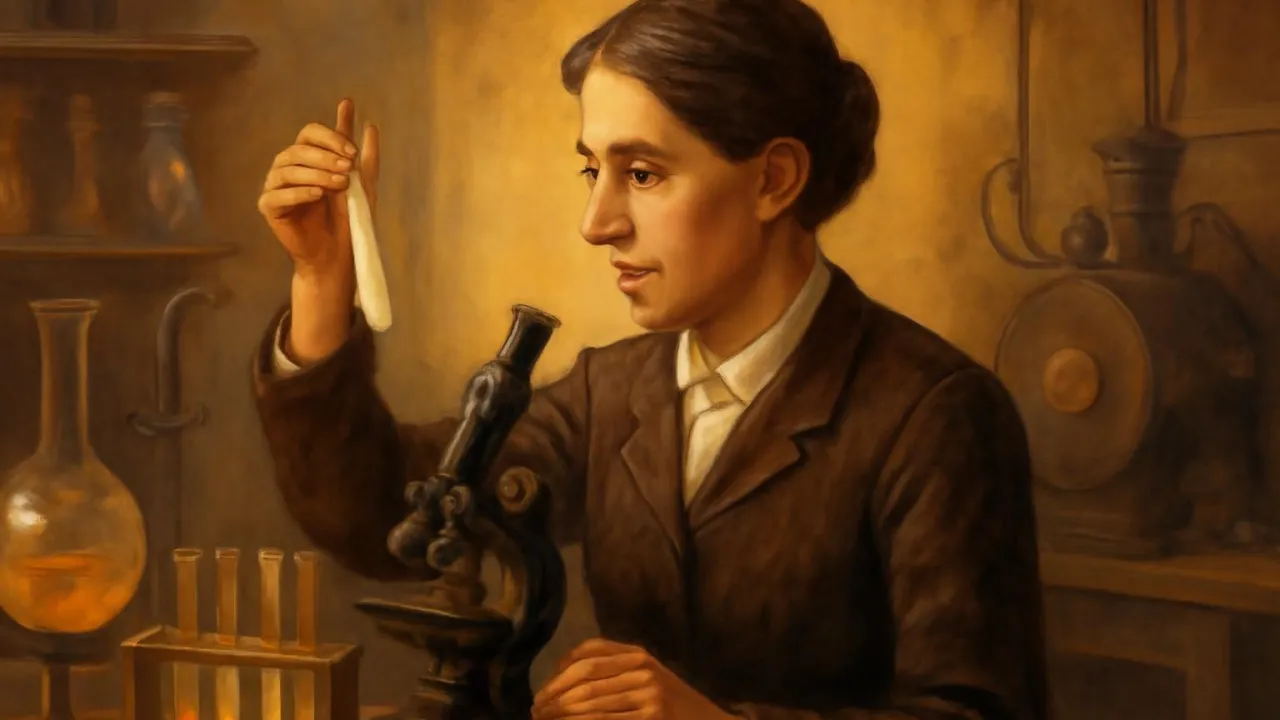
Lise Meitner was the first woman in Germany to become a physics professor!
✨ Word Sparks (Grade 2 Glossary)
Tap 🔊 to hear
energy
Power that makes things move or work
fission
Splitting an atom into smaller parts
professor
A teacher at a big school
🪝
Have you ever wondered what makes up everything around you?
1
Curious Young Lise
Lise Meitner loved to solve puzzles and ask questions about nature. She was always curious about light and tiny things. She wanted to know how the world worked. Her favorite place was her science books.
2
Hard Work in the Lab
Lise worked with glass tubes and glowing chemicals in her lab. She studied atoms, which are the smallest parts of everything. She practiced science every day and learned from her mistakes. Lise never gave up, even when it was hard.
3
A Big Science Surprise
Lise helped discover how to split an atom, called nuclear . This was a huge surprise for the world. Her discovery changed science forever and helped people understand . Lise became famous for her smart thinking.
The element meitnerium (Mt) is named after Lise Meitner!
✨ Word Sparks (Grade 3 Glossary)
Tap 🔊 to hear
radioactivity
Energy released from some tiny atoms
perseverance
Never giving up, even when it’s hard
element
A basic kind of matter, like gold
🪝
Imagine peering into a world so tiny, only science can reveal its secrets.
1
A Young Scientist’s Curiosity
As a child, Lise Meitner was fascinated by how light and matter behaved. She read every science book she could find and dreamed of making her own discoveries. Her family encouraged her curiosity, even though girls rarely became scientists then. Lise’s questions grew bigger as she grew older.
2
Chasing Answers in the Lab
Lise spent long hours in her laboratory, using special equipment to study atoms. She learned about and how atoms could change. Sometimes, experiments failed, but Lise’s kept her going. She worked with Otto Hahn, sharing ideas and testing new theories.
3
The Discovery of Fission
One day, Lise and Otto realized that splitting an atom released a huge amount of energy. This process, called nuclear fission, was a breakthrough in physics. Lise used math and science to explain how it worked. Her discovery helped scientists understand the power inside every atom.
4
Changing Science Forever
Lise Meitner’s work opened the door to new energy sources and medical treatments. Even though she did not win the Nobel Prize, people worldwide honor her achievements. She showed that teamwork and determination can solve big mysteries. Today, scientists remember Lise as a pioneer in nuclear physics.
Lise Meitner was nominated for the Nobel Prize in Physics and Chemistry a total of 48 times!
✨ Word Sparks (Grade 4 Glossary)
Tap 🔊 to hear
prejudice
Unfair treatment because of who you are
atomic structure
How the parts of an atom are arranged
periodic table
A chart showing all known elements
🪝
What if you could unlock the secret energy hidden inside every atom?
1
Breaking Barriers in Science
Growing up in Vienna, Lise Meitner was captivated by physics, even when few women were allowed in universities. She overcame many obstacles to attend college and eventually earned her doctorate in physics. In early 1900s Europe, women faced strong in science, but Lise’s determination never wavered. Her passion for discovery led her to Berlin, where she joined a team of brilliant scientists.
2
The Path to Nuclear Fission
Working closely with chemist Otto Hahn, Lise explored the mysteries of radioactivity and . Together, they conducted groundbreaking experiments, using advanced laboratory equipment to observe how atoms behaved under different conditions. In 1938, while in exile due to World War II, Lise interpreted experimental results showing that uranium atoms could split apart. She used physics and mathematics to explain the process, which she named nuclear fission.
3
A Discovery with Worldwide Impact
The discovery of nuclear fission changed the course of science and history. It provided the foundation for nuclear power plants, which generate electricity for cities, and for medical treatments that help fight cancer. Although Otto Hahn received the Nobel Prize, Lise’s essential contributions are now celebrated around the world. Her work showed how teamwork and scientific reasoning can solve the universe’s deepest puzzles.
4
A Lasting Legacy
Lise Meitner’s name lives on in the with the element meitnerium, honoring her groundbreaking achievements. She inspired generations of scientists, especially women, to pursue careers in physics and chemistry. Lise’s story teaches us the value of perseverance, collaboration, and curiosity in the face of challenges. Today, her discoveries continue to shape our understanding of energy and matter.
1. What did Lise Meitner name the process she discovered?
2. How did Lise Meitner inspire others?
🤯 Mind-Blowing Fact • Grade 5
Lise Meitner’s precise calculations explained why fission releases nearly 200 million electron volts of energy per atom!
✨ Word Sparks (Grade 5 Glossary)
Tap 🔊 to hear
isotope
A form of an element with extra particles
nucleus
The center part of an atom
resilience
Staying strong and positive through challenges
🪝
What if a single equation could explain the energy powering stars and cities alike?
1
A Trailblazer in a Challenging Era
In turn-of-the-century Vienna, Lise Meitner’s fascination with physics was unusual for a young woman. Despite strict social barriers, she became only the second woman to earn a doctorate in physics from the University of Vienna in 1906. Facing gender prejudice, she moved to Berlin, where she was forced to work in a basement laboratory because women were not allowed in the main institute. Her perseverance and love for science helped her overcome these obstacles and become a respected physicist among her peers.
2
Unraveling the Atom’s Secrets
Meitner collaborated with chemist Otto Hahn for over thirty years, investigating radioactivity and the behavior of atomic nuclei. Together, they developed new laboratory techniques for isolating radioactive and analyzing atomic reactions. In 1938, after fleeing Nazi Germany due to her Jewish heritage, Meitner received a letter from Hahn describing a puzzling experiment with uranium. Using physics and mathematics, she realized that the uranium had split into two smaller nuclei, releasing a tremendous amount of energy—a phenomenon she named nuclear fission.
3
Scientific Breakthrough and Global Impact
The discovery of nuclear fission revolutionized physics and had profound consequences for the world. It led to the development of nuclear reactors, which provide electricity for millions, and contributed to the creation of atomic weapons during World War II. Although Otto Hahn alone received the Nobel Prize for Chemistry in 1944, Meitner’s crucial role was later recognized by the scientific community. Her precise calculations and clear explanations helped scientists understand the immense energy released during fission.
4
Legacy and Recognition
Lise Meitner’s scientific achievements were eventually honored in many ways, including the naming of the element meitnerium (Mt) in her honor. She was nominated for Nobel Prizes 48 times and received prestigious awards such as the Enrico Fermi Award. Throughout her life, Meitner advocated for ethical science and refused to participate in weapons research. She inspired generations of physicists, especially women, to pursue careers in science despite obstacles.
5
Inspiration for Future Scientists
Lise Meitner’s story is a testament to the power of curiosity, , and collaboration in science. Her ability to solve complex problems and work across disciplines changed our understanding of atomic energy and matter. Today, her discoveries help power cities, advance medicine, and deepen our knowledge of the universe. Meitner’s legacy encourages young scientists everywhere to ask bold questions and persist in the face of adversity.