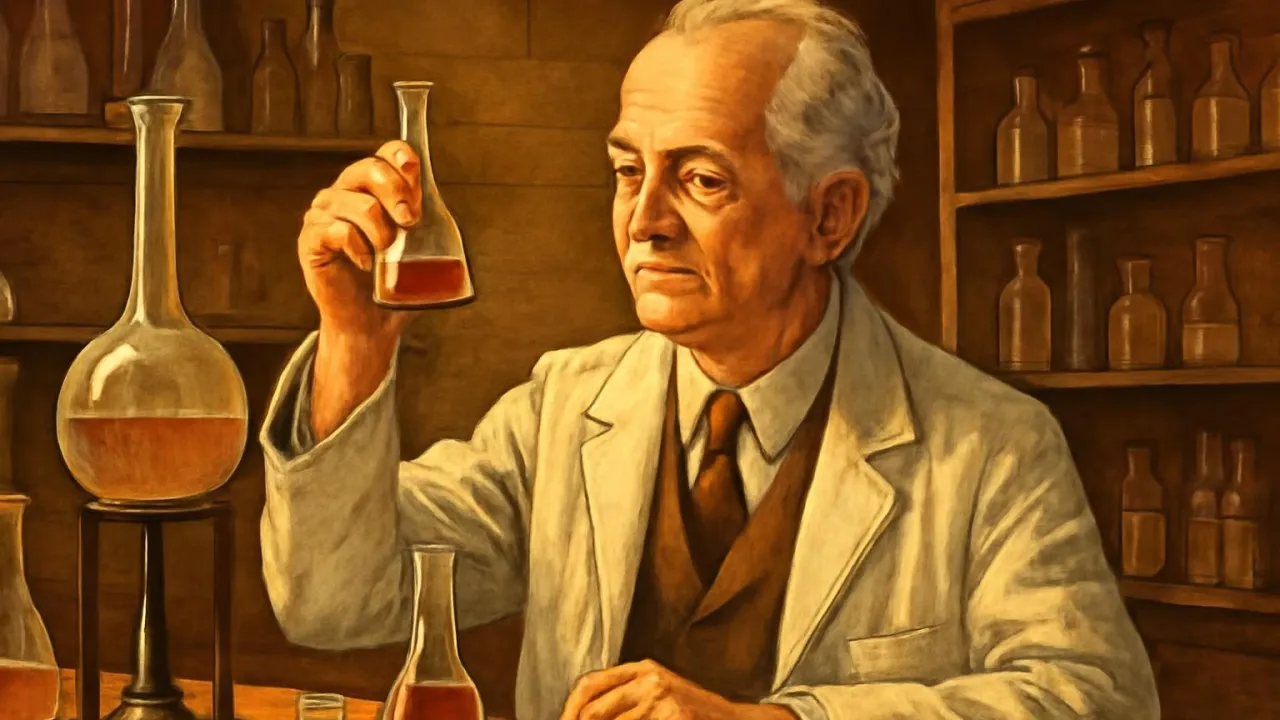
Linus Pauling won Nobel Prizes in both Chemistry and Peace for his amazing work.
✨ Word Sparks (Grade 2 Glossary)
Tap 🔊 to hear
molecule
A group of atoms joined together tightly
chemical bond
The glue that holds atoms side by side
vitamin C
A vitamin that helps keep you from getting sick
🪝
How can tiny atoms teach us about health and peace?
1
Curious About Tiny Things
Linus Pauling was curious about atoms and since childhood. He studied hard and loved science experiments. He built models to see how atoms connect and move.
2
Discovering Chemical Bonds
He worked many years to learn about and . His ideas helped scientists understand how atoms stick together. He showed that molecules have special shapes that matter.
3
Helping the World Stay Healthy
Linus also studied vitamins and their effects on health. He told people helps fight sickness and stay strong. Besides science, he spoke up for peace during hard times.
2. Which vitamin did Linus say helps people stay strong?
🤯 Mind-Blowing Fact • Grade 3
Pauling’s work on chemical bonds is still a foundation in modern chemistry classes worldwide.
✨ Word Sparks (Grade 3 Glossary)
Tap 🔊 to hear
hypothesis
A smart guess to explain how things work
perseverance
Trying hard even when things are tough
championship
Winning a big contest or prize
🪝
What can we learn from atoms to help people and the planet?
1
Early Curiosity and Perseverance
Linus Pauling showed great by asking questions about atoms and molecules. His curiosity led him to study chemistry and physics deeply. He believed that understanding tiny particles could explain big mysteries.
2
Revolutionizing Chemical Bonds
Pauling developed new ideas about chemical bonds that changed science forever. He explained how atoms share electrons to form strong bonds. This helped scientists understand molecular shapes and reactions better.
3
Vitamins and Health Discoveries
Pauling researched vitamin C and its role in preventing illness. He promoted the idea that vitamins could improve health and longevity. His work inspired many to think about nutrition and disease prevention.
4
Peace Activism and Global Impact
Besides science, Pauling advocated for peace and nuclear disarmament during tense global times. His leadership showed sportsmanship in science and society. He earned Nobel Prizes for both chemistry and peace efforts.
1. What did Pauling’s hypothesis explain about atoms?
2. What other important role did Pauling play besides science?
🤯 Mind-Blowing Fact • Grade 4
Pauling is one of the few to earn Nobel Prizes in two different fields: Chemistry and Peace.
✨ Word Sparks (Grade 4 Glossary)
Tap 🔊 to hear
electronegativity
How strongly atoms pull shared electrons
quantum mechanics
Science that explains tiny particles’ behavior
nutrition
How food helps your body grow and stay healthy
🪝
How did Linus Pauling change science and help the world during difficult times?
1
Scientific Breakthroughs in Chemistry
During the early 20th century, Pauling’s research revolutionized how scientists understood chemical bonds and molecular structures. His innovative use of explained how atoms form stable connections that create matter. This turning point helped chemistry become a precise and predictive science, influencing many future discoveries.
2
Signature Innovations and Techniques
Pauling introduced the concept of to describe how atoms attract electrons in bonds, changing the way chemists view interactions. He created detailed molecular models that visualized complex structures clearly and helped explain chemical behavior. These techniques remain essential tools for chemists worldwide and are taught in classrooms today.
3
Global Impact on Health and Nutrition
Pauling’s research on vitamin C sparked worldwide interest in ’s role in disease prevention and health improvement. His advocacy encouraged people to improve diets and consider supplements for better health outcomes. This global impact influenced medicine and public health policies, inspiring ongoing research into vitamins and wellness.
4
Peace Advocacy and Lasting Legacy
Beyond science, Pauling courageously spoke against nuclear weapons during the Cold War era, risking criticism to promote peace. His leadership earned him the Nobel Peace Prize and inspired many to pursue peace and disarmament efforts globally. His legacy combines scientific genius with humanitarian courage, showing how one person can impact the world.
1. What did Pauling’s electronegativity idea explain?
2. What important cause did Pauling support besides chemistry?
🤯 Mind-Blowing Fact • Grade 5
Linus Pauling is one of only two people to win Nobel Prizes in both Chemistry and Peace.
✨ Word Sparks (Grade 5 Glossary)
Tap 🔊 to hear
valence bond theory
How atoms share electrons to form bonds
resonance
When molecules have different shapes that help them stay strong
interdisciplinary
Using many types of science together to solve problems
🪝
How did Linus Pauling’s discoveries in chemistry and peace shape science and society forever?
1
Early Life and Scientific Passion
Linus Pauling’s early curiosity about the natural world led him to study chemical bonds and molecular structures in great depth. His academic journey combined physics and chemistry, which allowed him to pioneer new theories about atomic interactions. Pauling’s passion for understanding the invisible world of atoms fueled decades of groundbreaking research. He was determined to explain how tiny particles build everything around us.
2
Innovations in Chemical Bonding and Molecular Models
Pauling introduced the concept of electronegativity, which quantitatively describes how atoms attract electrons within bonds. His development of the and structures transformed chemistry’s understanding of molecular stability. Pauling’s precise molecular models enabled scientists to visualize complex molecules, advancing fields like biochemistry and pharmacology. These innovations remain foundational in scientific education and research.
3
Vitamin C Research and Health Advocacy
Pauling’s later work emphasized the health benefits of vitamin C, proposing that high doses could prevent colds and improve longevity. Although some claims sparked debate, his research encouraged further studies in nutritional science. His advocacy helped popularize vitamins as essential components of a healthy lifestyle worldwide. This work inspired many to explore how nutrition affects disease and well-being.
4
Peace Activism and Nobel Honors
During the Cold War, Pauling actively campaigned against nuclear weapons testing and promoted global peace. His efforts earned him the Nobel Peace Prize in 1962, making him one of only two individuals awarded Nobel Prizes in two distinct fields. Pauling’s leadership combined scientific rigor with humanitarian concern, inspiring generations. He showed how scientists can influence society beyond the lab.
5
Legacy and Lessons for Future Generations
Pauling’s legacy teaches us the power of curiosity, perseverance, and courage in science and society. His approach bridged chemistry, health, and peace activism, showing how knowledge can improve the world. Future scientists can learn from his example to pursue discovery and advocate for positive change. His life reminds us that science and kindness together can create a better future.