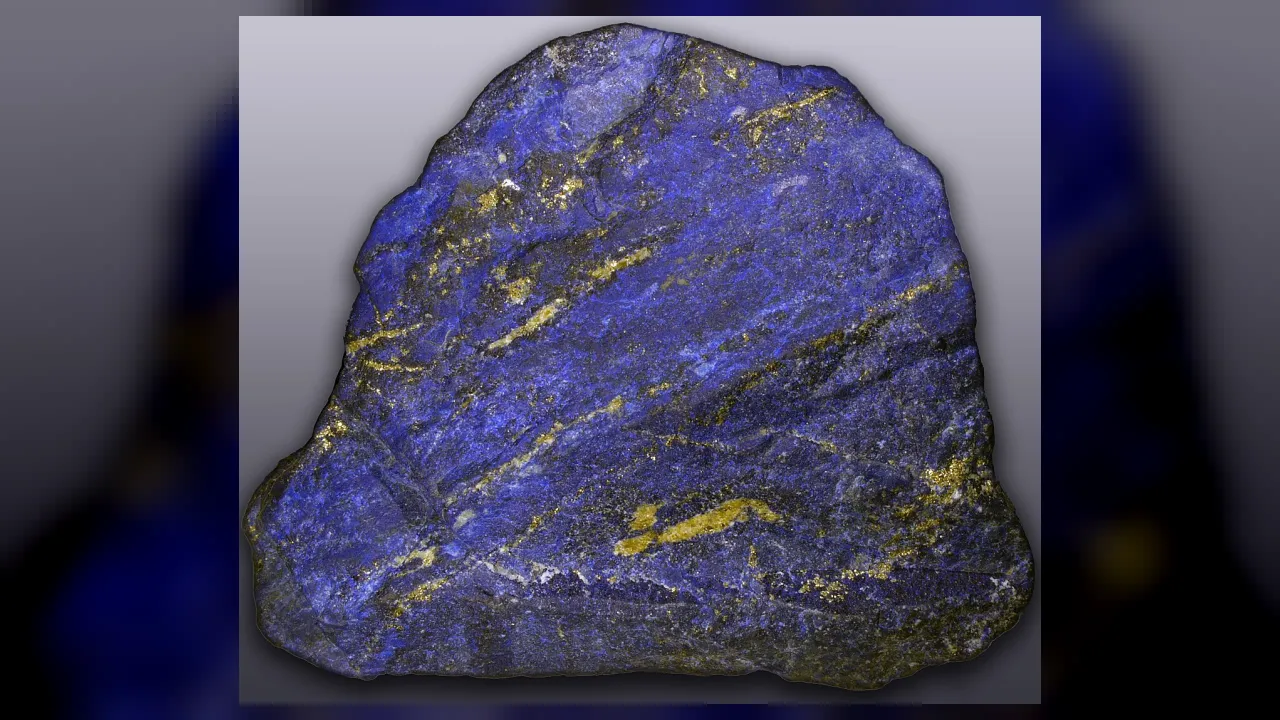
1. What are the tiny golden stars sparkling inside lapis lazuli actually made of?
2. How did master painters long ago use lapis lazuli?
🤯 Mind-Blowing Fact • Grade 2
The Sar-i Sang lapis lazuli mines high in the mountains of Afghanistan have been worked by humans for more than 6,500 years—making them among the oldest mines on Earth!
✨ Word Sparks (Grade 2 Glossary)
Tap 🔊 to hear
lazurite
The main deep-blue mineral inside lapis lazuli
calcite
A white mineral forming streaks in marble
ultramarine
Deep blue paint made from lapis lazuli
🪝
Why is lapis lazuli classified as a ROCK instead of a single mineral?
1
A Recipe of Three Minerals
Think of a chocolate-chip cookie: flour, sugar, and chocolate chips bake together into one treat. Geologists call lapis lazuli a rock rather than a single mineral because it blends blue , white , and golden pyrite!
2
Mined High in Snowy Peaks
For more than six thousand years, miners climbed steep snowy trails in the mountains of Afghanistan to harvest royal-blue lapis. Caravans carried those stones all the way to ancient Egypt and Mesopotamia.
3
Paint Worth More Than Gold
During the Renaissance in Europe, ships sailed blue lapis across the Mediterranean Sea. Artists called the paint ',' meaning 'beyond the sea,' and saved it for their most important paintings!
1. Why do Earth scientists classify lapis lazuli as a rock instead of a mineral?
2. What does the paint name 'ultramarine' literally mean?
🤯 Mind-Blowing Fact • Grade 3
Johannes Vermeer loved ultramarine paint made from crushed lapis lazuli so much that he used it even in shadows of 'Girl with a Pearl Earring,' nearly driving his family broke!
✨ Word Sparks (Grade 3 Glossary)
Tap 🔊 to hear
contact metamorphism
Rock changed directly by nearby hot magma
sulfur
A yellow non-metal element that colors lazurite
scarab
An ancient Egyptian beetle-shaped carved stone charm
🪝
What surprising non-metal element actually gives lapis lazuli its electric blue color?
1
Sulfur's Surprising Blue Secret
When you hear the word , you probably picture bright yellow volcano crystals! Yet inside lapis lazuli's main mineral—lazurite—tiny groups of three sulfur atoms lock inside microscopic mineral cages. Trapped in those cages, sulfur absorbs red and yellow sunlight to shine back intense royal blue!
2
Baked Where Magma Meets Marble
Lapis lazuli forms through : blazing-hot magma pushes right against ancient layers of white limestone, cooking the rock into marble packed with blue lazurite, snowy calcite, and brassy pyrite.
3
Pharaohs and Masterpieces
Ancient Egyptian carvers shaped lapis into beetles and inlaid the eyebrows of King Tutankhamun's golden mask. Centuries later, Dutch artist Johannes Vermeer painted 'Girl with a Pearl Earring' using genuine crushed lapis ultramarine!
4
Testing Hardness in Class
Because lapis mixes lazurite (hardness 5 to 5.5) with softer calcite (hardness 3) and harder pyrite specks (hardness 6.5), different spots on one stone scratch differently!
1. Which surprising element trapped inside mineral cages gives lazurite its deep royal-blue color?
2. How does lapis lazuli form underground?
🤯 Mind-Blowing Fact • Grade 4
In 1828, French chemist Jean-Baptiste Guimet won a national science prize by baking common clay, soda, and sulfur into synthetic ultramarine chemically identical to lapis lazuli's blue mineral!
✨ Word Sparks (Grade 4 Glossary)
Tap 🔊 to hear
aggregate
A solid rock mass combining multiple minerals
sodalite
A cousin blue silicate mineral without pyrite
synthesize
To build a chemical compound from ingredients
🪝
How did a nineteenth-century chemistry contest finally unlock royal ultramarine blue for every kid's paintbox?
1
Rock Cycle Lesson in One Stone
In Virginia Earth science classrooms, students learn the fundamental difference between minerals and rocks: minerals have one fixed chemical formula, while rocks multiple minerals. Lapis lazuli illustrates this beautifully! To earn the name lapis lazuli, a metamorphic marble must contain at least 25 percent blue lazurite, accompanied by white calcium-carbonate calcite, brassy iron-sulfide pyrite, and minor silicates like diopside and .
2
Why Ultramarine Cost More Than Gold
Turning raw lapis into pure paint took weeks: Renaissance workshops ground the rock into powder, kneaded it into warm dough made of beeswax, pine resin, and linseed oil, and washed it in alkaline lye so only pure blue lazurite floated free while gray waste stayed stuck in the wax!
3
The 1828 French Chemistry Prize
Because genuine lapis pigment cost more ounce-for-ounce than gold, France offered a 6,000-franc prize in 1824 to anyone who could its exact formula. In 1828, chemist Jean-Baptiste Guimet baked kaolin clay, soda ash, charcoal, and sulfur in a kiln—creating identical 'French ultramarine' affordable for artists everywhere!
4
World Deposits Beyond Badakhshan
Besides Afghanistan's Hindu Kush peaks, major lapis deposits occur high in Chile's Andes Mountains (their national stone) and near Lake Baikal in Siberia.
1. How did Renaissance artists separate pure blue lazurite grains from gray rock impurities?
2. Which South American country honors lapis lazuli from its high Andes peaks as a national stone?
🤯 Mind-Blowing Fact • Grade 5
In 2019, scientists found microscopic grains of Afghan lapis lazuli trapped in the fossilized tooth plaque of a 1,000-year-old German woman—proving women painted precious illuminated manuscripts in the Middle Ages!
✨ Word Sparks (Grade 5 Glossary)
Tap 🔊 to hear
feldspathoid
Cage-like aluminosilicate mineral low in silica
skarn
Metamorphic rock formed where magma alters marble
radical anion
Charged molecule group carrying an unpaired electron
🪝
Why did scraping millimeter-sized blue flecks from a medieval woman's teeth rewrite history about medieval artists?
1
Feldspathoid Cages and Trisulfur Radicals
Zoom inside lazurite—(Na,Ca)8(AlSiO4)6(SO4,S,Cl)2, a cubic member of the sodalite group—and you find zero transition-metal chromophores such as copper, cobalt, or titanium! Instead, alternating aluminum and silicon tetrahedra construct miniature truncated-octahedral cages called beta-cages. Sealed safely inside those cages sit negatively charged trisulfur (S3•−). Unpaired electrons jumping between molecular orbitals inside S3•− absorb a fierce band of orange-red light around 600 nanometers, transmitting an unfading ultramarine blue immune to centuries of light exposure.
2
Metasomatic Skarns of Badakhshan
At Sar-i Sang in Afghanistan's Kokcha River valley—towering more than 3,300 meters up in the Hindu Kush—Archean dolomitic marbles were intruded by granitic plutons. High-temperature metasomatic fluids rich in sodium, chlorine, and sulfur transformed layers of carbonate into calc-silicate hosting deep violet-blue lazurite lenses speckled with cubic pyrite (FeS2) and bordered by white forsterite-diopside marble.
3
Acid Sensitivity and Sodalite Look-Alikes
Geologists distinguish lapis lazuli from look-alike blue sodalite rock by two quick tests: lapis contains brassy pyrite crystals and releases a faint whiff of hydrogen sulfide ('rotten-egg' sulfur gas) if touched with dilute hydrochloric acid on a microscopic test spot, whereas chlorine-bearing sodalite lacks pyrite and sulfur.
4
Archaeological Discovery in Medieval Dental Calculus
In 2019, scientists using Raman microspectroscopy examined hardened dental plaque on the 1,000-year-old jawbone of a medieval woman buried at Dalheim, Germany. Trapped in her teeth were microscopic grains of pure Afghan lapis lazuli—proving she was an elite medieval manuscript illuminator who licked the tip of her paintbrush to paint fine blue details!
5
Etymology Across Continents
The name blends Latin 'lapis' (stone) with Persian 'lazhward' (sky blue)—the linguistic ancestor of the English color word 'azure'! Across six millennia of trade linking South Asia, Egypt, and Europe, this contact-metamorphic rock connected geology directly to human art, chemistry, and global history.