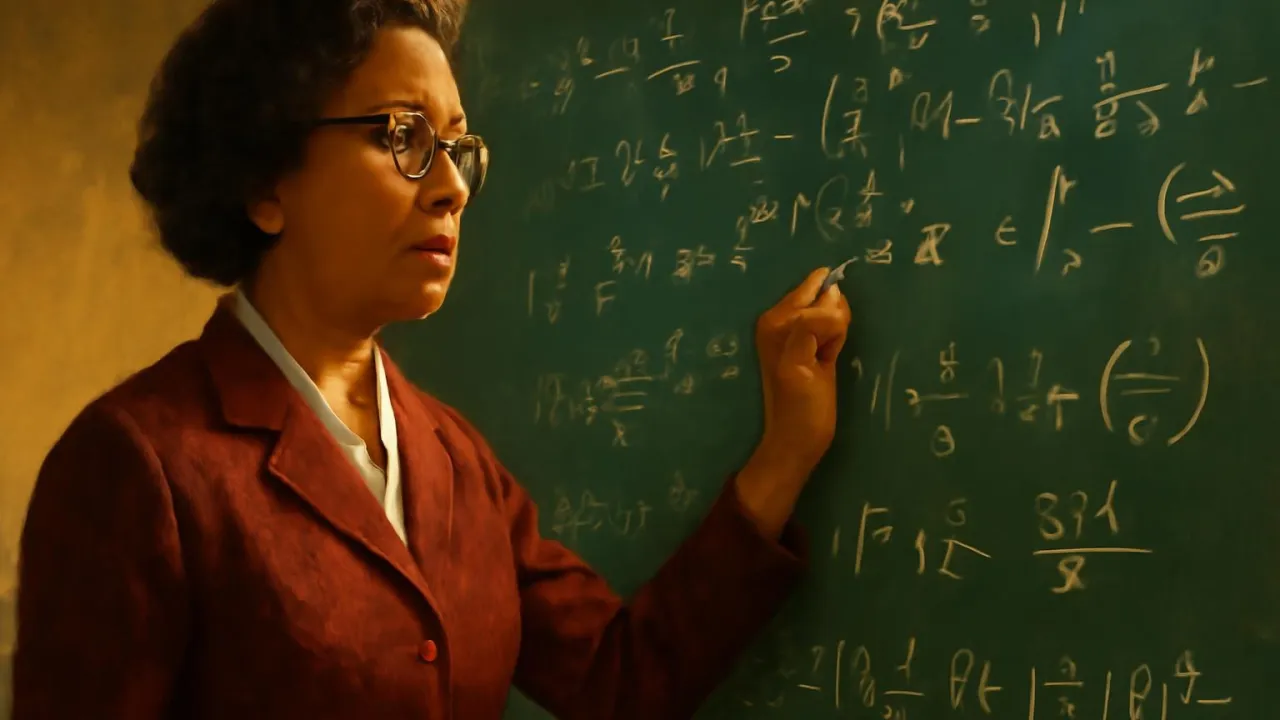
Katherine Johnson checked the numbers for the first American orbit around Earth!
✨ Word Sparks (Grade 2 Glossary)
Tap 🔊 to hear
orbit
A path around a planet or star.
NASA
America’s space exploration organization.
perseverance
Never giving up, even when it’s hard.
🪝
Could solving tricky math problems help people reach the stars?
1
A Math Star
As a child, Katherine counted everything around her, even the stars at night. She loved math so much that she finished school early. Her teachers noticed her talent and encouraged her to keep learning.
2
Practice and Perseverance
Katherine worked very hard in college and never gave up. She solved tough problems and learned new math every day. Her curiosity made her a great student and a future scientist.
3
Space Mission Hero
At , Katherine used her math skills to help astronauts travel safely. She checked the flight paths and made sure the rockets went the right way. Her work helped send John Glenn into .
Katherine Johnson’s math helped land astronauts on the Moon in 1969!
✨ Word Sparks (Grade 3 Glossary)
Tap 🔊 to hear
calculation
Careful solving of math problems.
legacy
What someone leaves behind for others.
barrier
A rule or wall that blocks people.
🪝
How could a love for numbers help launch people into outer space?
1
Curious Beginnings
Katherine’s curiosity about numbers started when she was a little girl. She counted everything, from steps to the stars in the sky. Her teachers saw her talent and helped her skip grades so she could keep learning.
2
Learning and Perseverance
Katherine attended college at just fifteen years old, where she studied mathematics. She faced challenges because of her race and gender, but her perseverance and love of learning kept her going. She became a teacher, inspiring others with her passion for math.
3
NASA and the Space Race
Katherine joined NASA as a ‘human computer,’ calculating important flight paths for astronauts. She checked and double-checked every number to keep the missions safe. Her helped John Glenn orbit Earth and return safely.
4
Changing History
Katherine’s work proved that women and African Americans could excel in science. She broke and inspired future scientists. Her shows the power of math, curiosity, and courage.
1. How old was Katherine when she started college?
2. What did Katherine’s work at NASA help prove?
🤯 Mind-Blowing Fact • Grade 4
John Glenn, the first American to orbit Earth, trusted Katherine’s math more than any machine!
✨ Word Sparks (Grade 4 Glossary)
Tap 🔊 to hear
segregation
Keeping people apart by unfair rules.
STEM
Science, Technology, Engineering, and Math.
expertise
Special skill or deep knowledge in something.
🪝
What does it take for one person’s math skills to change the course of history?
1
A Childhood Full of Questions
From a very young age, Katherine Johnson was fascinated by numbers and patterns, often counting everything she saw. Growing up in West Virginia during , she faced many obstacles, but her family and teachers supported her education. She skipped several grades and entered high school at ten, graduating college at just eighteen. Her early love of math set her on a path to greatness.
2
Breaking Barriers in Science
Despite facing discrimination as both an African American and a woman, Katherine’s perseverance was unstoppable. She became a teacher and later joined the National Advisory Committee for Aeronautics, which became NASA. At NASA, she worked as a ‘human computer,’ calculating complex flight paths for America’s first space missions. Her precise calculations were trusted by astronauts and engineers alike.
3
The Space Race and Apollo Missions
Katherine’s mathematical was crucial during the Space Race, especially for John Glenn’s orbit around Earth in 1962. Glenn personally requested that Katherine check the computer’s numbers before his flight. Later, her work helped plan the Apollo 11 mission, which landed astronauts on the Moon. Her careful calculations made these historic missions possible and safe.
4
A Lasting Legacy
Katherine Johnson’s achievements opened doors for women and minorities in science and engineering. She received the Presidential Medal of Freedom and inspired countless students to pursue careers. Her story reminds us that talent, determination, and curiosity can break down any barrier. Today, her legacy lives on in every rocket launch and every young scientist’s dream.
1. Why did John Glenn ask Katherine to check his flight numbers?
2. How did Katherine Johnson help future scientists?
🤯 Mind-Blowing Fact • Grade 5
Katherine Johnson’s calculations were so vital that NASA’s first computers had to match her answers before launching astronauts!
✨ Word Sparks (Grade 5 Glossary)
Tap 🔊 to hear
trajectory
The path something follows as it moves.
perseverance
Working hard and never giving up.
civilian
A person who is not in the military.
🪝
Imagine if your love for math could help astronauts reach the Moon—what would you do with that power?
1
A Childhood Spark for Numbers
Long before rockets soared into the sky, Katherine Johnson’s fascination with numbers shaped her world. As a child in segregated West Virginia, she counted everything she saw, from the steps she climbed to the stars she observed at night. Her remarkable curiosity and ability to solve complex problems led her to skip grades and begin high school at just ten years old. Encouraged by her family and teachers, Katherine graduated from college at eighteen, already dreaming of using math to solve real-world challenges. Her early life was marked by a relentless drive to learn, despite the barriers she faced because of her race and gender.
2
Breaking Into the World of Science
After college, Katherine became a teacher, but her ambitions reached far beyond the classroom. She joined the National Advisory Committee for Aeronautics, which would later become NASA, as one of the few African American women in the field. At NASA, she was known as a 'human computer,' performing complicated calculations by hand long before electronic computers were trusted. Katherine’s mathematical expertise and attention to detail made her indispensable, even in an era when women and minorities were often excluded from scientific work. Her and professionalism set her apart in a challenging environment.
3
Calculating for the Space Race
Katherine Johnson’s most famous contributions came during the tense years of the Space Race. She calculated the for Alan Shepard’s first American spaceflight in 1961 and, most famously, verified the computer-generated flight path for John Glenn’s historic orbit in 1962. Glenn insisted, 'Get the girl to check the numbers,' trusting Katherine’s calculations above all others. Her work was also critical for the Apollo 11 mission, which landed astronauts on the Moon in 1969. These missions depended on her precise math to ensure the astronauts’ safe journeys to space and back.
4
Legacy and Recognition
Katherine Johnson’s career broke barriers for women and African Americans in STEM fields. She co-authored 26 scientific papers and worked at NASA for 33 years, mentoring younger mathematicians and engineers along the way. In 2015, she received the Presidential Medal of Freedom, the highest honor in the United States, recognizing her extraordinary impact. Her story, once hidden, became widely known through books and films, inspiring new generations to pursue science, technology, engineering, and mathematics. Katherine’s life demonstrates how curiosity, hard work, and courage can change the world.
5
Inspiring Future Generations
Today, Katherine Johnson’s legacy lives on in every rocket launch, every STEM classroom, and every young person who dares to dream big. She proved that talent and determination matter more than any barrier society can build. Her achievements remind us that science needs all kinds of thinkers, and that diversity makes discovery stronger. Katherine’s journey from counting stars as a child to sending astronauts to the Moon is a powerful lesson in and possibility. Her story encourages us to ask questions, solve problems, and never stop reaching for the stars.