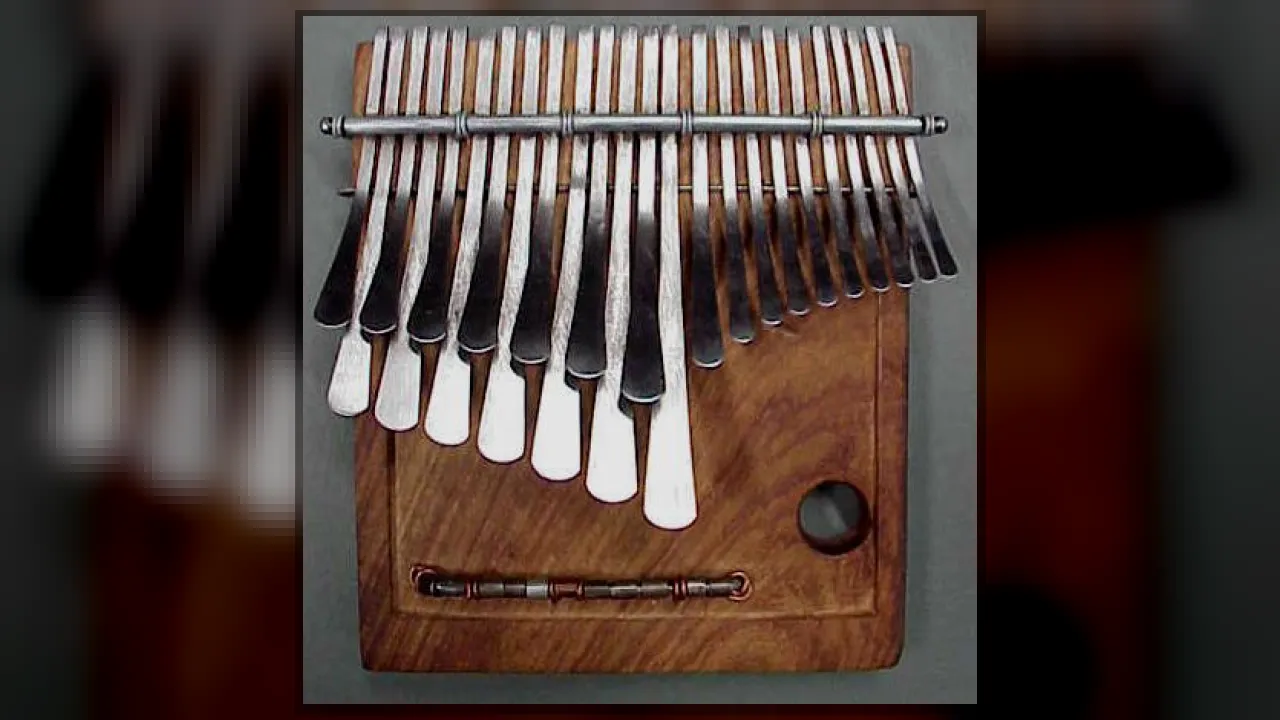
1. Which fingers do musicians use to pluck the metal strips on a kalimba?
2. Where are the longest, lowest-sounding metal strips usually placed?
🤯 Mind-Blowing Fact • Grade 2
To tune a kalimba, you gently tap a tiny metal hammer on the end of a tine to slide it shorter for a higher note or longer for a lower note!
✨ Word Sparks (Grade 2 Glossary)
Tap 🔊 to hear
soundbox
Hollow wooden body that boosts quiet vibrations
chord
Three or more notes ringing harmoniously together
forged
Shaped from hot metal using careful hammering
🪝
What would happen if a piano shrank to fit in your palms and scrambled its keys in a zigzag?
1
A Music Box You Play Yourself
Ting-ling, plink-plank! Under a starry African sky, soothing bell-like notes drift from a musician's cupped hands. Instead of pressing plastic keys, two thumbs flick slender steel strips fastened to a hollow wooden box.
2
Why the Notes Zigzag Left and Right
Look closely at the row of metal tines and you will spot a clever V-shape. The longest tine sits in the center for the lowest note, and each higher note jumps left, then right, then left again. Because neighbor tines on one side skip a note, sliding one thumb plays sweet !
3
Ancient Roots Across Africa
For thousands of years, African makers crafted early relatives from split bamboo and hand- iron. Today, beginners and concert stars alike love its gentle, calming voice!
1. Why do kalimba notes alternate left and right outward from the center tine?
2. What happens when a player slides a metal tine slightly shorter over the bridge?
🤯 Mind-Blowing Fact • Grade 3
Traditional African mbira players purposefully attach shells, beads, or flattened bottle caps to their wooden boards because the gentle buzzing sound helps quiet notes carry farther outdoors!
✨ Word Sparks (Grade 3 Glossary)
Tap 🔊 to hear
lamellophone
Instrument family using plucked thin vibrating tongues
soundboard
Flat wooden surface radiating string or tine vibrations
amplify
To make a quiet sound wave louder
🪝
How does a thin strip of steel clamped at one end turn thumb plucks into lingering bell tones?
1
Ruler-on-a-Desk Physics
Have you ever held a plastic ruler tightly over the edge of your school desk and flicked the free end? Boiiing! Slide more ruler onto the desk and the pitch jumps higher! That exact vibration principle powers the kalimba, a beloved African instrument that scientists classify as a .
2
From Tine to Soundboard
Each spring-steel tongue, or tine, passes over a narrow metal bridge while a tight pressure bar clamps its back end down. When your thumbnail plucks and releases the curved tip, the free length oscillates up and down. Those rapid vibrations travel straight through the bridge into a hardwood or hollow resonant chamber, amplifying a tiny metallic click into warm chime-like timbre.
3
Cousins Across Sub-Saharan Africa
In Zimbabwe, the Shona people play a revered relative called the mbira, often placing it inside a large dried gourd lined with shells or bottle caps that add a lively, rhythmic buzz.
4
Global Journeys in the 1950s
In the 1950s, music researcher Hugh Tracey adapted African designs to Western major scales and introduced the kalimba worldwide—inspiring pop bands, classroom ensembles, and peaceful video-game soundtracks.
1. How do vibrations travel from a plucked kalimba tine into the surrounding air?
2. Which famous Zimbabwean relative of the kalimba is often played inside a gourd resonator with buzzing shells?
🤯 Mind-Blowing Fact • Grade 4
Maurice White, founder of the legendary band Earth, Wind & Fire, plugged a pickup-equipped electric kalimba into concert amplifiers so twenty thousand fans could dance to a palm-sized thumb piano!
✨ Word Sparks (Grade 4 Glossary)
Tap 🔊 to hear
cantilever
Beam anchored at one end hanging free
vibrato
Gentle pulsing wave in pitch or tone
arpeggiate
Play chord notes one after another smoothly
🪝
How did three thousand years of African engineering evolve from split bamboo tongues into concert electric thumb pianos?
1
Two Evolutions in Sub-Saharan Africa
Slip a seventeen-key kalimba into your backpack and you are carrying one of humanity's cleverest acoustic inventions. Ethnomusicologists trace African lamellophones—instruments with plucked flexible tongues—back roughly three thousand years along the West African coast, where early makers carved resonant boards fitted with split bamboo or palm-rib tines. More than a millennium later in the Zambezi River valley of southeastern Africa, master blacksmiths smelted iron ore and hammered durable metal tines that rang with crystalline sustain.
2
Cantilever Beams and Helmholtz Wah-Wah
In mechanical engineering, a bar clamped firmly at one end and free to bounce at the other is called a beam. Because a cantilever's fundamental frequency drops rapidly as its free length grows, lengthening a steel tine by just one centimeter noticeably lowers its pitch. On hollow-box kalimbas, vibrating air inside the mahogany or koa chamber exits through a circular front sound hole and two rear finger ports. Covering and uncovering those ports shifts the chamber's resonant frequency, bending overtones into a shimmering 'wah-wah' !
3
Bilateral Symmetry for Effortless Harmony
When British-South African ethnomusicologist Hugh Tracey began building export kalimbas in 1954, he preserved a brilliant African layout: arranging diatonic scale degrees alternately left and right outward from the center root note. That bilateral layout spaces neighboring tines on either side a musical third apart, allowing a single thumb sweep to rich triads while alternating thumbs race through rapid melodies without crossing.
4
Stadium Grooves and Peaceful Screens
From Maurice White electrifying stadium crowds with Earth, Wind & Fire in the 1970s to Jeremy Zuckerman's meditative kalimba theme for Avatar: The Last Airbender, this humble wooden marvel enchants listeners everywhere.
1. In physics and engineering, what do we call a kalimba tine clamped at one end and free to vibrate at the other?
2. Why does sweeping one thumb across three neighboring tines on the same side of a kalimba automatically play a pleasing triad chord?
🤯 Mind-Blowing Fact • Grade 5
Because a clamped metal tine bends like a stiff beam rather than stretching like a string, its first overtone vibrates at 6.27 times the main frequency—giving every pluck a tiny bell-like sparkle right before the pure note rings out!
✨ Word Sparks (Grade 5 Glossary)
Tap 🔊 to hear
inharmonic
Overtones not matching whole-number multiples of pitch
diatonic
Seven-note major or minor musical scale pattern
flexural
Relating to bending back and forth elastically
🪝
Why do clamped spring-steel tines produce bell-like inharmonic clang tones on the instant of attack before settling into pure flute-like sustain?
1
Ancient Lamellophones of the Zambezi
Pluck a single kalimba tine beside a sensitive spectrum analyzer and watch two contrasting sonic worlds unfold at once: a bright, metallic chime flashes at the instant your thumbnail releases the tip, then melts within milliseconds into a warm, flute-pure fundamental hum. Classified in the Hornbostel-Sachs system under code 122.1 (plucked board or box idiophones, or lamellophones), the modern kalimba descends from centuries-old Sub-Saharan African instruments—including the Shona mbira dzavadzimu of Zimbabwe, the Congolese likembe, and the Tanzanian ilimba.
2
Euler-Bernoulli Cantilever Physics
Unlike a stretched guitar string—whose overtones line up in neat integer multiples (2f, 3f, 4f) of the fundamental frequency—each spring-steel kalimba tine behaves as an Euler-Bernoulli clamped-free cantilever beam. Its fundamental pitch is inversely proportional to the square of its overhanging length, meaning that shortening a tine by just thirty percent roughly doubles its frequency by an entire octave! Meanwhile, its second bending mode oscillates at approximately 6.27 times the fundamental frequency rather than an even harmonic multiple.
3
Rapid Damping of the 'Clang' Mode
Why doesn't that non-integer 6.27f overtone make a kalimba sound out of tune? High-frequency bending waves couple aggressively through the steel saddle bridge into the hardwood soundboard—often solid kiaat, mahogany, or acacia—radiating their energy almost instantaneously as a crisp bell-like attack transient before vanishing, leaving the pure fundamental (typically spanning C4 at 261.6 hertz to E6 at 1,318.5 hertz on a 17-key C-major model) singing serenely.
4
Helmholtz Cavity Coupling and Mirliton Buzzers
Hollow box resonators further enrich low fundamentals via a tuned Helmholtz air-cavity mode vented through a circular sound hole; modulating rear thumbholes alters aperture area to sweep cavity resonance in expressive 'wah-wah' vibrato. Conversely, traditional ceremonial mbiras intentionally attach loose shell or metal buzzers (mirlitons) to convert clean sine-like sustain into dense high-frequency spectral energy that carries across open-air gatherings. This deliberate contrast demonstrates how different cultures engineer acoustic clarity or rich buzzing complexity to match their musical architecture.
5
Hugh Tracey and Contemporary Synthesis
Following ethnomusicologist Hugh Tracey's 1954 standardization of bilateral tuning in South Africa, chromatic two-tier kalimbas, electro-acoustic pickups, and studio sampling carried African lamellophone artistry into global jazz, R&B, ambient minimalism, and contemporary film orchestration. From Zimbabwean master Forward Kwenda and Thomas Mapfumo's chimurenga ensembles to Maurice White's arena-shaking grooves and modern orchestral scores, the thumb-plucked tine continues to bridge ancient metallurgy and timeless melody.