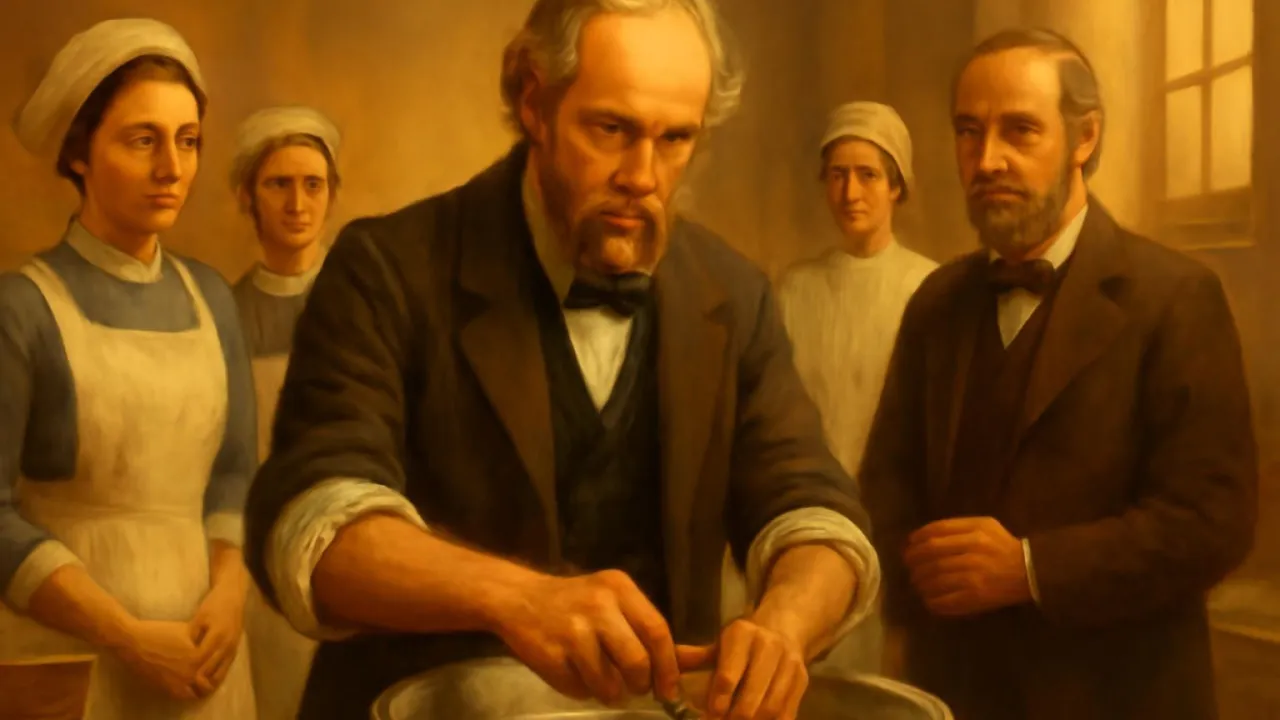
Joseph Lister’s ideas helped create the first safe surgeries.
✨ Word Sparks (Grade 2 Glossary)
Tap 🔊 to hear
infection
When germs make you sick
surgeon
A doctor who does surgery
liquid
Something you can pour, like water
🪝
Have you ever wondered why doctors wash their hands?
1
Young Joseph’s Wonder
Joseph loved to watch his father’s science experiments, and he was curious about everything. He noticed many people got sick after surgeries, and he wanted to help them. He started to ask, 'Why does this happen?'
2
A Clean Discovery
Joseph learned about germs and thought they might cause sickness. He began to clean his hands and tools with special before surgeries. Soon, fewer patients got , and more people got well.
3
Changing the World
Other doctors saw Joseph’s success and wanted to learn his ways. Hospitals became safer because of his new rules. Joseph’s big idea helped save many lives all around the world.
Lister’s methods helped reduce deaths from surgery by more than half.
✨ Word Sparks (Grade 3 Glossary)
Tap 🔊 to hear
carbolic acid
A strong liquid that kills germs
perseverance
Never giving up, even when it’s hard
wound
A cut or injury on the body
🪝
Can you imagine a time when doctors didn’t know about germs?
1
Curiosity in the Lab
Young Joseph Lister loved exploring his father’s laboratory and learning about science. He noticed that many patients died after surgery, even when the operation seemed to go well. Joseph wondered if something invisible was causing these infections. His curiosity made him ask questions that others ignored.
2
The Power of Antiseptics
Joseph read about tiny living things called germs. He believed these germs could make infected. He began using , an antiseptic, to clean wounds and tools before surgery. Soon, the number of infections dropped, and patients healed better.
3
Facing Doubt and Change
At first, many doctors did not believe Joseph’s ideas about germs. They thought cleaning everything was not needed. Joseph kept careful notes and showed his results to others. His helped change medical practice forever.
4
A Safer World
Joseph’s antiseptic methods spread to hospitals in many countries. Surgeons everywhere started to wash their hands and tools. This new practice saved countless lives and made surgery much safer. Joseph Lister became known as the 'father of modern surgery.'
Lister’s work inspired the name for Listerine, the mouthwash that kills germs.
✨ Word Sparks (Grade 4 Glossary)
Tap 🔊 to hear
sterilize
To make something completely free of germs
microscope
A tool to see tiny things
legacy
What someone leaves for the future
🪝
What if one person’s experiment could save millions of lives?
1
A Scientific Childhood
Growing up in Victorian England, Joseph Lister was fascinated by science and discovery, thanks to his father’s work with . He spent hours observing tiny things and wondered how they affected the world. When he became a surgeon, Joseph noticed that even successful operations often ended with deadly infections. This mystery inspired him to search for a scientific explanation.
2
The Antiseptic Revolution
After reading Louis Pasteur’s work on germs, Joseph realized that invisible organisms might be causing surgical infections. He began using carbolic acid to wounds, surgical instruments, and even the air in operating rooms. His methods dramatically reduced infection rates and proved that antiseptic procedures could save lives. This was a turning point in medical history.
3
Overcoming Resistance
Many doctors were skeptical of Joseph’s theories because germs could not be seen with the naked eye. Joseph carefully recorded his results and shared them through lectures and articles, slowly convincing others. His persistence and scientific evidence eventually changed the way surgeons worked across Europe and beyond.
4
A Lasting Legacy
Joseph Lister’s antiseptic techniques became the foundation of modern surgery. Hospitals around the world adopted his methods, making operations much safer for patients everywhere. Today, we remember Joseph Lister as the pioneer who used science to fight invisible dangers and protect countless lives.
Joseph Lister’s antiseptic methods reduced surgical death rates from nearly 50% to less than 15%.
✨ Word Sparks (Grade 5 Glossary)
Tap 🔊 to hear
hypothesis
A smart guess you can test in science
sterilization
Making things totally free of germs
mortality
How many people die from something
🪝
How did one surgeon’s quest for cleanliness transform the world of medicine forever?
1
A Childhood of Curiosity and Science
In Victorian England, Joseph Lister grew up surrounded by scientific curiosity, thanks to his father’s pioneering work with microscopes. Fascinated by the invisible world, Joseph spent hours observing microorganisms and pondering their effects on health. As a young medical student, he was deeply troubled by the high number of deaths from infections after surgery, a problem known as 'hospital gangrene.' This early exposure to science and suffering inspired him to seek a solution.
2
Discovering the Invisible Enemy
Joseph Lister was influenced by Louis Pasteur’s groundbreaking research, which showed that microorganisms could cause disease. Lister hypothesized that these invisible germs were responsible for deadly surgical infections. Determined to test his theory, he began experimenting with carbolic acid as an antiseptic to clean wounds, surgical tools, and even the air in operating rooms. His careful observations and methodical experiments soon led to a dramatic decrease in post-surgical deaths.
3
Changing Minds and Medical Practice
Despite his promising results, Lister faced strong opposition from many doctors who doubted the existence of germs because they could not see them. He meticulously documented his findings, publishing detailed case studies and delivering persuasive lectures to medical societies across Europe. Through persistence, scientific evidence, and the undeniable success of his antiseptic methods, Lister gradually convinced the medical community to adopt his practices.
4
A Global Medical Revolution
Lister’s antiseptic techniques revolutionized surgery and became the standard for hospitals worldwide. Surgeons began to sterilize their hands, instruments, and environments, leading to a dramatic reduction in surgical rates. His work laid the foundation for modern infection control, influencing everything from childbirth to battlefield medicine. By the end of his career, Lister had transformed surgery from a dangerous gamble into a life-saving science.
5
Legacy and Inspiration for the Future
Today, Joseph Lister is remembered as the 'father of antiseptic surgery,' and his legacy lives on in every clean hospital and safe operation. His scientific rigor, perseverance, and willingness to challenge old ideas have inspired generations of doctors and scientists. Lister’s story teaches us that even invisible enemies can be defeated with careful observation, bold ideas, and the courage to change the world for the better.