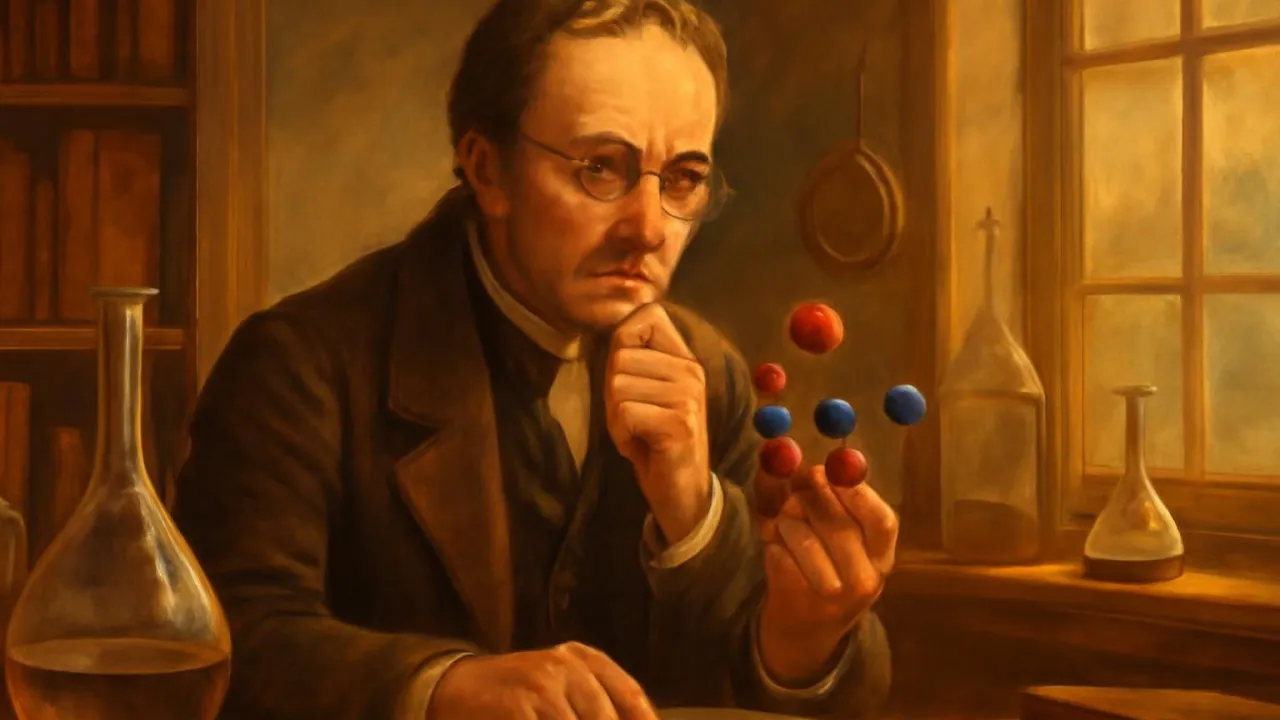
John Dalton kept weather records every day for over 50 years!
✨ Word Sparks (Grade 2 Glossary)
Tap 🔊 to hear
weather
What the sky and air are like
measure
To find out how big or small
theory
A big idea that explains something
🪝
Have you ever wondered what things are made of deep inside?
1
A Boy With Big Curiosity
John loved to watch rain and clouds, and he always asked questions. He wondered why the air felt different each day, and he wrote his ideas in a notebook. John was curious about everything around him.
2
Working With Numbers and Weather
John became a teacher and studied using special tools. He measured temperature and rain, and he wrote careful notes every day. John wanted to understand how things worked.
3
The Atom Idea
John thought everything must be made of small parts called atoms. He explained his idea to other scientists, and they were amazed. John’s atom changed how people thought about matter.
Dalton was also the first to study color blindness, which is sometimes called 'Daltonism' after him!
✨ Word Sparks (Grade 3 Glossary)
Tap 🔊 to hear
element
A basic kind of matter
molecule
Two or more atoms joined together
experiment
A test to learn something new
🪝
Imagine if you could see the tiniest pieces that make up everything around you!
1
Curiosity in the Countryside
Young John Dalton loved exploring the fields and skies of England. He kept a notebook to record weather, rain, and his questions about nature. John was fascinated by how things worked, especially the invisible things. His curiosity made him want to learn more every day.
2
Becoming a Scientist
As a teacher, John used instruments to study air, temperature, and water. He learned to measure and observe carefully, using tools like thermometers and rain gauges. John’s careful notes helped him spot patterns in the weather. He believed that everything, even air, was made of tiny parts.
3
The Atomic Theory
John Dalton imagined that all matter was made of atoms, which were like tiny balls. He explained that each had its own kind of atom, different from the others. Dalton used simple drawings of circles to show his ideas about atoms. His atomic theory helped scientists understand chemistry in a whole new way.
4
Changing Science Forever
Dalton’s ideas about atoms were new and bold for his time. Many people did not believe him at first, but his and notes convinced others. His work led to more discoveries about and . Today, we know that Dalton’s atomic theory changed science forever.
Dalton’s atomic symbols were the first used to show elements like hydrogen and oxygen on paper!
✨ Word Sparks (Grade 4 Glossary)
Tap 🔊 to hear
compound
A substance made of different atoms
symbol
A drawing or sign that means something
data
Information collected from experiments
🪝
What if you could unlock the secret code hidden inside every object in the world?
1
A Life of Questions and Weather
Growing up in rural England, John Dalton was surrounded by rolling hills and ever-changing skies, sparking his lifelong fascination with weather and nature. As a boy, he began recording daily weather observations, filling notebooks with about rain, clouds, and temperature. His careful attention to patterns in nature made him an excellent observer and thinker. This early curiosity led him to become a teacher and scientist.
2
Discovering the Building Blocks of Matter
Dalton’s greatest breakthrough came when he proposed that all matter is made of tiny, indivisible particles called atoms. He suggested that each chemical element is made of its own unique type of atom, and that these atoms combine in specific ways to form . Using simple and circles, Dalton created the first charts to represent different atoms and molecules. His atomic theory explained why substances mix, react, and change in predictable ways.
3
Facing Doubt and Proving His Theory
Not everyone believed Dalton’s atomic ideas at first, since atoms were invisible and mysterious. Dalton conducted careful experiments with gases, measuring how they combined and separated, to support his theory. His detailed notes and logical explanations slowly convinced more scientists. Over time, Dalton’s work became the foundation for modern chemistry and inspired others to explore the world of atoms and molecules.
4
Legacy Beyond Atoms
Dalton’s curiosity also led him to study color blindness, a condition he experienced himself. He wrote the first scientific paper about it, and today, color blindness is sometimes called 'Daltonism' in his honor. Dalton’s passion for asking questions and searching for answers changed how we understand everything around us. His legacy reminds us that big discoveries often begin with simple, thoughtful questions.
2. What did Dalton’s experiments with gases help prove?
🤯 Mind-Blowing Fact • Grade 5
Dalton’s weather diary, started at age twelve, grew to over 200,000 entries by the end of his life!
✨ Word Sparks (Grade 5 Glossary)
Tap 🔊 to hear
atomic theory
The idea that all matter is made of atoms
proportion
The amount of one thing compared to another
atmospheric pressure
The weight of air pressing down on us
🪝
Can you imagine believing in something so small that no one else can see it, and then convincing the world it’s real?
1
A Child’s Curiosity Sparks a Scientific Journey
Long before he became a famous scientist, John Dalton was a curious boy in the English countryside, fascinated by clouds, rain, and the mysteries of the air. He began keeping a weather diary at age twelve, recording daily changes in temperature, rainfall, and with homemade instruments. This habit of careful observation and note-taking became the foundation for his scientific thinking. Dalton’s early questions about the invisible forces shaping the world set him on a path of discovery that would change science forever.
2
From Teacher to Trailblazer in Chemistry
Dalton worked as a teacher and lecturer, sharing his love of science with students while conducting experiments in his spare time. He became especially interested in gases, measuring how they combined and separated using precise balances and glassware. Through hundreds of experiments, Dalton noticed that gases always combined in fixed, simple ratios—a clue that matter might be made of indivisible units. His careful data collection and logical reasoning led him to propose a radical new idea: all matter is made of tiny particles called atoms, each with a specific weight and properties.
3
The Birth of Atomic Theory
In 1808, Dalton published his , stating that elements are made of unique atoms that cannot be created or destroyed in chemical reactions. He introduced the first scientific symbols for elements like hydrogen (a simple circle) and oxygen (a circle with a dot), making chemistry easier to understand and communicate. Dalton’s theory explained why elements always combine in certain , laying the groundwork for the periodic table and modern chemistry. His ideas revolutionized how scientists viewed the building blocks of matter.
4
Overcoming Skepticism and Expanding Science
At first, many scientists doubted Dalton’s , since atoms were too small to see. Dalton responded by designing experiments with gases, such as measuring how different gases dissolved in water, to provide evidence for his ideas. He also studied color blindness, a condition he had himself, and published the first scientific paper on the topic—leading to the term 'Daltonism.' Dalton’s perseverance and clear explanations gradually convinced the scientific community, and his work inspired generations of chemists and physicists.
5
Legacy: The Invisible World Revealed
John Dalton’s vision of atoms as the invisible building blocks of matter transformed science and education worldwide. His remains a cornerstone of chemistry, and his methods of careful observation, record-keeping, and logical thinking are still taught in classrooms today. Dalton’s story shows that big discoveries can start with simple questions and the courage to believe in unseen possibilities. Because of Dalton, we now understand that everything—from water to air to living things—is made of atoms, unlocking endless mysteries of the universe.