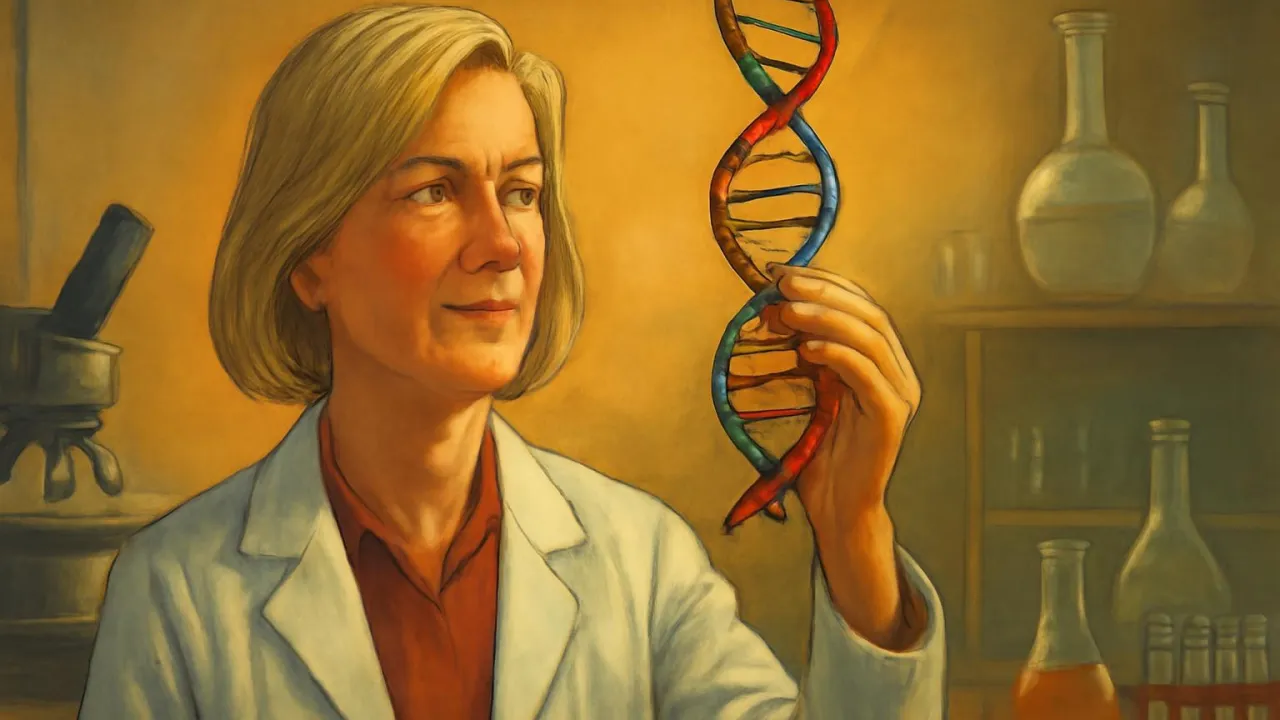
Jennifer’s CRISPR tool can help save lives by fixing genes!
✨ Word Sparks (Grade 2 Glossary)
Tap 🔊 to hear
discovery
Finding something new or important.
disease
Something that makes people or animals sick.
experiment
A test to learn or try something new.
🪝
Have you ever wondered how scientists can help cure diseases?
1
Curious About Life
Jennifer loved to explore the world around her, asking questions about how living things grow. She read many science books and dreamed of being a scientist. Her curiosity made her want to discover new things.
2
Hard Work in the Lab
Jennifer studied tiny things called genes, which tell our bodies how to work. She worked with a tool called CRISPR to change these genes. She practiced and learned from her mistakes every day.
3
A Big Achievement
Jennifer’s work with CRISPR helps doctors treat some . Her lets scientists fix broken genes in people and plants. Jennifer’s ideas changed science for everyone.
Jennifer Doudna’s CRISPR discovery earned her a Nobel Prize in Chemistry in 2020.
✨ Word Sparks (Grade 3 Glossary)
Tap 🔊 to hear
DNA
The code that tells living things how to grow.
perseverance
Trying again even when things are hard.
Nobel Prize
A very special award for great discoveries.
🪝
Imagine having a tool that lets you rewrite the instructions for life itself!
1
Wondering About Tiny Mysteries
As a child, Jennifer Doudna was fascinated by the world of plants and animals. She loved reading about how things grow and what makes them unique. Her curiosity about life’s building blocks led her to science. She wanted to discover how tiny pieces called genes shape every living thing.
2
Learning to Solve Problems
Jennifer spent many years studying biology and chemistry in school. She worked in laboratories, using microscopes and special tools to study . Sometimes her experiments did not work, but she used to keep going. Her hard work taught her the value of patience and careful observation.
3
The CRISPR Breakthrough
Jennifer and her team discovered how to use a tool called CRISPR to edit genes. CRISPR acts like scissors, cutting in precise places to fix or change instructions. This breakthrough made it possible to treat genetic diseases more easily. It also opened new doors for growing stronger crops and studying life.
4
Changing the World
Jennifer’s work with CRISPR has helped scientists all over the globe. Her invention is used in medicine, farming, and research. She teaches others about the importance of using science responsibly. Jennifer inspires young scientists to ask questions and dream big.
Jennifer Doudna’s CRISPR tool can help cure diseases that once seemed impossible to treat.
✨ Word Sparks (Grade 4 Glossary)
Tap 🔊 to hear
molecule
A tiny piece that makes up everything.
collaborator
Someone who works together with another person.
gene editing
Changing the instructions in our DNA.
🪝
What if you could repair the tiniest mistakes in the code of life itself?
1
A Childhood Filled with Curiosity
Jennifer Doudna grew up exploring the forests and beaches of Hawaii, always asking questions about nature’s secrets. Her fascination with the mysteries of life led her to read science books and dream of becoming a scientist. In school, she was inspired by a chemistry book her father gave her, which sparked her interest in . This early curiosity set her on a path to study biology and chemistry in college.
2
The Road to Discovery
Jennifer worked in many laboratories, learning how to use advanced tools to study DNA and genes. She faced setbacks, but her perseverance and careful thinking helped her solve difficult problems. Alongside her , Emmanuelle Charpentier, Jennifer explored how bacteria defend themselves using a system called CRISPR. Their teamwork and creativity led to a breakthrough that changed science forever.
3
Inventing CRISPR Gene Editing
Jennifer and her team figured out how to use CRISPR as a precise tool to cut and edit DNA. This discovery allowed scientists to change the genetic instructions in plants, animals, and even humans. CRISPR made it possible to treat genetic diseases, improve crops, and study how genes work in new ways. Jennifer’s invention quickly became one of the most important tools in modern biology.
4
A Global Impact and Responsibility
Jennifer’s work has inspired scientists around the world to use CRISPR for good. She speaks about the need to use responsibly and to think about its effects on society. In 2020, Jennifer Doudna and Emmanuelle Charpentier were awarded the Nobel Prize in Chemistry for their discovery. Jennifer continues to teach, research, and encourage young people to explore science with curiosity and care.
Jennifer Doudna’s CRISPR technology is now being used in clinical trials to treat genetic disorders such as sickle cell disease.
✨ Word Sparks (Grade 5 Glossary)
Tap 🔊 to hear
RNA
A molecule that helps carry genetic messages.
clinical trial
A test to see if new treatments work safely.
ethics
Thinking about what is right or fair.
🪝
Can you imagine holding a tool that could rewrite the very blueprint of life?
1
A Spark of Scientific Wonder
When Jennifer Doudna was a young girl growing up in Hawaii, she was captivated by the natural world around her. Her curiosity was ignited when her father gave her 'The Double Helix,' a book about the discovery of DNA’s structure. This gift inspired Jennifer to ask deep questions about how life works at the molecular level. Throughout her school years, she excelled in science classes and dreamed of making discoveries that could help people. Her early fascination with the invisible world of molecules set the stage for her groundbreaking career.
2
The Path to Molecular Mastery
Jennifer pursued her passion by studying biochemistry at Pomona College and earning her Ph.D. at Harvard University. She spent countless hours in laboratories, mastering techniques for analyzing and DNA—the molecules that carry genetic information. Jennifer’s research focused on understanding how cells use these molecules to control life’s processes. Her perseverance through failed experiments and her willingness to ask bold questions made her a respected scientist. She became a professor and led research teams dedicated to unlocking nature’s secrets.
3
CRISPR: A Revolutionary Discovery
In 2012, Jennifer Doudna and her collaborator Emmanuelle Charpentier made a transformative breakthrough: they discovered how the CRISPR-Cas9 system could be programmed to edit DNA with remarkable precision. CRISPR, originally found in bacteria as a defense mechanism, acts like molecular scissors that can cut and repair specific genetic sequences. This innovation allows scientists to remove, add, or change pieces of DNA in living organisms. Their discovery revolutionized genetic engineering, making it faster, cheaper, and more accurate than ever before.
4
Impact, Recognition, and Responsibility
Jennifer’s invention of CRISPR gene editing has had a profound impact on medicine, agriculture, and biological research worldwide. It enables the treatment of genetic diseases, the development of improved crops, and advances in understanding how genes function. In 2020, Jennifer Doudna and Emmanuelle Charpentier were awarded the Nobel Prize in Chemistry, recognizing their groundbreaking contribution to science. Jennifer is also a leader in discussing the ethical challenges of gene editing, emphasizing the need for careful and responsible use of this technology.
5
Inspiring Future Innovators
Beyond her scientific achievements, Jennifer Doudna is dedicated to mentoring young scientists and encouraging curiosity-driven research. She often speaks about the importance of perseverance, teamwork, and ethical thinking in scientific discovery. Jennifer’s story shows that asking big questions and working hard can lead to world-changing breakthroughs. Her legacy continues to inspire students everywhere to explore science and imagine new possibilities for the future. Jennifer Doudna reminds us that with curiosity and care, we can unlock the secrets of life itself.