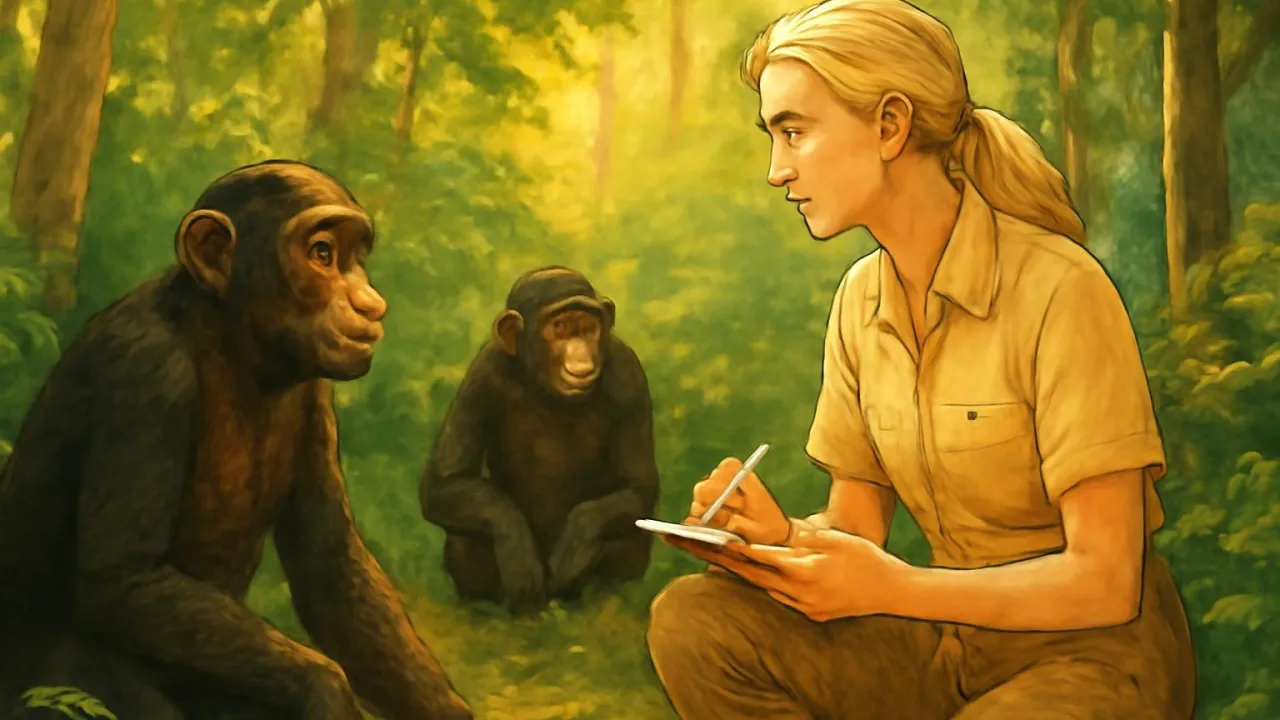
Jane Goodall still travels the world teaching kids about animals and nature.
✨ Word Sparks (Grade 2 Glossary)
Tap 🔊 to hear
Africa
A big continent with wild animals.
tool
Something used to help do a job.
discovery
Finding something new or amazing.
🪝
Have you ever wondered how animals talk to each other?
1
Jane’s Animal Curiosity
Jane loved reading animal stories and watching birds in her backyard. She wanted to visit and see wild animals with her own eyes. Her favorite animals were chimpanzees, and she dreamed of meeting them someday.
2
Hard Work in the Wild
Jane traveled to and spent many days in the forest. She had to sit quietly and wait for the chimpanzees to come near. Sometimes, she felt lonely, but she never gave up because she loved learning about them.
3
A Famous Discovery
Jane saw a chimpanzee use a stick to catch ants. Before Jane, scientists thought only humans used , so her was very important. Jane became famous for showing how smart chimpanzees are.
2. What made Jane’s discovery about chimpanzees special?
🤯 Mind-Blowing Fact • Grade 3
Jane Goodall’s first chimp friend, David Greybeard, helped the others trust her.
✨ Word Sparks (Grade 3 Glossary)
Tap 🔊 to hear
conservation
Caring for animals and nature.
termite
A tiny bug that lives in wood.
patience
Waiting calmly for something important.
🪝
What secrets would you discover if you could live among wild animals?
1
A Childhood Full of Questions
Jane Goodall always wanted to know how animals think and feel. She spent hours watching birds and reading adventure books about Africa. Her favorite toy was a stuffed chimpanzee named Jubilee, which inspired her dream to study real chimps. Jane wondered if animals had families and friendships like people do.
2
Journey to Africa
Jane saved money to travel to Africa, where she met scientist Louis Leakey. He believed Jane’s would help her study chimpanzees in Tanzania’s Gombe forest. Jane learned to observe without disturbing the animals, using a notebook to record everything she saw. She spent months gaining the trust of the chimpanzees before they let her come close.
3
Discovering Tool Use
One day, Jane saw a chimpanzee named David Greybeard using a stick to fish for . This was the first time anyone had seen a wild animal make and use a tool. Jane’s discovery changed what scientists thought about animal intelligence and human uniqueness. Her careful observations proved that chimpanzees could solve problems and learn new skills.
4
Changing the World for Animals
Jane gave each chimpanzee a name and wrote about their personalities. She spoke around the world to teach people about protecting animals and forests. Jane started the Roots & Shoots program to help kids become leaders. Her work continues to inspire people to care for wildlife and nature everywhere.
1. How did Jane record her chimpanzee observations?
2. Why was Jane’s tool discovery important?
🤯 Mind-Blowing Fact • Grade 4
Jane Goodall’s research showed that chimpanzees can feel joy, sadness, and even empathy.
✨ Word Sparks (Grade 4 Glossary)
Tap 🔊 to hear
primatology
The study of monkeys and apes.
habitat
The natural home of an animal.
empathy
Understanding how someone else feels.
🪝
Imagine patiently waiting in a rainforest for months—what might you discover about animal life?
1
A Childhood Dream Becomes a Mission
From a young age, Jane Goodall was fascinated by animal behavior and dreamed of exploring Africa’s wild places. She read books like 'Tarzan' and observed birds and insects in her backyard, always asking questions about how animals lived. Jane’s curiosity and determination led her to save money for a boat trip to Kenya, where she met the famous scientist Louis Leakey. Leakey saw Jane’s passion and invited her to study chimpanzees in Tanzania’s Gombe Stream National Park.
2
Learning from the Chimpanzees
Jane spent months sitting quietly in the forest, using patience and careful observation to gain the trust of the chimpanzee community. She gave each chimp a name, like David Greybeard and Flo, and recorded their family relationships, behaviors, and unique personalities. Jane’s gentle approach allowed her to witness amazing moments, such as mothers caring for babies and chimps sharing food. Her detailed notes showed that chimpanzees had complex social lives, much like humans.
3
A Discovery That Changed Science
Jane was the first to observe wild chimpanzees making and using tools to gather termites. Before her discovery, scientists believed only humans could create and use tools, so this finding challenged old ideas about what made humans unique. Jane’s work introduced new vocabulary, such as '' and 'ethology,' to describe the scientific study of animal behavior. Her research inspired scientists around the world to rethink the intelligence and emotions of animals.
4
A Global Voice for Conservation
Jane Goodall became an international leader in conservation, traveling the world to speak about protecting wildlife and their . She founded the Jane Goodall Institute and the Roots & Shoots program to help young people take action for animals and the environment. Jane’s lifelong dedication has helped save forests and endangered species, inspiring millions to care for the natural world. Her legacy continues as new generations join her mission to protect animals everywhere.
1. Why did Jane give chimps names instead of numbers?
2. What did Jane’s discovery about tool use prove?
🤯 Mind-Blowing Fact • Grade 5
Jane Goodall’s Roots & Shoots program now has youth groups in more than 100 countries worldwide.
✨ Word Sparks (Grade 5 Glossary)
Tap 🔊 to hear
primatologist
A scientist who studies primates like chimps.
fieldwork
Research done outdoors, not in a lab.
conservationist
A person who works to protect nature.
🪝
If you could dedicate your life to understanding another species, how would you earn their trust?
1
Curiosity and Courage: Jane’s Early Spark
As a child in England, Jane Goodall’s fascination with animals led her to spend hours observing birds and insects, recording their behaviors in notebooks. She was inspired by adventure books and dreamed of traveling to Africa to study wild creatures in their natural habitats. Despite having little money and no formal scientific training, Jane’s determination drove her to work as a secretary to save enough for a trip to Kenya. Her courage and curiosity set the stage for a career that would change the world’s understanding of animal intelligence.
2
Breaking Barriers in Gombe
In 1960, Jane arrived at Gombe Stream National Park in Tanzania, where she began her groundbreaking with wild chimpanzees. Unlike other scientists of her time, Jane chose to observe the chimps without cages or barriers, patiently waiting for them to accept her presence. She meticulously documented their social structures, family bonds, and daily routines, developing new methods in the field of primatology. Jane’s empathetic approach, including naming each chimpanzee and recognizing their personalities, revolutionized how scientists study animal behavior.
3
The Tool-Using Chimpanzees
Jane’s most famous discovery came when she observed a chimpanzee named David Greybeard using a twig to fish termites from a mound. This was the first recorded instance of a wild animal not only using but also modifying a tool, which challenged the long-held belief that tool-making was unique to humans. Jane’s detailed field notes and photographs provided undeniable evidence, leading to a redefinition of what it means to be human. Her findings were published in major scientific journals and earned her international recognition.
4
Global Conservation and Education
Beyond her scientific achievements, Jane Goodall became a passionate advocate for conservation and animal welfare. She founded the Jane Goodall Institute in 1977, which supports research, habitat preservation, and local community engagement. Jane launched the Roots & Shoots program to empower young people in over 100 countries to take action for animals, people, and the environment. Her tireless efforts have helped protect endangered species, restore forests, and inspire global movements for sustainability.
5
A Lasting Legacy of Hope
Jane Goodall’s legacy extends far beyond her discoveries in the African rainforest. She has received numerous honors, including being named a United Nations Messenger of Peace, and continues to travel the world speaking about the interconnectedness of all living things. Jane’s life teaches us that patience, respect, and curiosity can lead to extraordinary breakthroughs. Her story encourages future generations to protect our planet and to believe that even one person’s actions can make a difference. Jane’s message of hope continues to inspire millions to care for animals and the natural world.