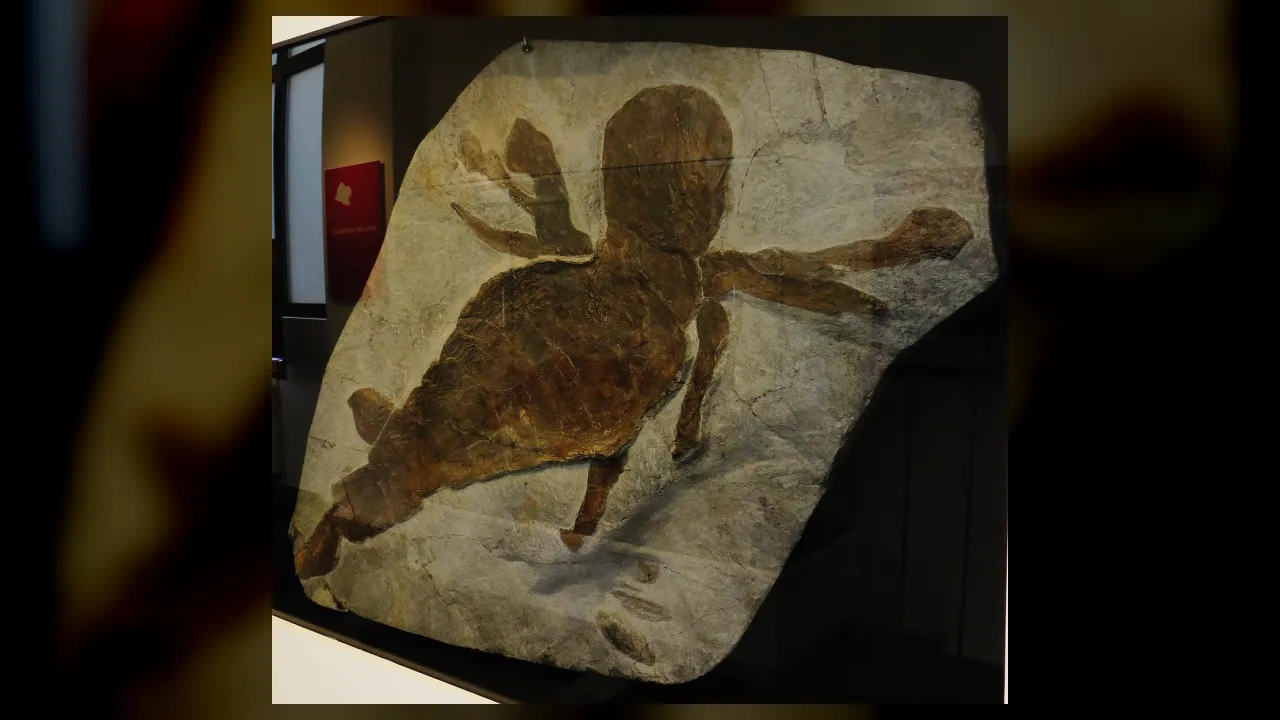
⚡ Survival SuperpowerLargest known arthropod in Earth's history with spiked, trap-like pincers
🤯 Mind-Blowing Fact • Grade 1
A single fossil claw of Jaekelopterus is eighteen inches long—about as long as a bowling pin!
✨ Word Sparks (Grade 1 Glossary)
Tap 🔊 to hear
Armor
Hard outer plates that protect an animal's body
Paddle
A flat limb shaped for pushing through water
Pincer
A front claw used to pinch and hold
🪝
Can you imagine a water bug longer than your bed?
1
A Giant Under the Waves
Snap! Two giant claws open wide in a warm river. Here comes Jaekelopterus! This ancient sea scorpion grew bigger than a grown-up human. Hard plates covered its long flat body.
2
Built to Swim Fast
Its back legs were flat like boat oars. It rowed through shallow water with strong strokes. A wide flat tail helped it steer and glide.
3
Super Spiky Claws
Two huge front claws reached out to catch slippery fish. Sharp spikes lined each claw so dinner could not wiggle free! No bug on Earth ever grew bigger.
1. How big did Jaekelopterus grow compared to a person?
2. What helped Jaekelopterus row smoothly through the water?
🤯 Mind-Blowing Fact • Grade 2
Even though Jaekelopterus was longer than an alligator, its outer shell was thin and lightweight so it could glide easily underwater!
✨ Word Sparks (Grade 2 Glossary)
Tap 🔊 to hear
Arthropod
Animal with jointed legs and an outer skeleton
Telson
The tail plate at the end of sea scorpions
Estuary
Where a freshwater river meets the salty sea
🪝
How did scientists figure out an eight-foot water giant existed from finding just one fossil claw?
1
King of the Arthropod Clan
Splash into a muddy river delta 390 million years ago, and watch the bottom closely! Resting in the weeds is Jaekelopterus, the largest ever discovered. Arthropods are animals with jointed legs and outer skeletons, like crabs, spiders, and insects.
2
Not Really a True Scorpion
People call Jaekelopterus a sea scorpion, yet it lived mostly in fresh rivers and lagoons. Instead of a curved venomous stinger, its tail ended in a flat, pointed fin called a that steered it like a rudder.
3
Eyes and Claws Ready
Two big compound eyes sat near the front of its head shield, watching for armored fish and smaller relatives. When prey swam close, eighteen-inch spiked pincers lunged forward faster than the fish could turn.
1. Where did Jaekelopterus actually spend most of its life?
2. What was at the tip of a Jaekelopterus tail instead of a venomous scorpion stinger?
🤯 Mind-Blowing Fact • Grade 3
Each compound eye of Jaekelopterus held thousands of tiny facets that gave it crisp, wide-angle vision in bright shallow streams!
✨ Word Sparks (Grade 3 Glossary)
Tap 🔊 to hear
Eurypterid
Extinct group of aquatic arthropods called sea scorpions
Exoskeleton
Hard protective covering on the outside of arthropods
Molt
To shed an old outer shell to grow
🪝
Why could an arthropod in the Devonian Period grow over eight feet long when modern bugs stay small?
1
A Discovery in German Rock
Crack! In 2007, paleontologists splitting 390-million-year-old quarry rock in western Germany uncovered a fossilized claw segment forty-six centimeters long. By comparing that huge pincer to complete fossils of closely related , scientists calculated that its owner, Jaekelopterus rhenaniae, measured roughly 2.5 meters—over eight feet—from head to tail!
2
Why Water Made Giants Possible
Every arthropod wears a tough that must be shed, or molted, to grow larger. On dry land, gravity would crush a newly molted eight-foot body before its fresh shell hardened. Buoyant river water supported the weight of Jaekelopterus, letting it reach record-breaking size.
3
Sharp Vision for Ambush Hunting
Microscopic studies of its fossilized compound eyes revealed thousands of tiny lenses packed together. This sharp eyesight matched modern active hunters like mantis shrimp and dragonflies, proving Jaekelopterus hunted in sunlit shallows rather than dark mud.
4
A Changing River World
Jaekelopterus ruled Early Devonian waterways, preying on early jawless fishes and smaller . Later in the Devonian, fast-swimming jawed fishes evolved stronger bites and gradually replaced giant eurypterids as top predators.
1. How did scientists estimate the eight-foot body length of Jaekelopterus in 2007?
2. How did living in water help Jaekelopterus grow much larger than land insects?
🤯 Mind-Blowing Fact • Grade 4
Unlike lobsters that chew with side-to-side mandibles, Jaekelopterus crushed its food using spiny grinding plates attached right to the bases of its walking legs!
✨ Word Sparks (Grade 4 Glossary)
Tap 🔊 to hear
Chelicerae
Claw-like front mouthparts of spiders, scorpions, and eurypterids
Cuticle
Layered outer material forming an arthropod's protective shell
Gnathobases
Spiny leg bases used to crush and shred prey
🪝
What biomechanical secrets allowed a jointed-legged cousin of horseshoe crabs to outgrow every insect, spider, and crustacean in history?
1
The Ultimate Chelicerate
Wade cautiously into the braided river channels of the Rhenish Massif 390 million years ago during the Early Devonian Period. Gliding over rippled sandbars is Jaekelopterus rhenaniae, a giant eurypterid belonging to the chelicerates—the arthropod group that includes modern horseshoe crabs, spiders, and scorpions. Measuring 2.5 meters (8.2 feet) excluding outstretched claws, it holds the record as Earth's largest known arthropod.
2
Chelicerae Engineered for Capture
In most spiders and horseshoe crabs, the front mouthparts—called —are modest feeding pincers. In pterygotid eurypterids like Jaekelopterus, these chelicerae evolved into forty-six-centimeter grappling arms lined with serrated, tooth-like denticles. Driven by powerful internal muscles, the claws snapped shut on armored ostracoderm fishes and smaller arthropods, pulling prey back toward shredding leg bases called near the mouth.
3
Lightweight Cuticle and Agile Swimming
Electron microscopy of preserved Jaekelopterus shows that its exoskeleton was surprisingly thin, flexible, and unmineralized compared with heavy crab shells. Combined with broad sixth-pair swimming paddles and a flattened, keeled telson, this lightweight build allowed rapid forward bursts and agile hovering above riverbeds.
4
Rise of Jawed Rivals
Compound eye analyses confirm high visual acuity tuned to bright, shallow freshwater habitats. Yet as the Devonian progressed, armored placoderms and fast jawed fishes diversified. Facing nimble new competitors and predators—especially during vulnerable molting stages—giant predatory eurypterids declined.
1. Which anatomical feature did Jaekelopterus use to grind up prey after catching it with its front claws?
2. What did microscopic study of fossilized Jaekelopterus cuticle reveal about its armor?
🤯 Mind-Blowing Fact • Grade 5
With its eighteen-inch spiked pincers fully extended forward, the total reach of Jaekelopterus stretched over ten feet (3.3 meters) from claw tip to tail tip!
✨ Word Sparks (Grade 5 Glossary)
Tap 🔊 to hear
Ecdysis
The biological process of shedding an old exoskeleton
Pterygotidae
Family of giant predatory sea scorpions with huge claws
Interommatidial
Angle between tiny lenses in a compound eye
🪝
How did a single fossilized pincer from Germany rewrite the upper size limit of arthropod evolution?
1
Uncovering a Devonian Titan
For nearly a century after German paleontologist Otto Jaekel first described fragments from the Early Devonian Klerf Formation in 1914, the true scale of Jaekelopterus rhenaniae remained uncertain. That changed in 2007 when Simon Braddy, Markus Poschmann, and Erik Tetlie analyzed a remarkably complete 45.5-centimeter chelicera excavated near Willwerath, Germany. Applying isometric scaling ratios established across the family , they demonstrated a body length of 2.33 to 2.59 meters—extending past three meters with claws outstretched and surpassing even Carboniferous Arthropleura as the largest arthropod in the fossil record.
2
Overcoming Physiological Limits on Size
Terrestrial arthropods hit strict size ceilings imposed by gravity on tubular exoskeletons during (molting) and by respiratory constraints. Living in Early Devonian deltaic channels and fresh-to-brackish lagoons mitigated gravitational collapse: water supported soft tissues while new chitinous cuticle sclerotized. Meanwhile, vascularized gill tracts called Kiemenplatten housed beneath ventral abdominal plates extracted dissolved oxygen efficiently, and a thin, pliable unmineralized cuticle minimized swimming mass.
3
Optical Acuity and Predatory Biomechanics
High-resolution inspection of preserved corneal lenses revealed low angles—under one degree—comparable to modern predatory dragonflies. Rather than scavenging blindly in murky depths, Jaekelopterus relied on binocular visual tracking in sunlit shallows, snapping hypertrophied, denticle-lined chelicerae onto armored agnathan and early gnathostome fishes before masticating them with coxal gnathobases.
4
Freshwater Refuge and Ecological Shift
Sedimentological evidence from the Klerf Formation shows ripples, mudcracks, and early land plants, confirming non-marine riverine habitats rather than open oceans. Freshwater ecosystems may have initially offered giant pterygotids a low-competition nursery and hunting ground.
5
The Devonian Nekton Revolution
Within fifteen million years of Jaekelopterus's reign, jawed vertebrates—including arthrodire placoderms and lobe-finned fishes—underwent rapid radiation. Outcompeted by agile, bone-jawed swimmers and vulnerable while molting, giant pterygotid eurypterids vanished by the Middle-to-Late Devonian, leaving smaller relatives to persist until the end-Permian extinction.