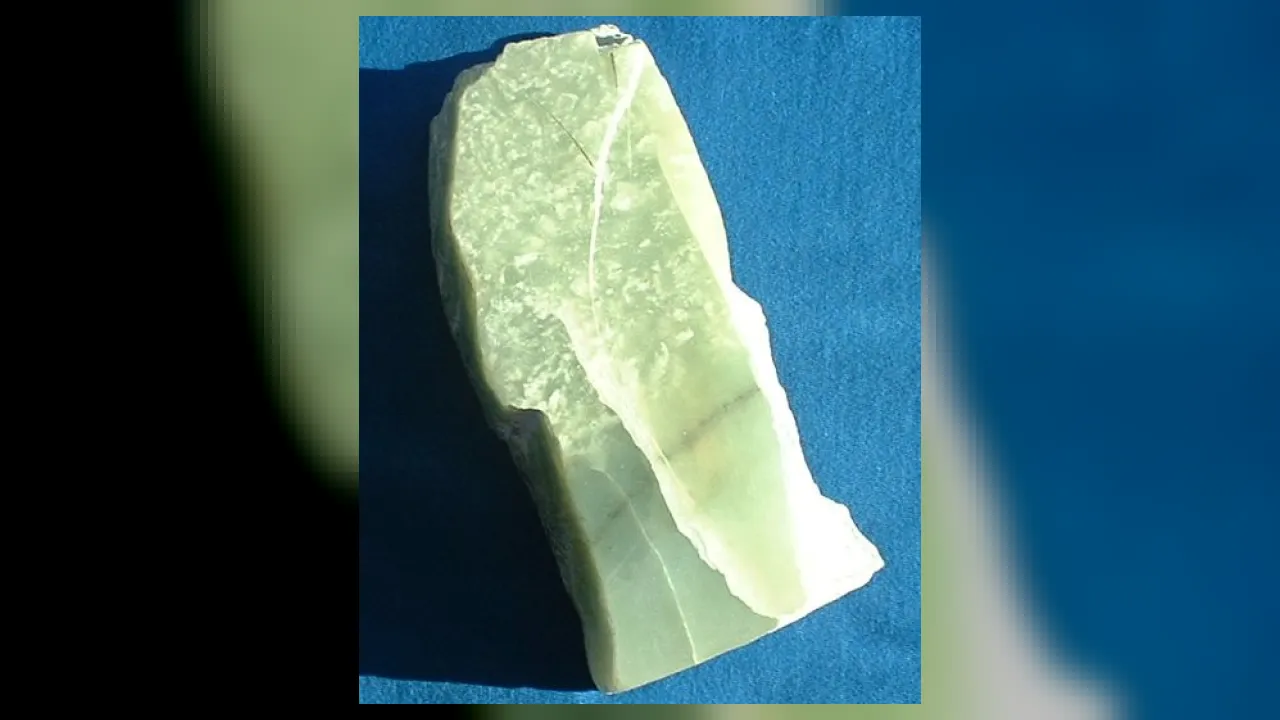
1. Why is jade so hard to break or crack when bumped?
2. What happens when you gently tap a thin bar of pure jade?
🤯 Mind-Blowing Fact • Grade 2
Prehistoric toolmakers across New Zealand, China, and Central America prized jade for axe blades because it would not shatter against hardwood trees!
✨ Word Sparks (Grade 2 Glossary)
Tap 🔊 to hear
nephrite
The super-tough fibrous kind of jade
jadeite
The rarer vivid-colored kind of jade
shatter
To break suddenly into many sharp pieces
🪝
Surprise! Did you know the word 'jade' actually belongs to TWO different minerals?
1
Two Stones, One Famous Name
For thousands of years, carvers in China and Central America treasured smooth green stones without knowing a secret. In 1863, a French scientist tested samples and discovered that 'jade' is actually two separate minerals: and !
2
Ropes of Microscopic Fibers
While diamond resists scratches better than anything, a sharp hammer blow can split a diamond. Jade is the opposite: tangled microscopic fibers lock together like felt, making jade tougher against smashing than steel!
3
Colors Beyond Green
Although glowing emerald-green 'imperial jade' is the rarest prize, natural jade also forms in creamy mutton-fat white, lavender purple, yellow, and jet black.
1. What surprising discovery did a French scientist make about jade in 1863?
2. Besides green, which of these colors can natural jade form in?
🤯 Mind-Blowing Fact • Grade 3
For the 2008 Summer Olympic Games in Beijing, every gold, silver, and bronze medal had a smooth ring of genuine Chinese nephrite jade set into the back—and none broke even if dropped!
✨ Word Sparks (Grade 3 Glossary)
Tap 🔊 to hear
toughness
How well a mineral resists cracking or breaking
subduction
One Earth plate diving beneath another plate
abrasive
Gritty sand powder used to grind stone
🪝
How can a mineral with hardness 6.5 survive hammer blows that shatter a hardness-10 diamond?
1
Hardness Versus Toughness
Imagine trying to tear a thick woven rug with your bare hands. Even if one thread is thin, thousands of tangled threads stop any rip from spreading! Geologists separate scratch hardness from impact : quartz (hardness 7) can scratch nephrite jade (hardness 6 to 6.5), yet nephrite's matted mineral fibers stop cracks cold!
2
Squeezed Where Ocean Plates Dive
Jadeite—slightly harder at 6.5 to 7—forms only where heavy ocean crust dives beneath a continent. Crushing pressure with surprisingly cool temperatures squeezes sodium, aluminum, and silica into tight interlocking grains.
3
Carved With Sand and Patience
Because steel chisels bounce off or barely scratch jade, ancient Chinese, Olmec, and Maya master carvers sawed and shaped intricate jade sculptures by rubbing wet quartz or garnet sand back and forth with bamboo and cord!
4
North American Jade Coasts
Along California's Big Sur coast, ocean waves still polish dark green nephrite pebbles tumbled down from coastal cliffs, while Wyoming and British Columbia host huge nephrite boulders.
1. How did ancient carvers cut and shape tough jade without modern diamond power tools?
2. Along which U.S. coastline do ocean waves polish natural nephrite jade pebbles?
🤯 Mind-Blowing Fact • Grade 4
To Mesoamerican Maya and Aztec rulers, translucent green jadeite symbolized life-giving water and sprouting corn—making it far more valuable than gold!
✨ Word Sparks (Grade 4 Glossary)
Tap 🔊 to hear
pyroxene
Chain-silicate mineral group that includes jadeite
amphibole
Double-chain silicate group that includes nephrite
Neolithic
The late Stone Age era of polished tools
🪝
Why do geologists search for rare jadeite along ancient colliding plate boundaries?
1
Cold Squeeze in Subduction Zones
Most metamorphic rocks heat up rapidly as they sink deeper underground. Jadeite (NaAlSi2O6), a member of the mineral group, demands a rare tectonic twist: immense pressure (10,000+ atmospheres) paired with relatively low temperatures! That exact combination occurs only inside subduction zones where cold oceanic plates plunge beneath continents in Myanmar, Guatemala, Japan, and California—making jadeite a signature geologic marker of ancient plate collisions.
2
Nephrite vs. Jadeite Under the Loupe
In mineral identification labs, students compare nephrite (a calcium-magnesium , Mohs 6–6.5, specific gravity 2.95) with jadeite (a sodium-aluminum , Mohs 6.5–7, specific gravity 3.34). Nephrite polishes to a warm, slightly waxy luster, while granular jadeite takes a brighter glassy polish and flashes vibrant chromium-green in prized 'imperial jade.'
3
Nine-Thousand-Year Cultural Legacy
Across China, Mesoamerica's Olmec and Maya civilizations, and Māori carvers ('pounamu' greenstone) in New Zealand, independently isolated cultures revered jade above gold for ceremonial blades, royal masks, and heirloom ornaments.
4
Fracture-Toughness Inspiration for Engineers
Materials scientists study nephrite's microscopic interlocking fiber bundles under electron microscopes to design crack-stopping ceramic armor and tougher artificial bone implants! When sharp pressure pushes against nephrite, tiny microcracks twist around millions of crossed threads instead of slicing straight through, demonstrating why mineral structure determines strength in Earth science.
1. What unusual combination of underground conditions is required to form pure jadeite?
2. Which trace element turns the rarest 'imperial jadeite' glowing emerald green?
🤯 Mind-Blowing Fact • Grade 5
Laboratory fracture-mechanics tests show it takes nearly thirty times more energy to drive a crack through felted nephrite jade than through solid crystal quartz!
✨ Word Sparks (Grade 5 Glossary)
Tap 🔊 to hear
metasomatic
Rock chemistry transformed by circulating deep fluids
serpentinite
Greenish metamorphic rock formed from hydrated mantle
lithophone
A musical instrument made of resonant stones
🪝
How did a French mineralogist analyzing treasures in 1863 prove that Chinese and Mesoamerican empires had been carving two completely different silicate rocks?
1
Alexis Damour's 1863 Breakthrough
For millennia, scholars assumed all tough green carvings shared one mineral identity. In 1863, French mineralogist Alexis Damour analyzed brilliant apple-green carvings newly arriving from northern Myanmar alongside classic Chinese archaic carvings and Mesoamerican celts. Chemical assays revealed two unrelated chain-silicate minerals! Classic Chinese Khotan carvings were nephrite—a dense microfibrous rock of the tremolite–actinolite amphibole series, Ca2(Mg,Fe)5Si8O22(OH)2—whereas Burmese and Mesoamerican treasures were jadeite, a clinopyroxene with formula NaAlSi2O6.
2
Fracture Mechanics of Felted Microstructures
Quantitatively, work-of-fracture tests rank nephrite jade as the toughest known natural mineral aggregate—requiring roughly 100,000 to 225,000 ergs per square centimeter to propagate a crack, nearly thirty times higher than crystalline quartz and tougher than many steels! When mechanical stress hits nephrite, sub-micrometer amphibole fibrils twisted into three-dimensional felted mats deflect, bridge, and blunt advancing microcracks before cleavage can split the stone.
3
Serpentinite Melanges and Blueschist Belts
Worldwide, fewer than twenty primary jadeitite localities exist—most famously Hpakan in Myanmar, Guatemala's Motagua Fault Zone, Itoigawa in Japan, and Russia's Polar Urals. In each setting, sodium-aluminum-silicate fluids squeezed out of subducting slabs at depths of 20 to 50 kilometers crystallized jadeitite pods encased within protective mantle .
4
Acoustic Resonance of Bianqing Lithophones
Because dense, defect-free nephrite transmits elastic sound waves rapidly with minimal internal damping, Bronze Age Chinese acousticians tuned L-shaped nephrite slabs called 'bianqing' into full chromatic percussion orchestras buried in royal tombs such as Marquis Yi of Zeng.
5
Gemological Grading and Polymer Detection
Infrared spectroscopy distinguishes untreated natural jadeite ('Type A') from acid-bleached, polymer-impregnated stones ('Type B') by detecting diagnostic synthetic resin stretching bands near 3,000 wavenumbers. Gemologists also measure refractive indices (1.66 for jadeite versus 1.61 for nephrite) and specific gravity so historic museum carvings can be authenticated without scratching a single millimeter of ancient stone.