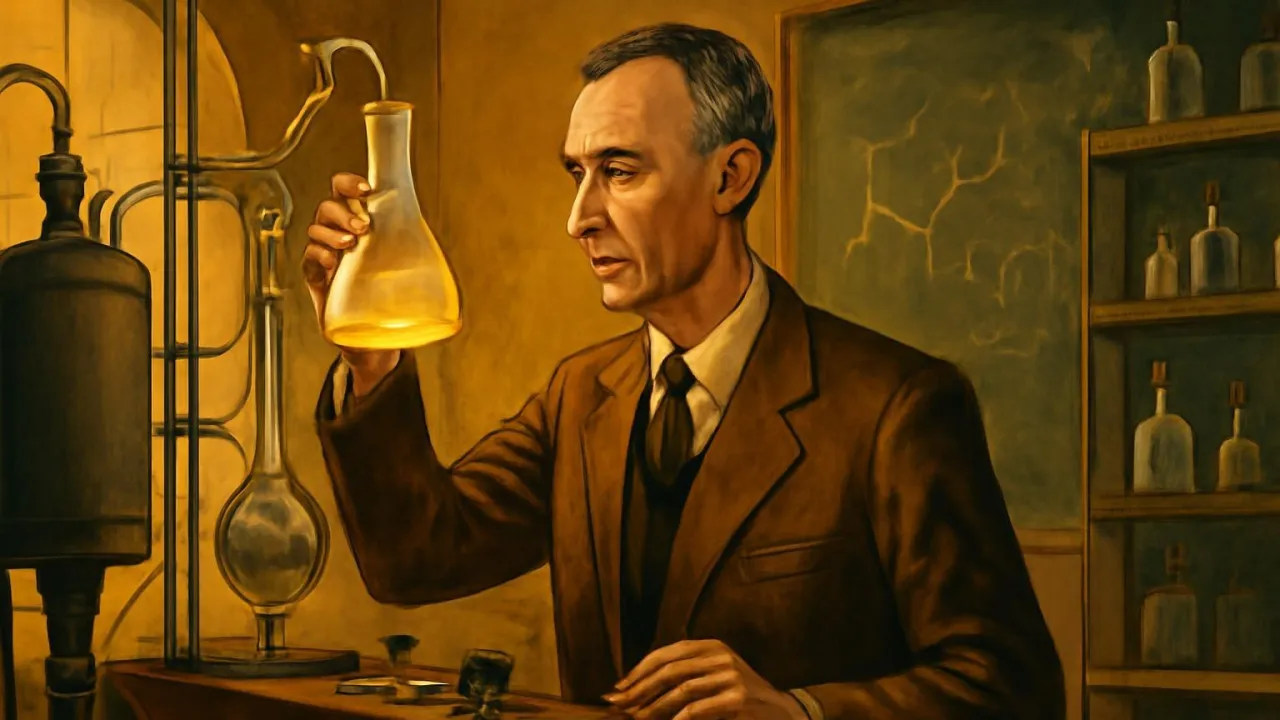
Oppenheimer’s leadership helped create the world’s first atomic bomb in 1945.
✨ Word Sparks (Grade 2 Glossary)
Tap 🔊 to hear
curious
Wanting to learn and know more
energy
Power that makes things move or change
physics
Science about how things move and work
🪝
How can tiny atoms hold so much power inside?
1
Curious About Atoms
Oppenheimer was very about how atoms worked and how they held inside. He read many books and asked smart questions about science and math. His curiosity helped him learn new ideas every day.
2
Hard Work and Study
He worked hard in school and used math and to solve hard problems. Oppenheimer loved to think deeply and try new ideas even when they were difficult. His hard work helped him become a great scientist.
3
Changing the World
Oppenheimer led a team to build the first atomic bomb during World War II. This bomb used atoms to make a huge explosion and changed history. His work helped end the war but also made people think about science and power.
Oppenheimer’s leadership united scientists to create the first atomic bomb in just a few years.
✨ Word Sparks (Grade 3 Glossary)
Tap 🔊 to hear
perseverance
Never giving up, even when it is hard
hypothesis
An idea that can be tested by science
sportsmanship
Being fair and kind when working with others
🪝
What happens when a scientist studies atoms with perseverance and curiosity?
1
Early Curiosity and Learning
Oppenheimer showed great curiosity about the tiny particles called atoms and their energy. He studied physics and mathematics with , always asking questions to understand nature’s secrets. His early experiments and theories helped him form important scientific ideas.
2
Scientific Breakthroughs
He became a leading physicist who worked on quantum mechanics and nuclear physics. Oppenheimer’s about atomic energy helped him lead a team to build the first atomic bomb. His knowledge of physics and strong leadership skills were crucial to this success.
3
Overcoming Challenges
During World War II, Oppenheimer faced many challenges, including tight deadlines and secrecy. His and teamwork helped overcome these obstacles. He inspired scientists to work together with great and dedication.
4
Changing History
The atomic bomb changed the course of history and showed the power of scientific discovery. Oppenheimer’s work raised important questions about science and ethics. His legacy teaches us about the responsibility that comes with knowledge.
2. What big question did Oppenheimer’s work raise?
🤯 Mind-Blowing Fact • Grade 4
Oppenheimer’s leadership during the Manhattan Project helped end World War II with a new kind of science.
✨ Word Sparks (Grade 4 Glossary)
Tap 🔊 to hear
quantum
Tiny particles that behave in surprising ways
fission
When atoms split and release energy
diplomacy
Working together to solve problems peacefully
🪝
How did Oppenheimer’s ideas and leadership change the world during a time of war?
1
Historical Context and Early Life
During the early 20th century, Oppenheimer grew fascinated by the emerging field of physics, which explained how tiny particles like atoms behave in surprising ways. He studied at top universities and became a brilliant physicist known for his deep thinking and curiosity about the universe.
2
Turning Point: The Manhattan Project
World War II created an urgent need for powerful new weapons, and Oppenheimer was chosen to lead the Manhattan Project, a secret effort to build the first atomic bomb. His ability to bring together many scientists and manage complex experiments was a key turning point in the project’s success.
3
Innovations and Scientific Techniques
Oppenheimer introduced new scientific techniques that helped understand nuclear —the process where atoms split to release huge amounts of energy. His leadership inspired collaboration and sportsmanship among diverse teams of physicists, chemists, and engineers working under pressure.
4
Global Impact and Legacy
The atomic bomb’s creation changed global history by ending World War II and starting a new era of nuclear science and . Oppenheimer’s legacy is complex, reminding us that scientific discoveries carry great responsibility and ethical challenges that affect the whole world.
The first atomic bomb test, led by Oppenheimer, released energy equivalent to about 20,000 tons of TNT.
✨ Word Sparks (Grade 5 Glossary)
Tap 🔊 to hear
quantum mechanics
Science studying tiny particles and their strange behaviors
nuclear fission
When atoms split to release huge energy
ethical
Knowing right from wrong and making good choices
🪝
How did J. Robert Oppenheimer’s brilliant mind and leadership shape the atomic age and modern science?
1
Early Life and Intellectual Foundations
J. Robert Oppenheimer grew up in New York City, where his early love for literature and science sparked a lifelong passion for knowledge. He excelled in physics and mathematics at Harvard and Cambridge, where he studied and theoretical physics, laying the groundwork for his future breakthroughs.
2
Scientific Mechanics and Leadership
Oppenheimer’s deep understanding of nuclear physics and quantum theory enabled him to lead the Manhattan Project, coordinating scientists from many fields to harness . His ability to solve complex problems and inspire collaboration was essential in developing the first atomic bomb, a technological marvel of its time.
3
Quantitative Achievements and Challenges
Under Oppenheimer’s direction, the Manhattan Project developed the atomic bomb in less than four years, culminating in the Trinity test in July 1945. This project involved thousands of scientists and engineers, producing a weapon with unprecedented energy release, measured in kilotons of TNT, which changed warfare forever.
4
Historical Legacy and Ethical Reflection
Oppenheimer’s work ended World War II but raised profound questions about nuclear weapons and their impact on humanity. He later advocated for international control of nuclear arms and reflected deeply on the responsibilities of scientists in society, influencing global discussions on science and peace.
5
Inspiring Lessons from Oppenheimer
Oppenheimer’s story teaches us about curiosity, perseverance, and the power of teamwork in solving great challenges. His life reminds us that scientific discoveries can change the world, and with knowledge comes the responsibility to use it wisely and ethically for the good of all. His legacy encourages future scientists to think carefully about how their work affects the planet and people.