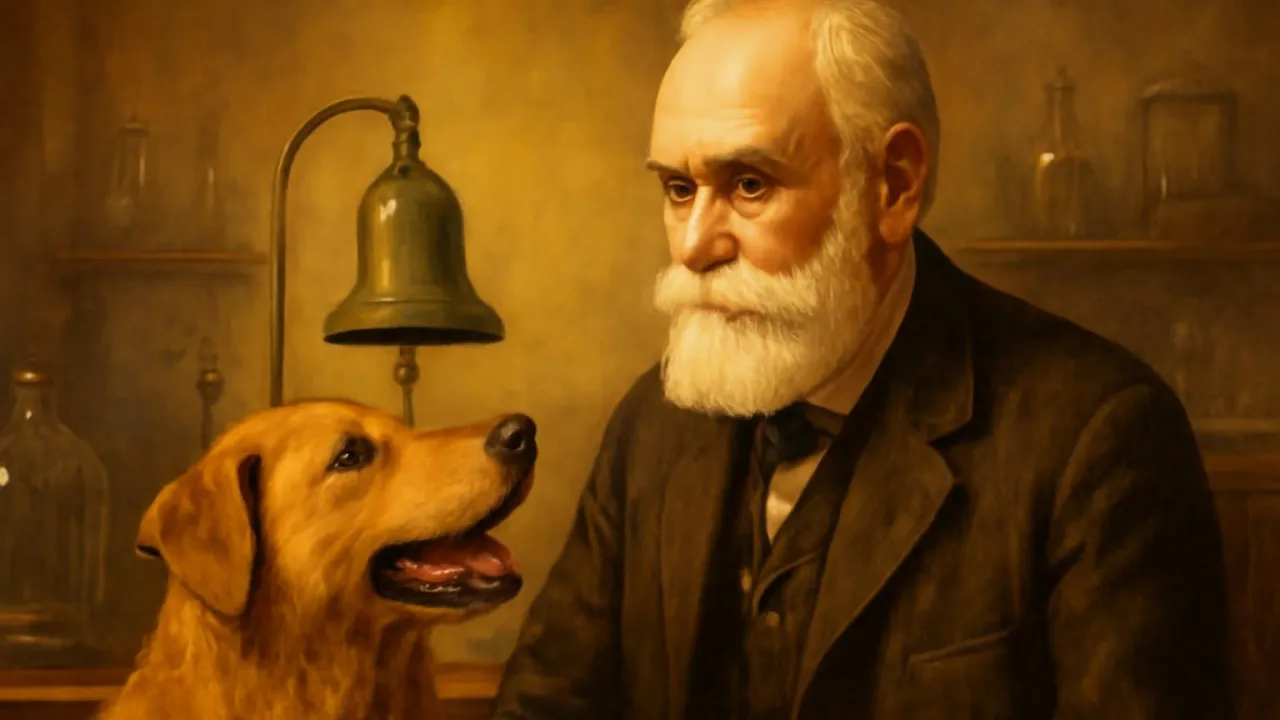
Pavlov won a Nobel Prize for his science experiments with animals.
✨ Word Sparks (Grade 2 Glossary)
Tap 🔊 to hear
conditioning
Learning by connecting things together
Nobel Prize
A big award for great discoveries
scientist
A person who studies and learns
🪝
Have you ever learned something just from a sound?
1
Ivan’s Curious Mind
Ivan loved watching animals and asking questions. He noticed dogs drooled when they saw food. He wondered if they could learn to drool from other things.
2
The Bell Experiment
Ivan rang a bell before feeding the dogs each day. Soon, the dogs started drooling just from hearing the bell. Ivan was amazed at how they learned this.
3
A Big Discovery
Ivan called this learning '.' His work helped people understand how animals and people learn. Today, still study his ideas.
Pavlov’s dogs started drooling just from hearing a bell ring!
✨ Word Sparks (Grade 3 Glossary)
Tap 🔊 to hear
classical conditioning
Learning by linking two things together
psychology
The study of how minds work
behavior
How someone or something acts
🪝
Can a simple sound make you feel hungry?
1
A Boy Who Loved Questions
As a child, Ivan Pavlov loved to explore and ask questions about animals. He watched how dogs behaved and noticed how they reacted to different things. This curiosity led him to become a scientist. Ivan wanted to discover how animals learn.
2
The Famous Dog Experiment
In his laboratory, Ivan set up a clever experiment with dogs, food, and bells. He rang a bell before giving the dogs their food every day. After a while, the dogs started to drool just from hearing the bell, even if there was no food. Ivan called this new kind of learning '.'
3
Changing Science Forever
Ivan’s experiment showed that animals could connect sounds with actions. This idea helped scientists understand how learning works in both animals and people. Ivan won the Nobel Prize for his work on animal and the digestive system.
4
A Lasting Legacy
Pavlov’s discoveries are still important in science and today. Teachers and doctors use his ideas to help people learn and change habits. Ivan’s curiosity and experiments changed the way we understand learning forever.
Pavlov’s research helped scientists treat fears and change habits in people and animals.
✨ Word Sparks (Grade 4 Glossary)
Tap 🔊 to hear
physiologist
A scientist who studies how bodies work
response
What happens when something acts on you
legacy
Something important left behind
🪝
How did a ringing bell change what scientists knew about learning?
1
Curiosity in Old Russia
In the late 1800s, Ivan Pavlov grew up in Russia, where curiosity about nature was encouraged. Fascinated by animals and science, Ivan became a , studying how living things work. He built a laboratory to explore how animals’ bodies and minds respond to the world. His early research focused on how dogs digest food and react to their environment.
2
The Bell and the Dog
Pavlov noticed that dogs would drool whenever they saw food, but he wondered if they could learn to drool at something different. He began ringing a bell each time he fed the dogs, carefully measuring their . After several tries, the dogs started drooling at the sound of the bell alone, even when no food appeared. This experiment led to the discovery of classical conditioning, a new way to understand learning.
3
A Nobel Prize and New Science
Pavlov’s discovery showed that animals could learn by connecting two things, like a sound and a treat. His work earned him the Nobel Prize in Physiology or Medicine in 1904, making him one of the most famous scientists of his time. His research changed the field of psychology and inspired scientists around the world. Today, classical conditioning is used to understand habits, fears, and even how we train pets.
4
Pavlov’s Lasting Impact
Ivan Pavlov’s experiments helped shape modern science, education, and medicine. His careful methods and creative ideas showed that learning can be studied using experiments and observations. Teachers, doctors, and animal trainers still use his discoveries to help people and animals learn new behaviors. Pavlov’s reminds us that asking questions and exploring ideas can change the world.
Pavlov’s research on conditioning is still used by psychologists, teachers, and animal trainers over 100 years later.
✨ Word Sparks (Grade 5 Glossary)
Tap 🔊 to hear
association
A link between two things in your mind
behavioral psychology
The science of how we learn and act
Nobel Prize
A top award for big discoveries
🪝
What if a simple bell could unlock the secrets of how we learn?
1
A Childhood Spark in Russia
Long before he became a world-famous scientist, Ivan Pavlov was a curious boy in rural Russia, endlessly fascinated by animals and nature. He spent hours observing how dogs behaved, noticing their habits and reactions to different sights and sounds. This early love of discovery inspired him to pursue science, eventually leading him to study physiology—the science of how living things function. Pavlov’s curiosity and determination set the stage for one of the most important experiments in history.
2
Inventing the Classical Conditioning Experiment
In his St. Petersburg laboratory, Pavlov designed a groundbreaking experiment that would change psychology forever. He noticed that dogs naturally salivated when they saw food, but he wondered if they could learn to salivate at something new, like a bell. By ringing a bell just before feeding the dogs, Pavlov created a situation where the dogs began to associate the sound with mealtime. After repeated pairings, the dogs started to salivate at the bell alone, even when no food was present. This process, which Pavlov called 'classical conditioning,' revealed how animals (and people) can learn by forming .
3
Scientific Rigor and Nobel Recognition
Pavlov’s experiments were famous for their careful design and precise measurement, setting new standards for scientific research. He used special tools to collect and measure the dogs’ saliva, recording every detail to ensure accurate results. In 1904, Pavlov received the in Physiology or Medicine for his discoveries about the digestive system and learning. His work not only advanced science but also inspired new fields like , which studies how actions are learned and changed.
4
Changing the Way We Understand Learning
Pavlov’s discovery of classical conditioning showed that learning is not just about thinking, but also about connecting experiences. His research helped explain how habits, fears, and even positive behaviors can be formed through . Today, teachers use these ideas to help students build good study habits, and animal trainers use them to teach pets new tricks. Doctors and therapists also use conditioning techniques to help people overcome fears or change unhealthy behaviors.
5
Legacy of Curiosity and Discovery
Ivan Pavlov’s legacy reaches far beyond his laboratory, influencing science, education, and medicine around the world. His creative experiments and careful observations proved that even simple questions—like what makes a dog drool—can lead to discoveries that change how we understand ourselves. Pavlov’s life reminds us that curiosity, patience, and scientific thinking can unlock the mysteries of the mind and help people live better lives.