1. What cool trick can a naturally magnetized chunk of magnetite do?
2. What color line does shiny silver-gray hematite leave when rubbed on a white tile?
🤯 Mind-Blowing Fact • Grade 2
NASA's Opportunity rover rolled across Mars in 2004 and discovered millions of tiny round hematite spheres nicknamed 'Martian blueberries' formed by ancient water!
✨ Word Sparks (Grade 2 Glossary)
Tap 🔊 to hear
lodestone
Naturally magnetized magnetite used for early compasses
compass
A tool with a magnetic needle pointing north
iron oxide
A mineral made of iron and oxygen
🪝
Why is the planet Mars rusty red—just like crushed hematite powder on Earth?
1
Why Mars Is the Red Planet
Look up at Mars glowing orange-red in the night sky! Space rovers discovered that Martian soil is coated in fine dust—and even round gray pebbles of hematite nicknamed 'Martian blueberries'!
2
Finding North With Lodestone
More than two thousand years ago in China and Greece, people noticed that hanging a magnetic chunk of magnetite ('') on a string made it swing to point north and south! Sailors used lodestones to rub iron needles and cross wide oceans.
3
Backbone of Modern Steel
Inside giant blast furnaces, workers melt hematite and magnetite with a pinch of carbon to forge tough steel for skyscrapers, ships, and bicycles.
1. What gives the surface of planet Mars its famous rusty red-orange color?
2. How did ancient sailors use lodestone (magnetite) on ocean voyages?
🤯 Mind-Blowing Fact • Grade 3
Sea turtles, honeybees, and homing pigeons actually grow microscopic crystals of magnetic magnetite inside their cells to navigate along Earth's magnetic field!
✨ Word Sparks (Grade 3 Glossary)
Tap 🔊 to hear
cyanobacteria
Ancient microbes that filled oceans with oxygen
ochre
Natural earthy red pigment made from hematite
banded iron
Striped ancient seafloor rock rich in iron
🪝
How did tiny ocean bacteria two billion years ago create almost all the iron ore we mine today?
1
When Ancient Oceans Rusted!
Travel back 2.5 billion years and Earth's oceans held zero breathable oxygen, yet swarmed with dissolved iron! Then tiny blue-green microbes called began making oxygen through photosynthesis. As oxygen bubbled into the sea, dissolved iron 'rusted' and snowed down onto the seafloor in colorful red-and-dark stripes called Formations!
2
Telling Magnetite From Hematite
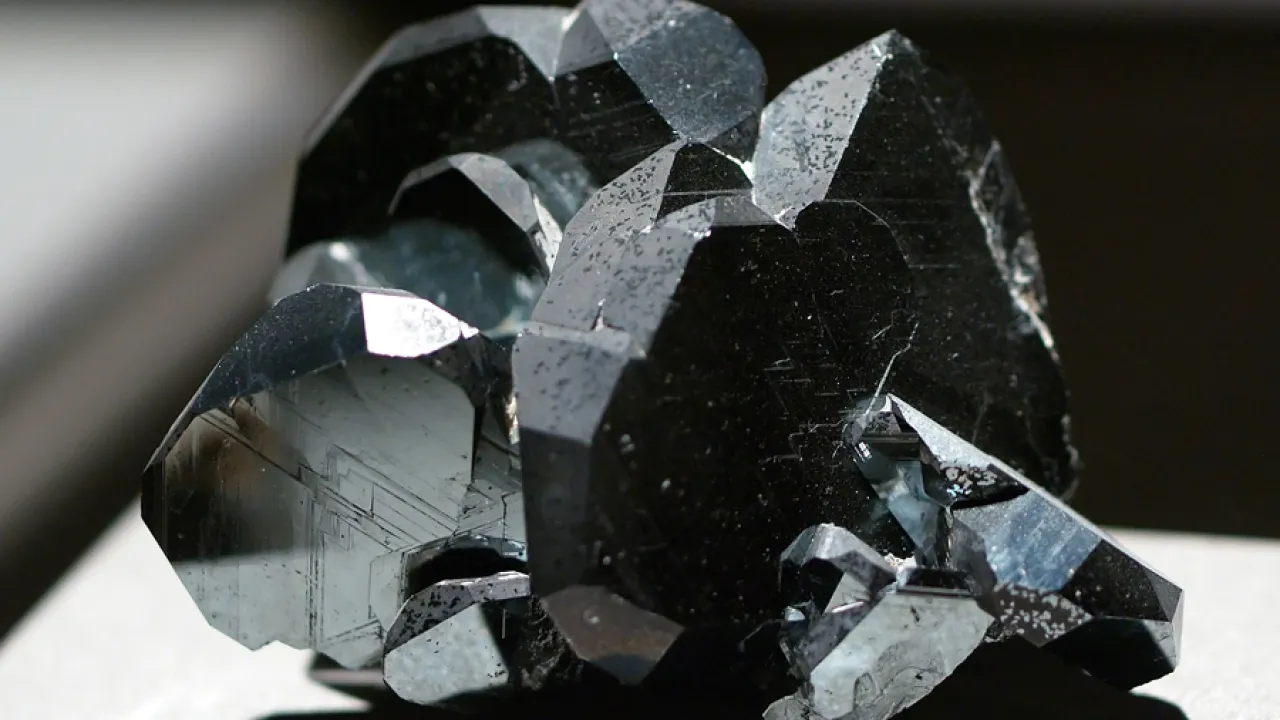
Both ores combine iron and oxygen, scoring 5.5 to 6.5 on the Mohs scale. Magnetite (Fe3O4) forms eight-sided black crystals, pulls magnets strongly, and leaves a black streak. Hematite (Fe2O3) can look dull brick-red OR mirror-shiny silver ('specular hematite'), yet ALWAYS leaves a reddish-brown streak!
3
Prehistoric Cave Paint
Thirty thousand years ago, Ice Age artists ground earthy red hematite ('red ') to paint charging bison and handprints on cave walls that still glow today!
4
Animal Built-In Compasses
Homing pigeons, sea turtles, and salmon grow microscopic crystals of magnetite right inside their bodies to sense Earth's magnetic field!
1. How can a student tell mirror-shiny silver hematite apart from black magnetite in a mineral lab?
2. What caused giant Banded Iron Formations to settle onto ancient seafloors over two billion years ago?
🤯 Mind-Blowing Fact • Grade 4
Magnetic stripes recorded by tiny magnetite grains inside seafloor basalt gave geologists the smoking-gun proof that continents drift apart and Earth's magnetic poles flip!
✨ Word Sparks (Grade 4 Glossary)
Tap 🔊 to hear
paleomagnetism
Ancient Earth magnetism preserved inside cooling rocks
blast furnace
Towering smelter turning iron ore into steel
specular
Sparkling mirror-like metallic form of hematite
🪝
How do volcanic rocks freeze tiny magnetite compass needles to prove that continents drift?
1
Tiny Compasses Frozen in Lava
When basalt lava erupts along mid-ocean ridges at 1,100 degrees Celsius, microscopic crystals of magnetite (Fe3O4) crystallize inside the cooling rock. As the rock cools past 580 degrees Celsius, each tiny magnetite grain locks into alignment with Earth's magnetic North Pole! By reading those frozen magnetic stripes on the Atlantic seafloor—including times Earth's magnetic poles flipped—20th-century Earth scientists proved seafloor spreading and plate tectonics!
2
Why Streak Beats Surface Color
Virginia Earth science labs love testing hematite (Fe2O3) because two samples can look like totally different minerals: one dull rusty-red lump and one sparkling metallic-silver 'kidney ore' or crystal! Rubbing both across a porcelain plate reveals identical cherry-red powder—proving streak is far more reliable than surface color.
3
Virginia's Historic Iron Furnaces
From Colonial Spotswood's 1716 Germanna furnace to 19th-century stone charcoal furnaces in Shenandoah and Botetourt counties—such as Tredegar Iron Works in Richmond—Virginia iron ores forged rails, tools, and bridges across early America.
4
Ninety-Five Percent of All Metal
Today, iron ore mined around Lake Superior (Minnesota and Michigan), Western Australia, and Brazil accounts for roughly 95 percent of every ton of metal produced worldwide! Better yet, magnetic cranes at recycling yards effortlessly lift old steel cans and car frames so steel can be remelted again and again.
1. How did microscopic magnetite grains in ocean-floor basalt help prove plate tectonics?
2. About what percentage of all metal produced worldwide comes from iron ore?
🤯 Mind-Blowing Fact • Grade 5
Geophysicists discovered that natural 'lodestones'—pieces of magnetite permanently magnetized strongly enough to pick up iron nails—were magnetized by direct prehistoric lightning strikes hitting shallow iron outcrops!
✨ Word Sparks (Grade 5 Glossary)
Tap 🔊 to hear
Curie temperature
Heat threshold where minerals lose permanent magnetism
ferrimagnetic
Strongly magnetic from unequal opposing atomic spins
Why are only rare surface-struck 'lodestone' chunks of magnetite able to pick up nails, even though ALL magnetite sticks to a magnet?
1
Ferrimagnetism and Lightning-Struck Lodestones
Here is a classic mineralogy brainteaser: touch a pocket magnet to ANY crystal of magnetite (Fe3O4, an inverse spinel combining Fe2+ and two Fe3+ ions) and it snaps on tightly—yet touch two ordinary underground magnetite crystals together and they ignore each other! Inside normal magnetite, microscopic magnetic domains point in random directions that cancel out externally. True 'lodestone'—permanent rock magnets able to lift iron nails—occurs almost exclusively at shallow surface outcrops containing microscopic intergrowths of oxidized maghemite, where million-ampere lightning bolts blasted intense magnetic fields through the rock and locked its domains in unison!
2
The Great Oxidation Event and Banded Iron Formations
Roughly 90 percent of global commercial iron ore comes from Precambrian Banded Iron Formations (BIFs)—thinly laminated marine rocks alternating iron-rich magnetite/hematite bands with red jasper chert, deposited between 3.0 and 1.8 billion years ago in Minnesota's Mesabi Range, Western Australia's Hamersley Basin, and Brazil's Carajás district. Photosynthetic cyanobacteria triggered the Great Oxidation Event, oxidizing soluble ferrous iron (Fe2+) into insoluble ferric hydroxides until the global ocean's dissolved iron reservoir was exhausted!
3
Curie Point and Geodynamo Archives
Above magnetite's of 580 degrees Celsius (and hematite's 675 degrees Celsius), thermal vibration scrambles magnetic alignment. Cooling below that threshold locks thermoremanent magnetization—archiving 3.5 billion years of Earth's protective core dynamo.
4
Reduction Chemistry: Blast Furnaces to Green Hydrogen
Traditional steelmaking reduces Fe2O3 (69.9% Fe) and Fe3O4 (72.4% Fe) at 1,600 degrees Celsius using carbon monoxide from metallurgical coke, releasing CO2. Next-generation 'green steel' plants react iron ore pellets with renewable hydrogen gas (H2) instead—releasing harmless water vapor (H2O)!
5
Magnetotactic Bacteria and Biomineralization
Aquatic magnetotactic bacteria synthesize chains of single-domain 50-nanometer magnetite crystals ('') that passively steer the microbes along geomagnetic field lines toward optimal low-oxygen sediment zones. Chitons—armored marine mollusks grazing rocky coastlines—even harden their rasping radula teeth with crystalline magnetite, the hardest biomineral produced by any living animal!
1. What natural phenomenon magnetizes ordinary surface magnetite into permanent nail-lifting 'lodestone'?
2. What clean byproduct is released when next-generation 'green steel' plants reduce iron oxide ore using pure hydrogen gas (H2) instead of coal carbon?