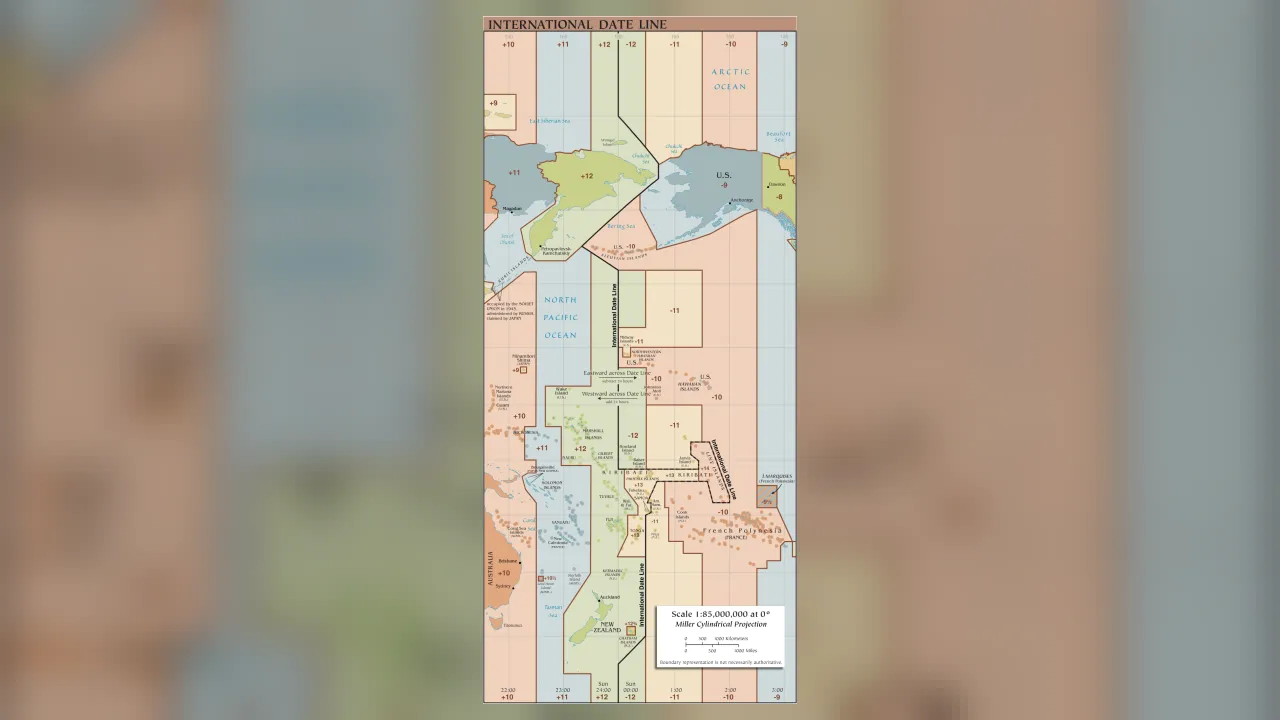
1. Through which giant ocean does the International Date Line run?
2. What changes when a ship sails across the International Date Line?
🤯 Mind-Blowing Fact • Grade 2
People call Alaska's Little Diomede Island 'Yesterday Isle' and Russia's nearby Big Diomede Island 'Tomorrow Isle' because the International Date Line passes right between them!
✨ Word Sparks (Grade 2 Glossary)
Tap 🔊 to hear
180 Degrees
Longitude halfway around Earth from zero
Zigzag
A line bending sharply side to side
Boundary
A dividing line between two areas
🪝
Why did mapmakers draw the International Date Line down the middle of the ocean instead of across dry land?
1
Halfway Around From London
Spin a globe halfway around from England's zero-degree Prime Meridian, and your finger lands at longitude in the middle of the Pacific Ocean! That spot is home to the International Date Line, where each new calendar date officially begins.
2
Why Not Through a City?
Imagine how confusing school would be if walking across your street changed Tuesday into Wednesday! Putting the International Date Line across open ocean water means almost nobody accidentally crosses into a different day while walking the dog.
3
Westward Jumps Ahead, Eastward Repeats
Travelers flying west from California to Japan skip ahead one calendar day on crossing the line. Flying east from Japan back to California lets travelers live the same calendar date a second time!
1. Why did mapmakers place the International Date Line mostly across open ocean?
2. What happens to the calendar date when an airplane flies west from Hawaii to Japan across the Date Line?
🤯 Mind-Blowing Fact • Grade 3
In Jules Verne's classic adventure novel Around the World in Eighty Days, hero Phileas Fogg thinks he arrived one minute too late—until realizing that traveling eastward across the Pacific gained him a whole extra day!
✨ Word Sparks (Grade 3 Glossary)
Tap 🔊 to hear
Circumnavigate
To sail or fly all around Earth
Aleutian Islands
Chain of volcanic islands stretching from Alaska
Antimeridian
180-degree line opposite the Prime Meridian
🪝
How did Ferdinand Magellan's crew solve a mysterious 'missing day' when their ship returned from circling the globe?
1
The Sailors' Missing-Day Mystery
In 1522, Magellan's surviving ship Victoria completed history's first voyage all the way around Earth! Scholar Antonio Pigafetta dutifully marked his ship's journal every single sunrise without ever missing one. Yet when the sailors docked in Cape Verde, locals told them it was Thursday—while Pigafetta's diary insisted it was Wednesday!
2
Why Circling Westward Loses a Sunrise
Had the crew slept through twenty-four hours? Not at all! By sailing westward in the same direction sunsets travel, they stretched every single day by a few extra minutes—experiencing one fewer sunrise than people standing still at home! An International Date Line solves that puzzle automatically.
3
Clever Bends Around Island Nations
Instead of cutting straight along 180 degrees longitude, the Date Line swerves east around Russia's tip, bends west around Alaska's , and loops far east around the Pacific island nation of Kiribati.
4
First to Ring in New Year's Day
Thanks to that eastern loop, Kiribati's Line Islands welcome January 1 before anywhere else on planet Earth!
1. Why was Magellan's crew logbook off by one full day after sailing westward all the way around Earth?
2. Which Pacific island country celebrates New Year's Day first because the Date Line loops east around it?
🤯 Mind-Blowing Fact • Grade 4
After Samoa switched sides of the Date Line in 2011, flyers taking the thirty-minute hop from Samoa to American Samoa can celebrate their birthday on Samoa, fly east, and celebrate their exact same birthday all over again!
✨ Word Sparks (Grade 4 Glossary)
Tap 🔊 to hear
Offset
Hours added or subtracted from Universal Time
Sovereign
Self-governing nation making its own laws
Paradox
A puzzle that sounds impossible yet is true
🪝
Why did the island nation of Samoa voluntarily skip Friday, December 30, 2011, and jump straight from Thursday to Saturday?
1
Closing the 24-Hour Global Loop
Try a quick mental trip around the Equator starting at 12:00 noon Monday in Greenwich, England! Step twelve time zones east across Europe and Asia, adding twelve hours, and your watch hits 12:00 midnight starting Tuesday at 180° longitude. Now start at Greenwich again and step twelve zones west across Virginia and Hawaii, subtracting twelve hours, and your watch hits 12:00 midnight starting Monday at that exact same 180° line! Same clock minute, twenty-four hours apart in date—proving why a Date Line must exist.
2
No International Treaty Required!
Surprisingly, no international law forces countries onto one side of the Date Line; each nation chooses its own standard time . In 1995, Kiribati shifted the Date Line over 3,000 kilometers eastward so its western and eastern islands wouldn't lie on different weekdays when government offices called one another!
3
Samoa's Bold 2011 Calendar Leap
Similarly, in December 2011, Samoa and neighboring Tokelau decided to align their workweek with major trading partners Australia and New Zealand rather than sitting twenty-one hours behind them. At midnight on Thursday, December 29, 2011, Samoa skipped December 30 completely and woke up on Saturday, December 31—while nearby American Samoa stayed on the U.S. side of the line!
4
Three Dates on Earth at Once?
Because Kiribati uses UTC+14 while uninhabited Baker and Howland Islands use UTC-12, for two hours every day three consecutive calendar dates actually coexist on Earth at the exact same moment!
1. Why did Kiribati bend the International Date Line far eastward in 1995?
2. Why did Samoa skip Friday, December 30, 2011?
🤯 Mind-Blowing Fact • Grade 5
For fifty-one hours straight—not just twenty-four!—any single calendar date like your birthday exists somewhere on planet Earth, from its birth at UTC+14 in Kiribati until its final minute at UTC-12 on Baker Island!
✨ Word Sparks (Grade 5 Glossary)
Tap 🔊 to hear
Concurrent
Happening at the exact same moment
Nautical Mile
Ocean distance equal to one latitude arcminute
Territorial Waters
Coastal ocean belt governed by a country
🪝
How can Earth simultaneously hold Wednesday, Thursday, and Friday during a daily two-hour window across the Pacific?
1
Abulfeda's Paradox and Rotational Relativity
Two centuries before Magellan's ships sailed, fourteenth-century Syrian geographer Abulfeda deduced purely by spherical geometry that two travelers circling Earth in opposite directions would return disagreeing on the weekday by two full days relative to each other—and by one day relative to home! Because solar days count rotations relative to the Sun while Earth rotates eastward at 1,670 km/h at the Equator, circumnavigation adds or subtracts one full turn relative to fixed meridians.
2
Historical Shifts Across Alaska and the Philippines
Historically, colonial trade routes shaped where the Date Line ran. Spanish galleons sailing west from Mexico placed the Philippines on the American calendar until New Year's Eve 1844, when Manila skipped December 31, 1844, to join Asian dates! Conversely, when the United States purchased Alaska from Russia in October 1867, Sitka switched from the Russian side to the American side—repeating a Friday while shifting from Julian to Gregorian dates.
3
The 26-Hour Span and Three Concurrent Dates
If global time zones stayed strictly inside UTC-12 to UTC+12, at most two calendar dates would ever exist simultaneously. However, because Kiribati's Line Islands (Kiritimati) operate at UTC+14 and Samoa uses UTC+13 while U.S. territories Baker and Howland Islands sit at UTC-12, world time offsets span 26 hours! Every day between 10:00 and 11:59 UTC, it is late night Wednesday at UTC-12, Thursday across most of the world, and already early Friday morning at UTC+14!
4
Nautical vs. De Facto Boundaries
On the high seas beyond 12-nautical-mile , merchant vessels follow straight 15-degree nautical time zones where UTC-12 and UTC+12 each span only 7.5 degrees on either side of 180°, whereas commercial aviation and island nations follow the jagged civil Date Line.
5
Precision Aviation and Satellite Timestamps
To avoid any ambiguity when transpacific flights cross 180° longitude mid-ocean, pilots, air-traffic controllers, and meteorological satellites log every event exclusively in unshifting Coordinated Universal Time (UTC).