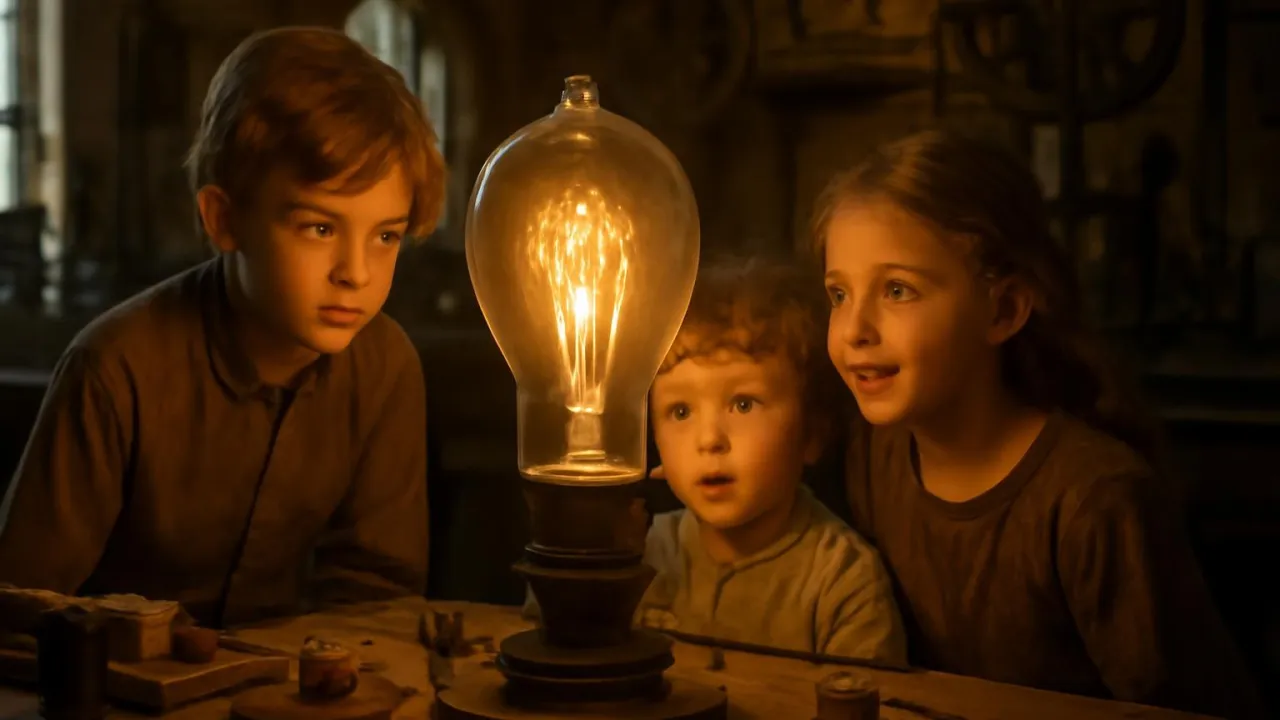
The oldest working light bulb has glowed since 1901!
✨ Word Sparks (Grade 2 Glossary)
Tap 🔊 to hear
filament
A thin, glowing wire
switch
A button that turns things on
inventor
A person who makes new things
🪝
Have you ever wondered how a dark room becomes bright?
1
The Magic Glow
When you flip a , a bulb glows. It lights up your room fast. The glass bulb keeps the glowing wire safe. People use bulbs every night and day.
2
How It Works
A thin wire called a heats up. Electricity flows through the wire and makes it shine. The glass keeps air out so the wire does not burn. That is why the bulb can last a long time.
3
Changing the World
Long ago, people used candles for light. The light bulb let cities shine after sunset. Now, people can read, play, and work at night. The world became much brighter and safer.
Edison’s team tested over 6,000 plants for the perfect filament!
✨ Word Sparks (Grade 3 Glossary)
Tap 🔊 to hear
incandescence
Glowing from being very hot
prototype
A first try at an invention
oxygen
A gas in the air we breathe
🪝
Imagine clicking a switch and seeing darkness turn to bright, warm light!
1
A Bright Idea
Long ago, people lit their homes with candles and oil lamps. When Thomas Edison invented the incandescent light bulb, everything changed. Suddenly, rooms could be filled with steady, safe light. The world after dark became much more exciting and busy.
2
How Does It Work?
Inside each bulb is a thin metal filament. When electricity flows through the filament, it heats up and glows. This glowing is called , and it produces the light we see. The glass bulb keeps out so the filament does not burn away.
3
Building the First Bulb
Edison tested hundreds of materials to find the best filament. He finally used carbonized bamboo, which lasted many hours. His team made and tested them in their workshop. Soon, light bulbs were lighting up homes and streets everywhere.
4
Changing the World
The light bulb made it easier for people to work and read at night. Cities grew brighter and safer because streets were lit. Factories could run late, and people could gather after sunset. The invention sparked new ideas in science and engineering.
Tungsten filaments in bulbs can reach 4,500 degrees Fahrenheit when glowing!
✨ Word Sparks (Grade 4 Glossary)
Tap 🔊 to hear
tungsten
A metal that gets very hot
incandescence
Glowing because of heat
prototype
A first model to test ideas
🪝
What would life be like if you could only read or play when the sun was up?
1
Lighting Up the Night
Before the light bulb, people relied on candles, oil lamps, and gaslights, which were dim and sometimes dangerous. Thomas Edison’s incandescent bulb offered a safer, brighter, and longer-lasting way to light homes and streets. The invention quickly spread through cities and towns, transforming daily life. Suddenly, people could work, study, and socialize long after sunset.
2
The Science Behind the Glow
The heart of the bulb is a filament, usually made from , a metal with a very high melting point. When electricity flows through the filament, it vibrates and heats up until it glows with visible light—a process called . The glass bulb is sealed to keep out oxygen, preventing the hot filament from burning up. This clever design lets bulbs shine for hundreds or even thousands of hours.
3
Inventing and Improving the Bulb
Edison’s team built hundreds of , searching for a filament that would last. Early bulbs used carbonized bamboo, but soon became the standard because it could withstand even higher temperatures. Each improvement made bulbs brighter, safer, and more affordable for families everywhere. The invention was so important that it helped spark the spread of electricity to homes and cities.
4
A World Transformed
The incandescent bulb changed how people lived, worked, and played. Factories could operate at night, students could study after dark, and city streets became safer. The invention also inspired new technologies, like electric appliances and communication systems. Today, while many people use LED or fluorescent lights, the incandescent bulb’s bright idea still shines in history.
The world’s longest-burning light bulb, in California, has glowed for over 120 years!
✨ Word Sparks (Grade 5 Glossary)
Tap 🔊 to hear
lumens
A measure of how bright light is
oxidation
When things burn or rust with oxygen
inert gas
A safe gas that does not react
🪝
Can you picture a world where darkness ruled every night until one invention sparked a revolution?
1
From Flickering Flames to Steady Light
For centuries, people depended on fire, candles, and oil lamps for illumination, but these sources were dim, smoky, and often hazardous. The arrival of the incandescent light bulb in 1879, invented by Thomas Edison and his team in Menlo Park, marked a turning point in history. Edison's approach built on earlier work by inventors like Sir Joseph Swan, but his design made electric lighting practical and affordable for everyday use. Suddenly, homes, streets, and workplaces could be brightly lit, extending productive hours far beyond sunset.
2
Engineering the Glow: Physics and Materials
The incandescent bulb’s core innovation is its filament—a slender wire, originally carbonized bamboo but later tungsten, chosen for its exceptional melting point of 3,422°C (6,192°F). When electric current passes through the filament, resistance causes it to heat up and emit visible light, a phenomenon called incandescence. The glass bulb is evacuated or filled with , such as argon, to prevent oxygen from reaching the hot filament and causing rapid . This engineering allowed bulbs to last hundreds to thousands of hours while producing a warm, inviting glow.
3
Inventors, Patents, and Global Impact
Edison’s team tested over 6,000 materials for filaments, eventually patenting a design that balanced durability, brightness, and cost. Their success led to the rapid spread of electric lighting, transforming cities, industries, and daily routines worldwide. Factories could operate around the clock, students could study after dark, and public spaces became safer and more welcoming. The incandescent bulb became a symbol of progress and innovation, inspiring countless new inventions in electrical engineering.
4
Evolution and Legacy of the Light Bulb
Although the incandescent bulb dominated lighting for over a century, it is not very energy efficient—about 90% of its energy is lost as heat rather than light. This limitation led to the invention of fluorescent, halogen, and LED bulbs, which use different principles to produce light more efficiently. Still, the incandescent bulb’s simple design and warm light remain iconic, and its invention is remembered as one of humanity’s greatest engineering achievements. Museums and science centers often display Edison's original bulbs, some of which still glow today.
5
Quantitative Specs and Enduring Influence
A standard household incandescent bulb typically uses 40 to 100 watts of power and produces about 450 to 1,600 of light. The tungsten filament inside can reach temperatures up to 4,500°F (2,500°C) during operation. While modern lighting technologies have surpassed it in efficiency, the incandescent bulb’s impact on society, culture, and technology is immeasurable. Its invention electrified the world, illuminating everything from classrooms to city skylines and paving the way for a future powered by innovation.