🦴 PREHISTORIC
🦴 Ichthyostega stensioei • Stegocephalia
VA Science SOL 2.5, 3.4, 3.5, 5.8 (Fossils, Adaptations & Earth History)
Ichthyostega
Seven-Toed Swamp Pioneer of Early Land
Grade 4 • Expanding • 194 words
🌋 Geologic Period & RegionLate Devonian (365–360 MYA) • Celsius Bjerg Floodplains, East Greenland
📏 Size & Weight5 ft (1.5 m) long • ~45–55 lbs (20–25 kg)
🦴 Diet & FossilsSemi-Aquatic Carnivore • East Greenland Red Sandstone Skeletons
⚡ Survival SuperpowerSeven webbed toes on each hind paddle and heavy armor-like overlapping ribs
🤯 Mind-Blowing Fact • Grade 1
Before five toes became the standard rule for land animals, Ichthyostega rocked seven toes on each back foot!
✨ Word Sparks (Grade 1 Glossary)
Tap 🔊 to hear
Webbed
Toes connected by skin for swimming well
Swamp
Shallow wetland filled with mud and plants
Fin
Flat body part fish use to steer
🪝
Count your toes—now imagine having seven toes on one foot!
1
Out of the Weedy Swamp
Squish, squelch! Heavy front legs pull a wide body onto muddy reeds. Meet Ichthyostega! It was one of the first animals with legs and toes instead of only .
2
Seven Toes and a Fish Tail
Look closely at its back paddle foot. Count seven toes in a row! Behind its legs waved a flat tail just like a fish.
3
Big Gulps of Air
Wide ribs protected its chest so its lungs would not squish on land. It rested on sunny mudbanks, then splashed back in to hunt fish!
1. How many toes grew on each hind foot of Ichthyostega?
2. What fish-like body part did Ichthyostega still carry at its rear end?
🤯 Mind-Blowing Fact • Grade 2
Ichthyostega's ribs were so wide and tightly overlapped that it could barely wiggle its waist from side to side!
✨ Word Sparks (Grade 2 Glossary)
Tap 🔊 to hear
Digit
A finger or toe on a limb
Ribcage
Basket of curved bones protecting heart and lungs
Mudskipper
Modern amphibious fish that scoots across mudflats
🪝
Did one of Earth's earliest four-legged animals walk like a lizard or scoot like a seal?
1
A Five-Foot Wetland Explorer
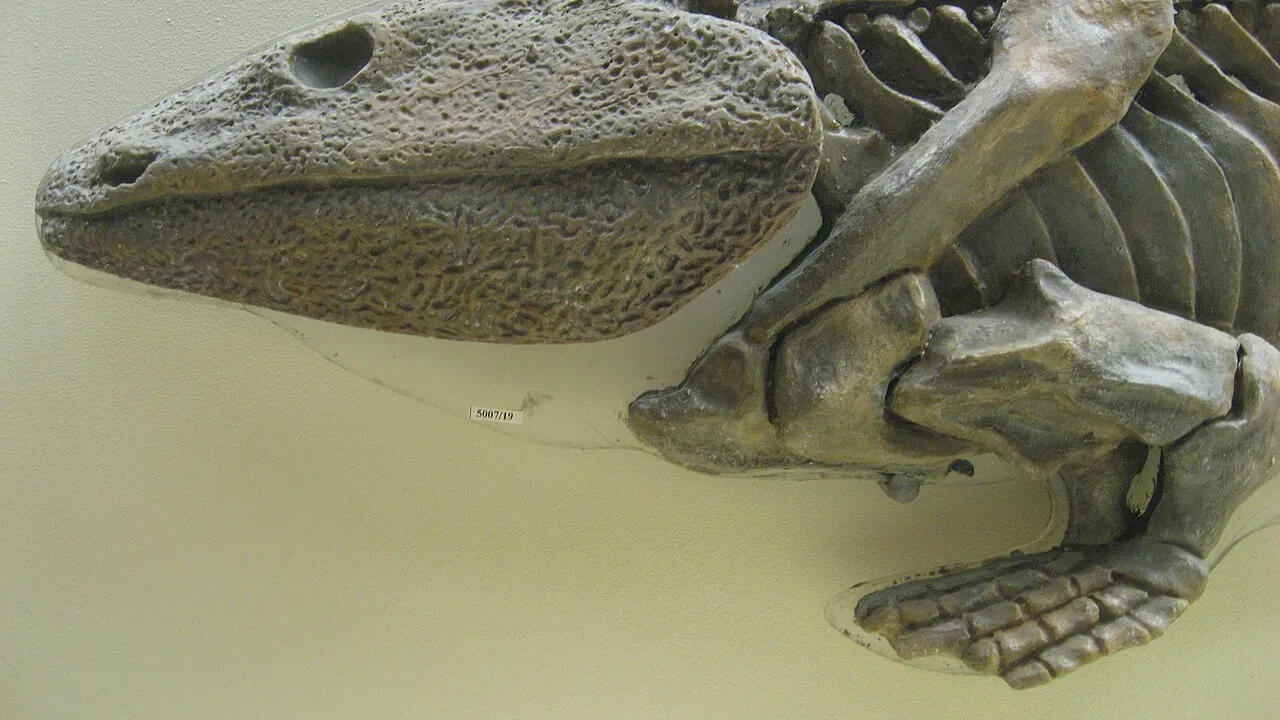
Splash through a shallow river in ancient Greenland 362 million years ago! Hauling its heavy head onto a muddy bank is Ichthyostega, whose name means 'fish roof' because the top of its flat skull looked like an ancient fish's head.
2
Scooting Like a Mudskipper
For many years, museums drew Ichthyostega marching across dry ground like a giant salamander. Later, 3D computer models of its joints revealed a surprise! Its back legs worked best as swimming paddles, while its strong front arms pulled its body forward in unison like a seal or .
3
Built-In Rib Armor
Broad ribs overlapped like barrel staves along its sides. That stiff kept gravity from crushing its lungs while it rested on riverbanks.
1. How did 3D computer models show Ichthyostega moved across muddy banks?
2. Why does the name Ichthyostega mean 'fish roof'?
🤯 Mind-Blowing Fact • Grade 3
Grooves etched across Ichthyostega's skull prove it still carried a fish-style lateral line system to sense ripples from swimming prey underwater!
✨ Word Sparks (Grade 3 Glossary)
Tap 🔊 to hear
Polydactyly
Having more than five fingers or toes per limb
Lateral line
Sensory canal helping aquatic animals feel water vibrations
Enamel
Hard outer mineral coating on vertebrate teeth
🪝
Why did nature experiment with six, seven, and eight toes before land vertebrates settled on five?
1
Discovery on Frozen Peaks
In 1931, young Swedish paleontologist Gunnar Säve-Söderbergh climbed icy mountains in East Greenland and chipped Late Devonian red sandstones dated to about 365 million years ago. Inside lay skulls of Ichthyostega, the earliest four-limbed vertebrate known for over half a century!
2
Breaking the Five-Toe Rule
Until the late 1980s, scientists assumed all earliest tetrapods started out with five fingers and five toes. Then paleontologist Jennifer Clack collected fresh Greenland fossils showing Ichthyostega had seven digits on each hind foot—three stout leading toes bound together and four wider toes forming a stiff paddle! Nearby cousin Acanthostega even had eight digits.
3
Stiff Spine, Up-and-Down Flex
Unlike salamanders that bend sideways as they walk, Ichthyostega had massive overlapping ribs and tall back spines that blocked sideways twisting. Instead, its lower spine flexed slightly up and down like an inchworm or seal.
4
Shallow-Water Ambush Hunter
Sharp labyrinthodont teeth with folded lined its jaws, ideal for seizing lungfish and smaller Devonian vertebrates in weed-choked marshes.
1. Who discovered in the late 1980s that Ichthyostega actually had seven toes on its hind foot?
2. How do scientists know Ichthyostega could still feel tiny water ripples like a fish?
🤯 Mind-Blowing Fact • Grade 4
Young Ichthyostega lived almost completely underwater before gradually strengthening their shoulders as adults to haul out onto shallow mudbanks!
✨ Word Sparks (Grade 4 Glossary)
Tap 🔊 to hear
Biomechanics
Study of how bones and muscles create movement
Synchronous
Moving together at the exact same time
Stapes
Small inner-ear bone that transmits sound vibrations
🪝
How did 3D X-ray scans and robotic joint models prove that an iconic textbook 'land walker' couldn't actually take alternating steps?
1
Rewriting a Classic Museum Mount
Step onto the monsoonal floodplains of East Greenland 362 million years ago during the Famennian Stage of the Late Devonian. Lurking at the water's edge is the 1.5-meter stem-tetrapod Ichthyostega stensioei. For decades after Erik Jarvik reconstructed its skeleton in the 1950s, textbooks portrayed Ichthyostega striding firmly across dry land on four sturdy legs. Modern biomechanical engineering told a very different story.
2
Testing Joint Range of Motion in 3D
In 2012, Stephanie Pierce, Jennifer Clack, and John Hutchinson CT-scanned Ichthyostega limb bones and built digital rig models testing every joint angle against living salamanders, crocodiles, seals, and mudskippers. Their results were striking: Ichthyostega's shoulder and hip sockets lacked the rotational freedom required to swing limbs forward and plant feet flat for symmetrical terrestrial walking. Its seven-toed hindlimbs angled outward as specialized steering paddles.
3
Forelimb Crutching and Axial Mechanics
Rather than walking upright, Ichthyostega used powerful elbows and shoulders to execute 'crutching' push-ups—dragging its hindquarters over wet mudbars much like a modern mudskipper. Flange-like overlapping ribs formed a rigid thoracic corset that prevented side-to-side undulation while supporting air-filled lungs.
4
Underwater Hearing Ears
CT scans of Ichthyostega's otic capsule also revealed a thin, spoon-like bone framing an air-filled chamber—creating a specialized underwater ear tuned to vibrations beneath marsh surfaces.
1. Why couldn't Ichthyostega walk on land using alternating diagonal footsteps like a modern salamander?
2. What surprising adaptation did CT scans uncover inside Ichthyostega's ear region?
🤯 Mind-Blowing Fact • Grade 5
Unlike fish that flex their spines left and right, Ichthyostega evolved regionalized back vertebrae that flexed up and down—a mammal-like spinal trick that appeared 150 million years before mammals existed!
✨ Word Sparks (Grade 5 Glossary)
Tap 🔊 to hear
Pentadactyl
Having five fingers or toes on each limb
Stegocephalia
Broad clade of four-limbed vertebrates and stem-tetrapods
Dorsoventral
Moving or curving from back to belly
🪝
What does Ichthyostega reveal about how evolution cobbled together disparate experiments in breathing, hearing, and multi-toed limbs at the edge of Devonian wetlands?
1
Icon of the Celsius Bjerg Sandstones
Collected from Famennian fluvial red beds (~365–360 MYA) on Gauss Peninsula in East Greenland during the 1931–1955 Danish expeditions and named by Gunnar Säve-Söderbergh in 1932, Ichthyostega stensioei long stood as the archetypal transitional tetrapod. Measuring roughly 1.5 meters, this robust stegocephalian combined a broad, dermal-ornamented skull and true ray-supported caudal fin (complete with lepidotrichia) with fully differentiated digits.
2
Polydactyly Before Pentadactyly
Expeditions led by Jennifer Clack and Per Ahlberg in 1987 overturned the dogma of ancestral five-toed limbs. Articulated Ichthyostega pes specimens preserved seven digits arranged in a stiff, asymmetrical paddle—three diminutive anterior digits reinforcing the leading edge alongside four stout central-to-posterior digits (whereas the manus remains incompletely known). Together with eight-toed Acanthostega and six-toed Tulerpeton, Ichthyostega proved Devonian stem-tetrapods explored variable polydactyly before Carboniferous crown lineages canalized the bauplan.
3
Digital Joint Rigging and Mudskipper Analogies
In 2012, Stephanie Pierce, Clack, and John Hutchinson constructed three-dimensional micro-CT osteological rigs to quantify maximal joint mobility. Pronounced humeral and femoral torsion restrictions prevented long-axis limb rotation—eliminating lateral sequence walking. Furthermore, broad imbricating costal flanges locked the presacral column against lateral undulation while permitting flexion between lumbar and sacral regions. Ichthyostega likely navigated shallow obstacle-strewn channels via synchronous forelimb crutching, employing hindlimbs as aquatic rudders rather than terrestrial props.
4
Specialized Auditory and Respiratory Systems
Synchrotron and CT studies also revealed loss of internal ossified gill grooves in adults alongside an extraordinary auditory apparatus: a paper-thin, plate-like stapes projecting into an air-filled spiracular diverticulum, transducing underwater acoustic pressure waves with high sensitivity.
5
An Evolutionary Experiment, Not a Direct Ancestor
Rather than representing a linear ancestor of modern amphibians, Ichthyostega illuminates an extinct Devonian adaptive radiation—a specialized semi-aquatic predator engineered for shallow monsoonal wetlands just prior to the Hangenberg end-Devonian extinction.