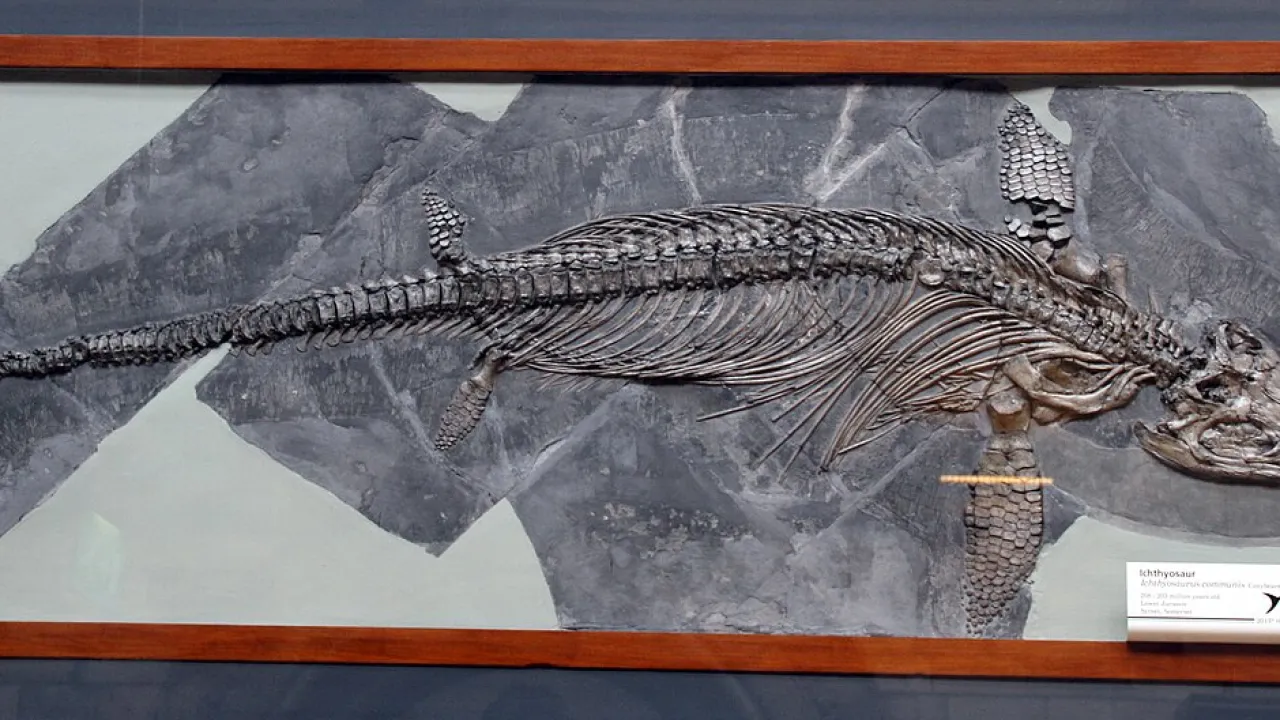
Fossilized poop called coprolites still holds tiny fish scales and squid hooks from Ichthyosaurus meals eaten 195 million years ago!
✨ Word Sparks (Grade 2 Glossary)
Tap 🔊 to hear
cliff
A high, steep wall of rock
vertical
Standing straight up and down
coprolites
Ancient animal droppings turned into stone
🪝
How did a twelve-year-old girl help introduce the world to Ichthyosaurus?
1
Fossil Treasure on the Beach
Imagine walking along windy sea in southern England after a storm! In 1811, young Mary Anning and her brother Joseph spotted a four-foot skull sticking out of seaside rock. They had found Ichthyosaurus, an ocean reptile from the Early Jurassic Period.
2
Shaped for Speed
Even though Ichthyosaurus was a reptile, its body looked remarkably like a modern porpoise. It had a stiff back fin for balance, paddle-shaped front flippers for steering, and a tail fin that whipped side to side.
3
Chasing Slippery Squid
Huge eyes helped Ichthyosaurus spot darting fish and squid in dim ocean light. Tiny grooved teeth lined its narrow beak, grabbing slippery meals before gulping them whole.
1. How did the tail of Ichthyosaurus move differently from a dolphin's tail?
2. Who helped uncover the first well-known Ichthyosaurus skeleton in England?
🤯 Mind-Blowing Fact • Grade 3
Fine rock layers in Germany and England even preserved dark pigment cells showing Ichthyosaurus had a dark back and lighter belly for ocean camouflage!
✨ Word Sparks (Grade 3 Glossary)
Tap 🔊 to hear
convergent evolution
Unrelated animals developing similar helpful body shapes
sclerotic ring
A circle of bone supporting an eyeball
camouflage
Colors or patterns that help animals blend in
🪝
Why do sharks, dolphins, and Ichthyosaurus look like triplets if they aren't closely related?
1
Nature's Favorite Swimsuit
Watch a shark, a dolphin, and an Ichthyosaurus side by side in your imagination, and they look like cousins! Yet one is a fish, one is a mammal, and Ichthyosaurus was a Jurassic reptile. Scientists call this : different animals evolving the same torpedo shape because physics rewards smooth swimmers.
2
Built for Life Offshore
Growing about six to eleven feet long, Ichthyosaurus descended from land reptiles whose legs transformed into steering paddles. Because its limbs could no longer support weight on shore, females gave birth to live young underwater. Babies emerged tail-first so they wouldn't inhale seawater before swimming up for their very first breath!
3
Rings Inside Giant Eyes
Each large eye held a circle of overlapping bony plates called a . Like rigid goggle frames, these bones kept the eyeball from squishing under heavy water pressure during rapid dives after glowing squid and silver fish.
4
Soft Tissue Locked in Stone
Fine mud on ancient European seafloors preserved incredible outlines around skeletons. Thanks to those dark carbon impressions, paleontologists discovered Ichthyosaurus had a fleshy dorsal fin and a crescent tail—parts without bones that usually rot away!
1. Why were baby Ichthyosaurus swimmers born tail-first?
2. How do scientists know Ichthyosaurus had a boneless dorsal fin on its back?
🤯 Mind-Blowing Fact • Grade 4
Tiny microscopic structures called melanosomes preserved in fossilized Ichthyosaurus skin proved these reptiles wore insulating blubber much like modern whales and seals!
✨ Word Sparks (Grade 4 Glossary)
Tap 🔊 to hear
belemnites
Extinct squid-like sea creatures with hooked arms
countershading
Dark back and light belly ocean camouflage
collagen
Tough natural protein fibers supporting skin and fins
🪝
How did fossilized skin outlines and blubber transform our picture of Early Jurassic sea reptiles?
1
Sparking the Science of Extinction
Waves crashing against the crumbling limestone cliffs of Lyme Regis in Dorset, England, exposed a puzzle in 1811 that changed science forever. When twelve-year-old Mary Anning carefully chiseled out the body matching a long-snouted skull found with her brother Joseph, scholars realized this creature matched nothing alive today. Ichthyosaurus communis helped prove that entire worlds of prehistoric animals had lived and vanished millions of years before humans.
2
Hydrodynamic Perfection
Measuring roughly two to three meters in length, Ichthyosaurus exemplified convergent evolution with modern dolphins and tuna. Its downward-curving backbone supported the lower lobe of a crescent caudal fin, while dense fibers stiffened the boneless upper lobe and triangular dorsal fin. Front paddles packed with dozens of coin-shaped finger bones acted as hydrofoils to bank and pivot instantly.
3
Warm-Blooded Hunters with Blubber
Chemical studies of remarkably preserved fossils reveal that ichthyosaurs wore smooth, scaleless skin underlain by an insulating layer of blubber! Combined with —dark pigment above to match deep water and pale undersides to blend with sunlit waves—this insulation kept muscles warm during swift pursuits of fish and hook-armed cephalopods called .
4
Sensory Mastery Underwater
Grooves branching across the slender snout carried sensitive nerves and blood vessels, likely letting Ichthyosaurus detect subtle water pressure shifts from darting prey. Meanwhile, giant eyes reinforced by bony sclerotic rings gathered faint underwater light without deforming under water pressure.
1. Why was Mary Anning's 1811 Ichthyosaurus discovery so important to science?
2. What role did blubber play inside an Ichthyosaurus's body?
🤯 Mind-Blowing Fact • Grade 5
Unlike almost any living tetrapod, some Ichthyosaurus species evolved up to nine separate digits inside each front flipper, forming a dense mosaic of over a hundred tiny finger bones!
✨ Word Sparks (Grade 5 Glossary)
Tap 🔊 to hear
thunniform
Swimming with a stiff body and crescent tail
viviparity
Giving birth to live young instead of eggs
homeothermy
Maintaining a steady warm internal body temperature
🪝
What molecular secrets hidden inside 190-million-year-old fossils proved Ichthyosaurus shared traits with warm-blooded marine mammals?
1
A Discovery That Reshaped Deep Time
Picture winter gales battering the Blue Lias shale cliffs of Lyme Regis along southern England's coast in 1811–1812. Amid fallen boulders, Joseph and Mary Anning excavated an extraordinary 5.2-meter marine reptile skeleton with massive eye sockets and elongated jaws. Named Ichthyosaurus ('fish lizard'), the specimen stunned Georgian naturalists by demonstrating that terrestrial tetrapods had returned to the sea during the Early Jurassic—and later vanished completely through extinction.
2
Thunniform Biomechanics
Adult Ichthyosaurus species typically spanned 2 to 3.3 meters and weighed around ninety kilograms. Unlike early eel-shaped Triassic ichthyosaurs that undulated their entire trunks, Jurassic forms evolved locomotion similar to bluefin tuna and lamnid sharks. Their stiffened torso minimized drag while propulsion concentrated solely in a lunate caudal fin, where the vertebral column kinked sharply downward into the ventral tail lobe.
3
Polydactyly and Viviparity
Forelimbs in Ichthyosaurus displayed both hyperphalangy—extra joints per finger—and hyperdactyly, possessing up to eight or nine tightly packed digits encased in a unified hydrofoil mitt. Fully emancipated from land, these reptiles practiced . Exceptional German Lagerstätten preserve gravid females with embryos oriented tail-first in the birth canal, an adaptation mirroring cetaceans that prevents neonatal drowning.
4
Molecular Paleontology of Blubber
Spectroscopic and electron-microscope analyses of soft-tissue fossils have uncovered degraded lipid molecules from subcutaneous blubber alongside cellular melanosomes. This adipose blanket confirms —stable elevated body temperatures—and countershaded camouflage, equipping Ichthyosaurus for sustained high-speed pursuit across cool European epicontinental seas.
5
Cephalopod Diet and Trophic Niche
Spiral bromalites (fossilized digestive matter) and stomach contents packed with chitinous arm-hooklets demonstrate that Ichthyosaurus specialized in hunting fast coleoid cephalopods like belemnites alongside actinopterygian fish. Tiny infolded dentine walls strengthened its conical teeth—a feature called plicidentine—while sclerotic rings stabilized its enormous eyes during rapid vertical dives.